Insights
Best Higher Education Marketing Strategies for 2026
Discover the best higher education marketing strategies to drive enrollment growth, increase qualified applications, and fill your classes.
READING TIME · 11 MIN · UPDATED QUARTERLY

Higher education institutions face unprecedented challenges in 2026. Declining birth rates, changing student expectations, and increased competition demand sophisticated marketing approaches that deliver measurable enrollment results. The best higher education marketing strategies combine data-driven targeting, automated nurturing systems, and personalized engagement to convert prospective students into enrolled learners. Understanding which tactics produce qualified inquiries and which merely generate awareness is essential for institutions seeking sustainable enrollment growth in an increasingly competitive landscape.
Understanding the Modern Higher Education Marketing Landscape
The higher education marketing environment has fundamentally transformed over the past five years. Traditional approaches like viewbooks and campus tours remain valuable touchpoints, but prospective students now conduct extensive digital research before ever contacting an institution. According to recent benchmark data, the average prospective student engages with 15-20 touchpoints across multiple channels before submitting an application.
This complexity requires institutions to build integrated marketing systems rather than isolated campaigns. The best higher education marketing strategies recognize that enrollment is a journey spanning months or even years, requiring consistent messaging and strategic nurturing throughout the decision process.
Shifting Student Expectations
Today's prospective students expect immediate responses, personalized communications, and digital-first experiences. They research programs on mobile devices, expect chat functionality on websites, and abandon inquiry processes that require excessive form fields or delayed follow-up.
Key behavioral shifts include:
- Preference for video content over text-based program descriptions
- Expectation of response within 5 minutes of initial inquiry
- Research conducted primarily via mobile devices (67% of traffic)
- Heavy reliance on peer reviews and social proof
- Demand for transparent pricing and outcome data
Schools that implement automated inquiry response systems capture significantly more qualified leads than those relying on manual follow-up processes.
Data-Driven Targeting and Segmentation Strategies
Generic mass marketing no longer delivers acceptable return on investment in higher education. The best higher education marketing strategies employ sophisticated segmentation models that identify and prioritize prospects most likely to enroll based on demographic data, behavioral signals, and engagement patterns.
Effective segmentation begins with clearly defined personas representing different student types. Traditional undergraduate students require different messaging and channels than adult learners, international students, or transfer candidates. Each segment responds to distinct value propositions and follows unique decision timelines.

Building Predictive Enrollment Models
Advanced institutions now leverage predictive analytics to score inquiries based on enrollment probability. These models analyze hundreds of variables including geographic location, program interest, engagement velocity, and demographic factors to identify which prospects warrant intensive personal outreach versus automated nurturing.
| Scoring Factor | Weight | Data Source |
|---|---|---|
| Geographic fit | High | Inquiry form, IP address |
| Program alignment | High | Website behavior, search terms |
| Engagement velocity | Medium | Email opens, page visits, downloads |
| Demographic match | Medium | Form data, third-party enrichment |
| Financial indicators | Low | ZIP code analysis, FAFSA timing |
Institutions implementing these approaches report 40-60% improvement in admissions counselor productivity by focusing human resources on highest-probability prospects.
Multi-Channel Campaign Architecture
The question isn't which single channel works best, but rather how to orchestrate multiple channels into cohesive campaigns. The best higher education marketing strategies deploy coordinated efforts across paid search, social media, email nurturing, content marketing, and traditional outreach.
Recent enrollment benchmarks reveal that successful institutions allocate budgets across an average of 7-9 distinct channels, with performance measured by contribution to enrollment rather than isolated channel metrics.
Paid Search and SEO Fundamentals
Search remains the dominant channel for program discovery, with 78% of prospective students beginning their research via Google. Institutions must maintain strong visibility for program-related keywords while ensuring technical SEO foundations support discoverability.
Essential search optimization elements:
- Program pages optimized for specific degree + location combinations
- Fast page load speeds (under 2 seconds) on mobile devices
- Structured data markup for programs, reviews, and events
- Local SEO optimization for region-specific recruitment
- Regular content publication addressing student questions
Following Google's technical SEO guidelines ensures your institution appears in relevant searches when prospective students are actively researching options. Many institutions also benefit from partnering with specialists in digital marketing automation to optimize campaign performance across search and social channels.
Social Media Strategy Beyond Brand Awareness
Social platforms serve multiple functions in the enrollment funnel. While organic social builds brand awareness and community, paid social campaigns drive inquiry generation through precise targeting capabilities. The best higher education marketing strategies treat social media as both a top-of-funnel awareness mechanism and a direct response channel.
Platforms like Facebook and Instagram enable targeting by field of study interest, education level, geographic location, and life events like high school graduation. LinkedIn proves particularly effective for graduate programs and adult learner recruitment.
Content strategy should balance institutional messaging with authentic student stories. User-generated content from current students consistently outperforms polished marketing materials in engagement metrics and conversion rates.
Automated Inquiry Management and Nurturing Systems
The period immediately following inquiry submission represents the highest-leverage opportunity in the entire enrollment cycle. Institutions that respond within 5 minutes are 100 times more likely to qualify and convert that lead than those waiting even 30 minutes. Manual processes cannot consistently achieve this responsiveness.
Automated inquiry management systems capture leads from all sources, instantly acknowledge receipt, route to appropriate admissions staff, and trigger personalized nurture sequences based on prospect characteristics and behavior. These platforms transform inquiry volume into enrollment growth by ensuring no prospect falls through communication gaps.
Multi-Touch Nurture Sequences
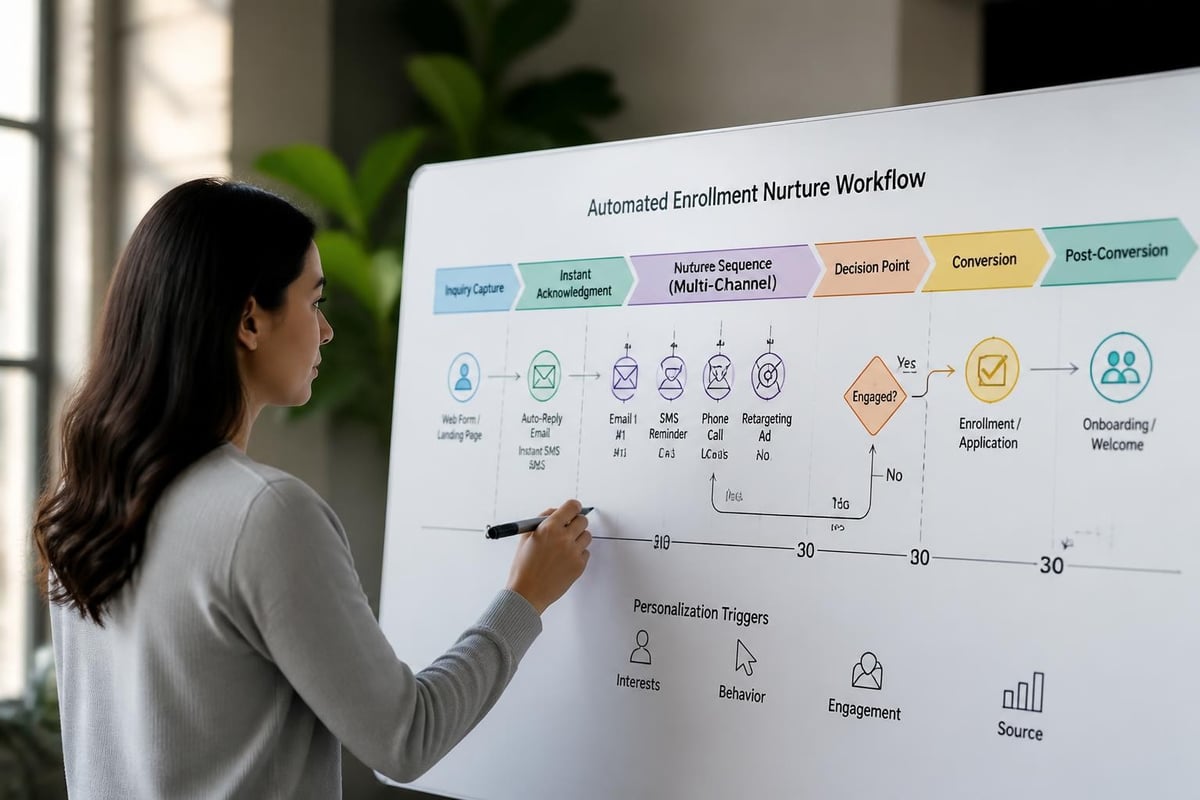
Prospective students require multiple touchpoints before taking action. Effective nurture sequences blend automated email, SMS messaging, phone outreach, and retargeting ads into coordinated campaigns that maintain engagement without overwhelming prospects.
Sample 30-day nurture sequence structure:
- Day 0: Instant email confirmation with program details and next steps
- Day 1: SMS with admissions counselor introduction and scheduling link
- Day 3: Email featuring student testimonials and outcome data
- Day 7: Phone call from admissions counselor (automated task assignment)
- Day 10: Email addressing common questions and concerns
- Day 14: SMS reminder about application deadlines
- Day 21: Email with financial aid information and calculator
- Day 30: Final outreach with limited-time incentive
Each touchpoint includes personalization based on program interest, location, and previous engagement. Prospects who interact with specific content trigger additional relevant communications. Those working with specialized higher education enrollment marketing partners typically see 3-5x improvement in inquiry-to-application conversion rates.
Content Marketing That Drives Enrollment
Content serves dual purposes in higher education marketing: building organic search visibility and educating prospects throughout their decision journey. The best higher education marketing strategies develop comprehensive content libraries addressing every question prospective students ask during their research process.
Effective content extends beyond program descriptions to career outcomes, student life, financial aid guidance, application strategies, and success stories. Video content particularly resonates with prospective students, with institutions reporting 8-12x higher engagement on video versus text-based content.
Strategic Content Development Process
Rather than creating content randomly, strategic institutions map content to specific stages in the enrollment funnel and questions prospects ask at each stage.
| Funnel Stage | Prospect Questions | Content Types |
|---|---|---|
| Awareness | Should I pursue this field? | Career guides, industry trends, outcome data |
| Consideration | Which program is right for me? | Program comparisons, curriculum details, faculty profiles |
| Decision | Can I afford this? Will I succeed? | Financial aid guides, student testimonials, application tutorials |
| Application | What happens next? | Process timelines, checklist guides, deadline reminders |
Publishing content consistently also improves search visibility. Institutions implementing automated content strategies maintain publishing momentum even with limited marketing staff, ensuring fresh content regularly appears in search results.
Conversion Rate Optimization for Enrollment
Traffic and inquiries mean nothing without strong conversion at each funnel stage. The best higher education marketing strategies obsessively optimize conversion rates from visitor to inquirer, inquirer to applicant, and applicant to enrolled student.
Small improvements compound dramatically. Increasing website inquiry conversion from 2% to 3% effectively requires 33% less traffic for the same inquiry volume. Similarly, improving inquiry-to-application conversion from 20% to 25% reduces required inquiry volume by 20% for target enrollment.
Website Optimization Priorities
Your website serves as the central hub for all marketing efforts. Every campaign, email, and advertisement ultimately drives prospects to web pages where conversion occurs.
High-impact optimization areas:
- Reduce form fields to absolute minimum (name, email, program interest)
- Implement live chat with instant response capability
- Display clear calls-to-action above the fold on all program pages
- Show authentic student photos rather than stock imagery
- Include video testimonials from current students and alumni
- Display transparent pricing and financial aid information
- Optimize mobile experience for touch interactions and form completion
- Add trust signals like accreditation, rankings, and outcome data
A/B testing these elements systematically yields continuous improvement. Tools like Google Analytics 4 enable tracking of micro-conversions and multi-touch attribution to understand which marketing touchpoints truly drive enrollment.
Personalization at Scale Through Marketing Automation
Modern marketing platforms enable sophisticated personalization previously possible only through manual one-to-one communication. The best higher education marketing strategies leverage automation to deliver personalized experiences to thousands of prospects simultaneously.
Personalization extends beyond inserting first names in emails. Dynamic website content displays different messaging based on visitor source, previous behavior, and profile characteristics. Email sequences adapt based on engagement patterns, delivering different content to highly engaged prospects versus those showing declining interest.
Behavioral Trigger Campaigns
Rather than time-based sequences alone, behavioral triggers create relevant touchpoints based on prospect actions. When a prospect downloads a program guide, visits the financial aid page multiple times, or abandons an application, automated systems respond with appropriate follow-up.
These triggers capture moments of high intent and address specific concerns precisely when prospects are most receptive. Institutions implementing behavioral trigger campaigns report 50-80% higher engagement rates compared to generic time-based sequences.
Enrollment Marketing Performance Measurement
Marketing strategy means nothing without rigorous measurement and optimization. The best higher education marketing strategies establish clear metrics at every funnel stage and hold tactics accountable to enrollment contribution rather than vanity metrics like impressions or clicks.
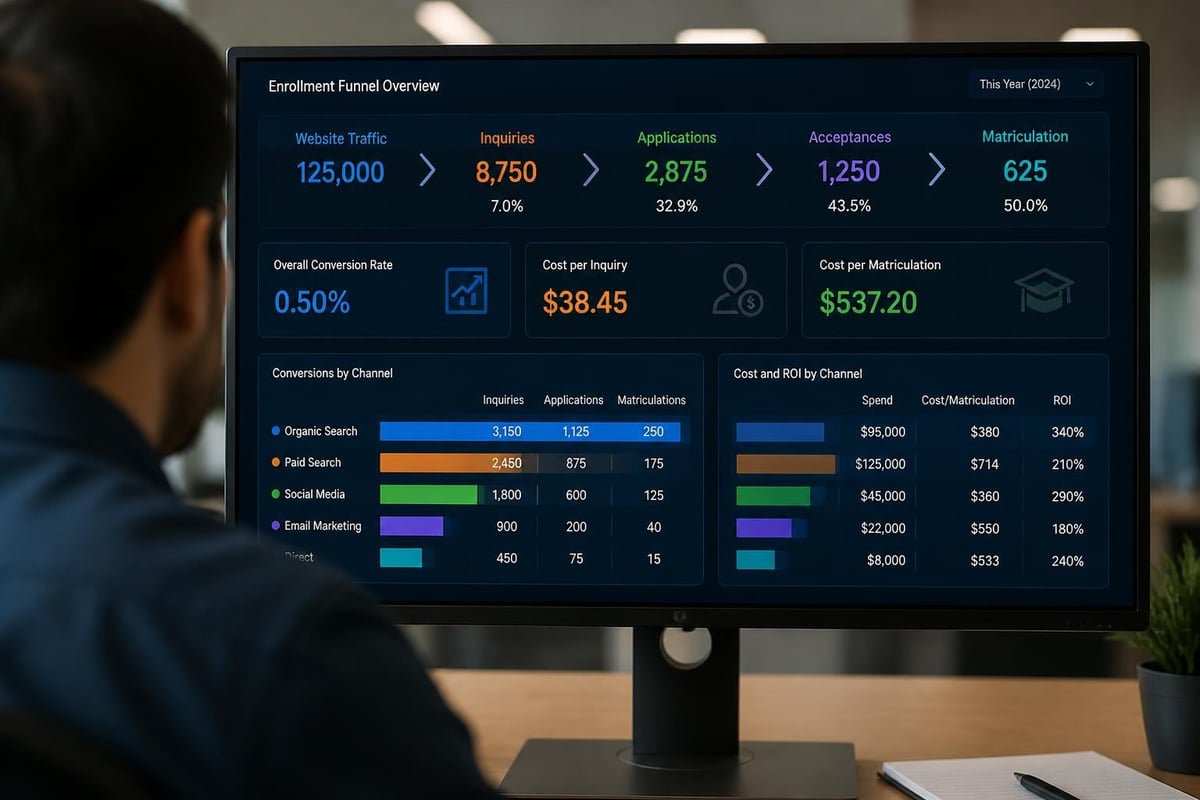
Leading institutions implement enrollment attribution models that track prospect touchpoints from first awareness through matriculation, assigning appropriate credit to each marketing interaction. This multi-touch attribution reveals which combinations of tactics drive enrollment, not just which generate inquiries.
Essential Enrollment Marketing KPIs
Different stakeholders need different metrics, but enrollment marketing teams should monitor these core indicators:
Traffic and awareness metrics:
- Website visitors by source and device
- Program page views and engagement time
- Video view completion rates
- Social media reach and engagement
Inquiry generation metrics:
- Inquiry volume by source and campaign
- Cost per inquiry by channel
- Inquiry form conversion rate
- Inquiry quality score distribution
Conversion and enrollment metrics:
- Inquiry-to-application conversion rate
- Application-to-acceptance rate
- Acceptance-to-enrollment (yield) rate
- Cost per enrolled student by source
- Enrollment revenue attributed to marketing
Leading CMOs in higher education increasingly focus on enrollment ROI as their primary success metric, measuring total enrollment revenue generated per marketing dollar invested.
Reputation Management and Public Perception
Marketing effectiveness depends partly on institutional reputation and public perception of higher education generally. Recent research shows shifting public attitudes toward colleges and universities, requiring institutions to address skepticism about value and outcomes proactively.
The best higher education marketing strategies incorporate reputation management through strategic review solicitation, outcome transparency, and authentic storytelling that demonstrates tangible student success. Addressing concerns about cost, career outcomes, and student debt directly in marketing content builds trust with skeptical prospects and families.
Professional services like Italian bar exam preparation programs demonstrate how specialized educational providers build reputation through personalized instruction, transparent success rates, and intensive student support. Higher education institutions can apply similar principles of customization and outcome focus to strengthen market position.
Privacy Compliance and Data Ethics
Marketing strategies must operate within legal and ethical boundaries regarding student data and privacy. Federal regulations like FERPA restrict how institutions use and share student information, while broader privacy laws affect prospect tracking and targeting.
The best higher education marketing strategies build trust through transparent data practices while maximizing marketing effectiveness within legal constraints. This includes clear privacy policies, appropriate consent mechanisms, secure data storage, and ethical use of behavioral tracking.
As third-party cookies disappear and privacy regulations tighten, first-party data collection through owned channels becomes increasingly valuable. Email lists, CRM databases, and direct relationships with prospects provide marketing reach independent of external platforms.
Integration with Traditional Recruitment Activities
Digital marketing doesn't replace traditional recruitment activities like high school visits, college fairs, and campus tours. Rather, the best higher education marketing strategies integrate digital and traditional tactics into unified enrollment campaigns.
Digital campaigns can drive registration for campus events, nurture prospects before recruitment travel, and maintain engagement after in-person interactions. Mobile apps and digital tools enhance on-campus visit experiences while capturing valuable engagement data for follow-up.
Many institutions now employ comprehensive enrollment services that coordinate all recruitment activities into systematic programs with clear handoffs between marketing, admissions, and enrollment teams.
International Student Recruitment Strategies
International student enrollment requires specialized marketing approaches addressing unique decision factors, longer timelines, and additional stakeholders. The best higher education marketing strategies for international recruitment combine digital targeting in specific countries with partnerships, agent networks, and international credential evaluation support.
Cultural adaptation of messaging, multilingual content, and understanding of education systems in target markets prove essential. Financial considerations, visa support, and employment prospects receive heightened emphasis in international marketing.
Digital channels enable cost-effective international reach previously requiring extensive travel budgets. Targeted social media campaigns, search marketing in specific countries, and virtual events allow institutions to build awareness and generate inquiries globally before investing in in-person recruitment travel.
Continuous Testing and Optimization Culture
The best higher education marketing strategies embrace continuous testing rather than "set and forget" campaigns. A/B testing of email subject lines, landing page designs, ad creative, form fields, and call-to-action language yields ongoing improvement in conversion rates and enrollment outcomes.
Creating an optimization culture requires establishing testing processes, allocating resources for experimentation, and accepting that many tests will show neutral or negative results. The compounding effect of multiple small improvements across the enrollment funnel produces substantial enrollment growth over time.
Testing priority framework:
- High-impact, low-effort tests: Form field reduction, button colors, headline variations
- High-impact, medium-effort tests: Landing page redesigns, email sequence timing, offer testing
- Medium-impact, low-effort tests: Image selection, body copy variations, mobile optimization
- Exploratory tests: New channels, radical message variations, audience expansion
Documenting test results and sharing learnings across the organization prevents repeated mistakes and accelerates optimization velocity.
The enrollment landscape demands sophisticated, integrated marketing systems that convert prospective students efficiently throughout their decision journey. By implementing data-driven targeting, automated nurturing, personalized engagement, and rigorous measurement, institutions can achieve sustainable enrollment growth even amid demographic challenges. ScholarSurge specializes in building these comprehensive enrollment growth systems for colleges, universities, and educational institutions, guaranteeing increased qualified inquiries and applications through automated inquiry management, rapid response protocols, and strategic nurturing that fills your classes.