
Insights
Enrollment Performance Agency Guide for Schools and Colleges
An enrollment performance agency ties fees to results. See how it works, what to demand, and how schools and colleges can fill seats with accountable systems.
READING TIME · 10 MIN · UPDATED QUARTERLY

An enrollment performance agency is a marketing and admissions partner that is paid, in whole or in part, on measurable enrollment outcomes such as qualified inquiries, applications and enrolled students rather than on hours or ad impressions. For heads of school and admissions directors, the appeal is simple: the agency carries part of the risk, so its incentives match yours.
This guide explains how the model works, what separates a real performance partner from a standard vendor, and how to judge one before you sign. It is written for K-12 schools, colleges and sports academies in North America that need to fill seats and protect tuition revenue.
What Is an Enrollment Performance Agency?
An enrollment performance agency is an outside team that owns the full path from first ad impression to enrolled student and is compensated according to the results it produces. Where a traditional agency sells deliverables (a campaign, a website, a set of social posts), a performance agency sells outcomes.
The difference shows up in four areas:
- Accountability: targets are written into the agreement, such as inquiry volume, application starts and enrollments.
- Integration: advertising, landing pages, follow-up and CRM run as one system, not as separate contracts managed by separate people.
- Pricing: fees are linked to enrollment results instead of retainers alone.
- Reporting: dashboards track cost per qualified inquiry and conversion by stage, not clicks and reach.
This model is closely related to what a school enrollment agency does, with the added condition that payment depends on performance.
Why Performance Accountability Matters Right Now
Enrollment is recovering unevenly, which makes accountable spending more important, not less. Final fall 2024 estimates showed total undergraduate enrollment up 4.5% from fall 2023, according to the Richmond Fed. Growth was not evenly distributed: public two-year institutions grew 5.8%, while private for-profit four-year institutions posted the strongest sector growth.
First-year enrollment grew 5.5% in fall 2024, an increase of about 130,000 students year over year, per K-12 Dive. Momentum continued into the spring, when total U.S. higher education enrollment reached 18.4 million, up 3.2% year over year, according to the Education Writers Association.
A rising national tide does not fill your seats. Families are comparing more options, expecting faster answers and abandoning slow responders. In that environment, an institution that cannot show what each dollar of marketing produced is guessing. Performance-based partnerships replace the guess with a number.
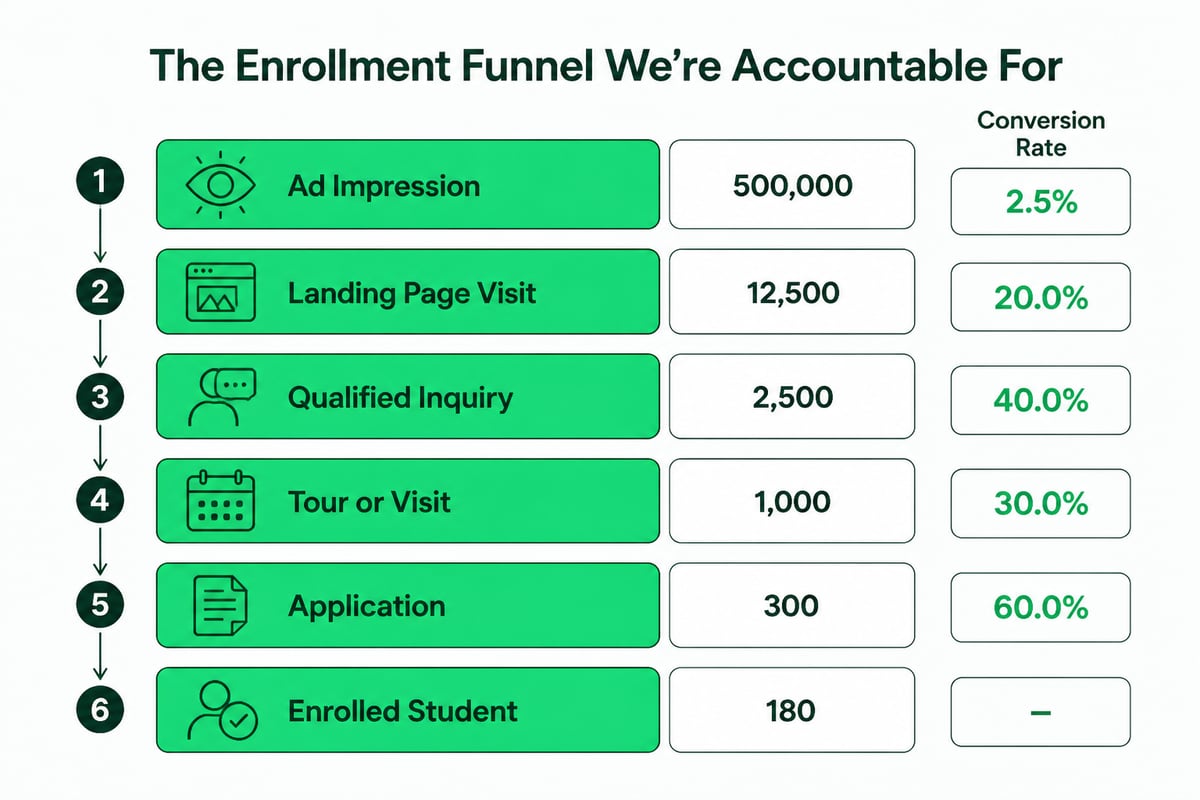
How a Performance-Based Enrollment Model Works
A performance-based model works by defining the result first, building the system to reach it, and tying payment to progress. The sequence is consistent across most strong engagements.
- Audit the current funnel. The agency reviews inquiry sources, response times, follow-up cadences and conversion rates to find where families drop out.
- Set measurable targets. Targets are tied to qualified inquiries, applications and enrollments, with a defined time frame.
- Build the acquisition engine. Paid search, paid social, targeted landing pages and tracking are launched as a single system.
- Automate response and nurture. Every inquiry receives an immediate reply and a structured follow-up sequence.
- Hand off to your team. Warm, qualified families arrive with context so admissions staff spend time on conversations, not sorting.
- Report and refine. Results are reviewed against targets and budgets shift toward what produces enrollments.
Pricing varies. Some agencies charge a lower base fee plus a bonus per enrollment, others charge per qualified inquiry, and some tie fees entirely to enrolled students. What matters is that the structure rewards the same outcome you care about.
Speed to Lead: The Metric That Decides Outcomes
Speed to lead, the time between a family submitting an inquiry and receiving a meaningful reply, is often the largest single lever in enrollment conversion. A family researching schools rarely submits one form. They submit several, and the institution that answers first usually frames the rest of the conversation.
Many admissions offices take a long time to answer, especially after a weekend or event. An automated response layer closes that gap. ScholarSurge, for example, aims to respond to inquiries automatically, then continues nurturing the family with timed follow-up until a tour, visit or application is booked.
Speed alone is not enough. The first reply should be relevant to the family's stated interest (a grade level, a program, a sport), and the follow-up should feel like a conversation with a person, not a mass email. The goal is to move a family from curiosity to a scheduled visit before attention fades.
What to Look for When Evaluating an Agency
The strongest agencies share a short list of traits, and each can be verified before you sign. Use this checklist in vendor conversations:
- Education specialization. Enrollment cycles, tuition decisions, parent and student roles and compliance concerns differ from retail or B2B marketing. Ask for results at schools or colleges similar to yours.
- A single accountable owner. If ads, landing pages, CRM and follow-up sit with different vendors, no one owns the outcome. Look for one system with one point of accountability.
- Transparent metrics. Ask for cost per qualified inquiry, inquiry-to-visit rate and visit-to-application rate, not just traffic.
- Risk sharing. A genuine performance partner puts something at stake, whether through results-based fees or a guaranteed inquiry target.
- Clear definition of "qualified." A guarantee of 100 inquiries means little if half are unreachable or outside your service area. Agree on criteria in writing.
- Data ownership. Your contact lists, tracking accounts and CRM data should belong to you if the relationship ends.
When ScholarSurge frames its offer, it ties pricing to enrollment and describes its commitments as specific, testable targets. That is the kind of commitment worth asking any agency to put in writing.
Matching the Model to Your Institution Type
The performance model applies across institution types, but the funnel, timeline and decision-makers differ, so the agency's playbook should too.
| Institution type | Typical decision-maker | Key funnel feature | Where performance partners help most |
|---|---|---|---|
| Private K-12 school | Parents, sometimes the student | Long consideration, tours and open houses | Fast inquiry response, tour scheduling, nurture through re-enrollment cycles |
| College or university | Student and family | Multi-touch, application deadlines, yield | Inquiry-to-application conversion, program-specific campaigns |
| Small private college | Student and family | Tight budgets, high competition | Cost-efficient lead generation, melt reduction |
| Sports academy | Athlete and parents | Tryouts, seasons, performance focus | Targeted outreach to athletes, quick booking of evaluations |
For deeper material, see ScholarSurge's resources on private school enrollment, college enrollment and sports academy enrollment.
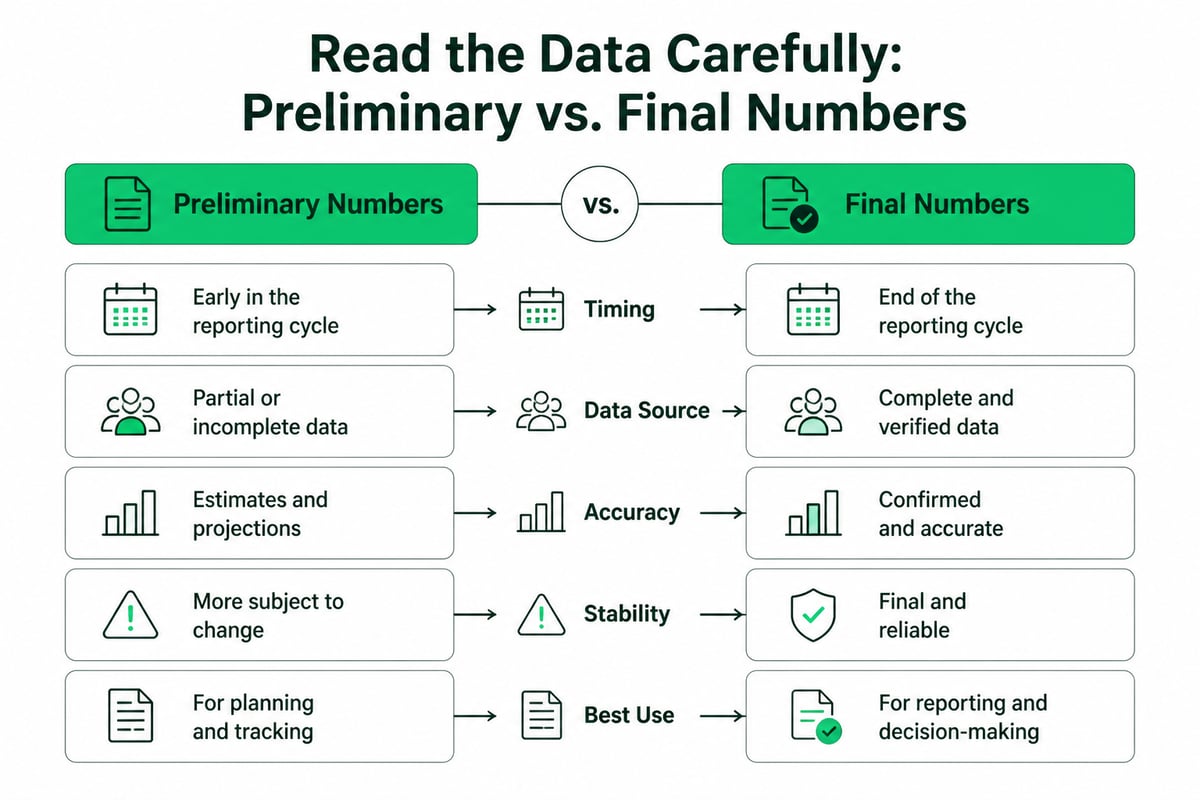
Read the Data Carefully: Preliminary vs. Final Numbers
An agency's own reporting should be read with the same care you would give national enrollment data, because early figures often tell a different story than final ones. The National Student Clearinghouse Research Center updates its preliminary fall dashboards during the first two months of the term and releases final estimates each January, and preliminary estimates may be revised.
The same principle applies to campaign reports. A dashboard in week three may show healthy inquiry volume while the inquiries that actually enroll arrive later or never arrive at all. Early national data can also show headline undergraduate growth and freshman enrollment diverging, as the National Student Clearinghouse has reported.
Practical safeguards for your own reporting:
- Track cohorts, not just totals, so you see what happened to the families who inquired in a given month.
- Compare inquiry volume with downstream stages, including visits, applications and deposits.
- Set review points at 30, 60 and 90 days, and treat early numbers as directional until enrollments are counted.
Tools and Operational Support Around Your Agency
A performance agency works best when your own operations can keep pace with the leads it produces, so a few supporting investments are worth considering. Staff who can interpret automation and analytics get more from the system, and structured training such as AI Certified programs gives admissions and marketing teams practical grounding in applying AI to business workflows.
Visual content also affects conversion. Photography of classrooms, labs, athletic facilities and campus life gives landing pages credibility, and a specialist such as Squareshot can help if you also need polished product-style imagery for school stores, merchandise or program materials.
Reliable infrastructure matters as well. Forms, CRM integrations and email delivery all need to work without interruption during peak inquiry periods, which is where a managed IT provider like Blowfish Technology can reduce the risk of downtime or security lapses at the worst moment.
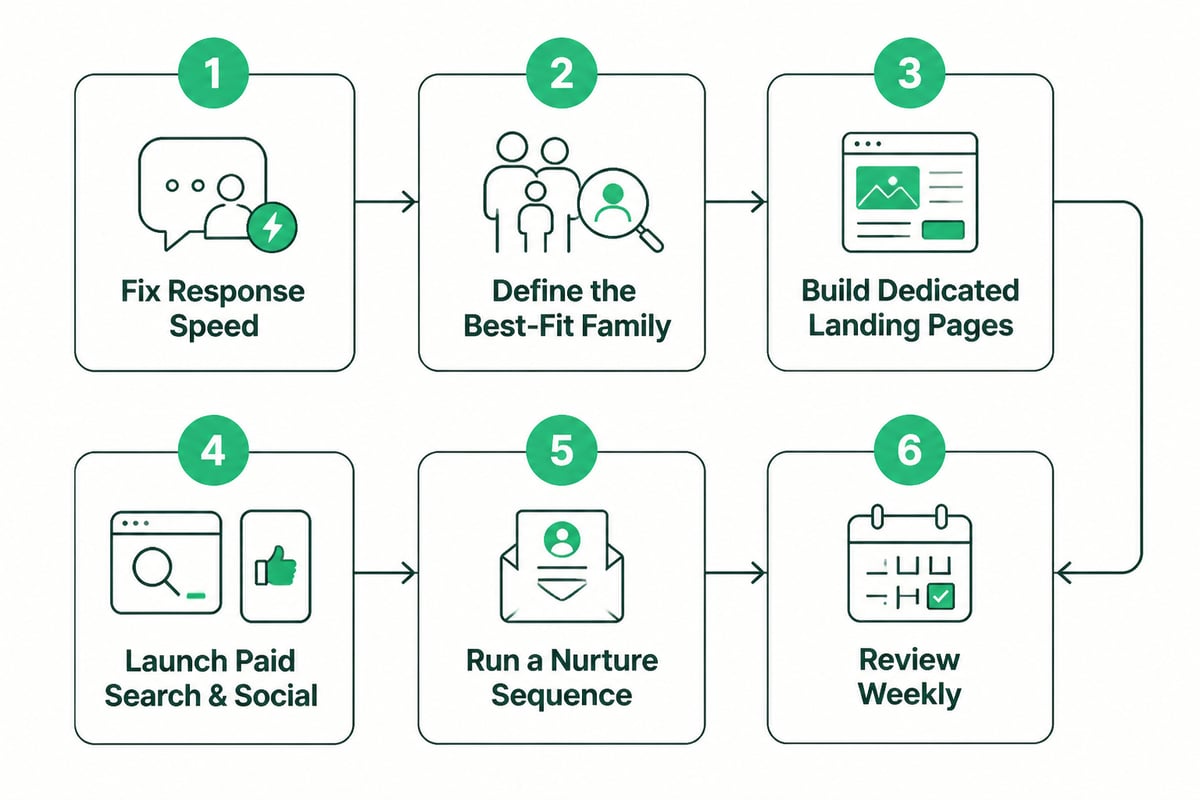
How to Promote Enrollment: A Practical Starting Plan
Promoting enrollment effectively starts with fixing response speed and follow-up, then adding acquisition channels once the funnel can convert what it receives. A sequence that works for most institutions:
- Fix the leak first. Measure how quickly you reply to inquiries today. If the answer is hours or days, automation will produce a faster return than additional ad spend.
- Define your best-fit family or student. Specify grade levels, programs, geography and, for sports academies, athlete profiles.
- Build dedicated landing pages. One page per program or audience, with a single clear action such as booking a tour or requesting information.
- Launch targeted paid channels. Search captures families already looking, while social reaches those who have not started. Budget search for intent and social for awareness.
- Create a nurture sequence. Several timed messages across email and text, each answering a likely question, from tuition to schedules to outcomes.
- Review weekly. Look at qualified inquiries, cost per inquiry and visit bookings, and shift spend accordingly.
Transfer pathways deserve attention for colleges. Two-year institutions are a common starting point for students who later enroll at four-year schools, a pattern the National Student Clearinghouse's research reports highlight. Dedicated transfer messaging, aimed at students already enrolled elsewhere, is often an under-built part of a college's funnel. More ideas appear in ScholarSurge's guide on how to increase school enrollment.
What Is Strategic Enrollment Management, and Where Does an Agency Fit?
Strategic enrollment management (SEM) is an institution-wide planning process that aligns recruitment, admissions, financial aid, retention and academic programming around enrollment goals. It sets the "what" and "why": target class size, desired student mix, tuition revenue and retention rates.
An enrollment performance agency supports the recruitment and conversion pieces of that plan. It does not replace your SEM committee or decide admissions policy. It supplies the engine that generates and converts demand once your leadership has defined the goals. Institutions get the best results when the agency receives clear targets from the SEM process and shares funnel data back so leadership can adjust program mix, capacity and pricing.
What Does an Enrollment Advisor Do?
An enrollment advisor, sometimes called an admissions counselor, guides prospective students and families from first inquiry through application, financial planning conversations and enrollment. Day to day, the role includes answering questions, scheduling tours, reviewing application steps, following up with undecided families and flagging barriers that could stop someone from enrolling.
Performance agencies do not remove the need for advisors. They change how advisors spend their time. When automated systems handle the first reply, nurture and scheduling, advisors enter conversations with families who are already warm and informed. That shift is why many teams describe the model as adding a virtual enrollment team alongside the human one.
Performance Marketing Agency vs. Enrollment Performance Agency
A performance marketing agency is any agency paid on measurable results such as leads or sales; an enrollment performance agency applies that model specifically to students and seats. The distinction matters because generic performance shops optimize for cheap leads, which in education can mean unqualified inquiries from outside your geography or program fit.
An education-specific partner understands seasonality (fall deadlines, spring open houses), the role of parents in K-12 decisions and the longer consideration windows involved in tuition-based choices. It also treats follow-up and visit conversion as part of the job, not an afterthought handed back to your office.
FAQ
How much does an enrollment performance agency cost?
Costs depend on the pricing model. Some agencies charge a monthly retainer plus a bonus per enrollment, others bill per qualified inquiry, and some charge only when a student enrolls. Ask for the full structure in writing, including ad spend, and compare it to your current cost per enrolled student.
How long before results appear?
Inquiry volume typically begins to rise within the first few weeks after campaigns and landing pages launch, while enrollments follow your admissions timeline. A fair agreement sets a 90-day milestone for qualified inquiries and a longer window for enrollments, with ROI judged on cohorts rather than single weeks.
Can small schools and colleges use this model?
Yes. Performance pricing is often attractive to smaller institutions because it limits upfront risk when budgets are tight. The key is confirming that the agency can work with your inquiry volume and that the targets are realistic for your market size.
Start with one number: pull your last ninety days of inquiries and measure how long each family waited for a first reply, then compare that to how many booked a visit. That single audit usually shows where seats are being lost. ScholarSurge builds the system that closes those gaps, with replies in under 60 seconds and pricing tied to enrollment, and you can Book Your Free Enrollment Audit to see what a performance-based approach would look like for your school, college or academy.