Insights
College Enrollment Agency: Growth Systems for 2026
Discover how a college enrollment agency drives qualified inquiries, applications, and full enrollment through proven systems and automation.
READING TIME · 12 MIN · UPDATED QUARTERLY

The higher education landscape in 2026 faces unprecedented challenges. Demographic shifts, rising tuition costs, and intense competition for qualified students have forced colleges and universities to rethink traditional recruitment strategies. A college enrollment agency provides specialized expertise, proven systems, and dedicated resources that help institutions overcome these barriers and achieve sustainable enrollment growth. These agencies serve as virtual enrollment teams, implementing automated inquiry management, rapid response protocols, and sophisticated nurturing campaigns that convert prospective students into enrolled learners.
The Modern Role of College Enrollment Agencies
Today's college enrollment agency operates far beyond simple marketing or lead generation. These specialized firms function as strategic partners that integrate deeply with institutional goals, brand positioning, and student success outcomes.
Comprehensive Enrollment Management Systems
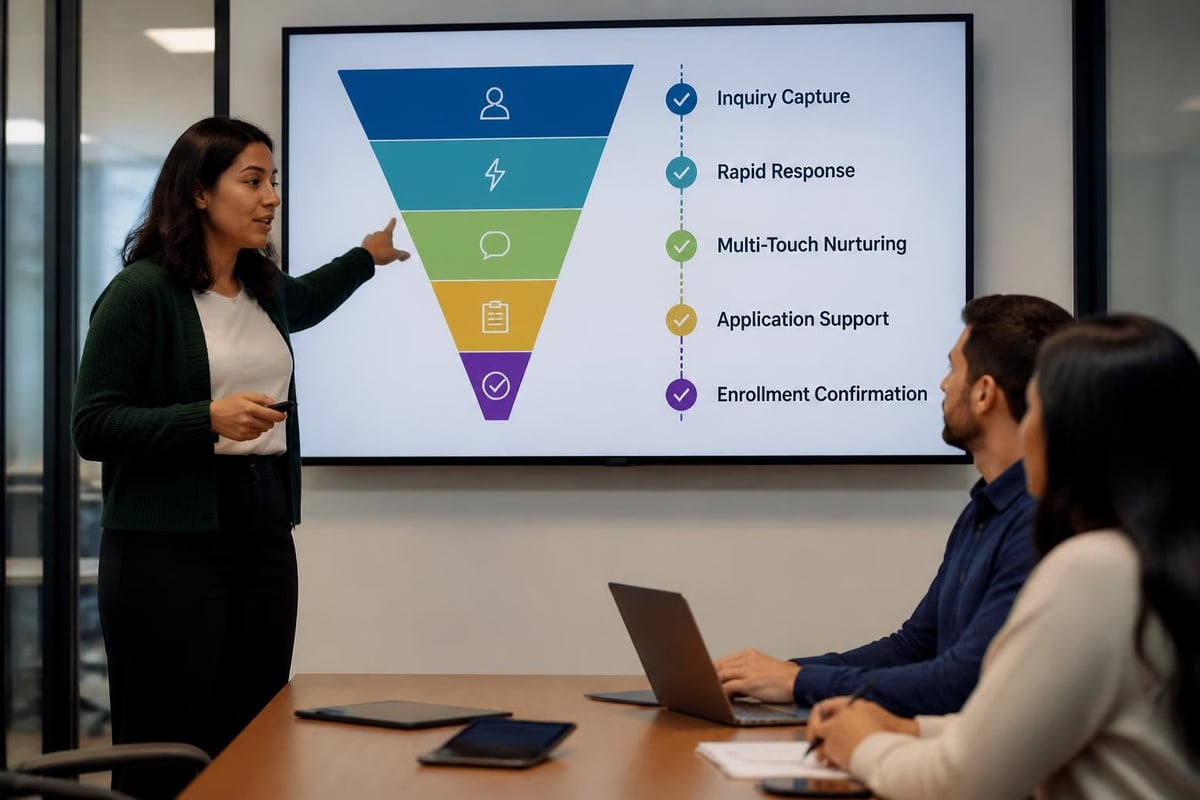
A professional college enrollment agency builds end-to-end systems that address every stage of the student journey. From initial awareness through application submission and enrollment confirmation, these systems ensure no prospective student falls through the cracks.
Core system components include:
- Automated inquiry capture and qualification
- Rapid response protocols (under 5 minutes)
- Multi-channel nurturing sequences
- Application support and guidance
- Enrollment conversion optimization
- Retention-focused onboarding
The National Student Clearinghouse Research Center current-term enrollment estimates reveal continuing volatility in enrollment patterns, making systematic approaches more critical than ever. Institutions can no longer rely on traditional recruitment cycles or passive inquiry management.
Strategic Differentiation Through Data
Modern college enrollment agencies leverage sophisticated data analytics to identify high-intent prospects, optimize messaging, and allocate resources efficiently. The EducationDynamics Marketing & Enrollment Management Benchmarks 2025 provides valuable performance metrics that agencies use to benchmark institutional performance against sector standards.
| Metric Category | Industry Benchmark | High-Performing Institutions |
|---|---|---|
| Inquiry-to-Application | 15-20% | 25-35% |
| Application-to-Enrollment | 30-40% | 50-65% |
| Response Time (First Contact) | 24-48 hours | Under 5 minutes |
| Nurture Campaign Engagement | 8-12% | 18-25% |
These benchmarks highlight the performance gap that a skilled college enrollment agency helps institutions close. Data-driven decision making replaces guesswork, ensuring marketing budgets generate measurable returns.
Why Colleges Partner With Enrollment Agencies
The decision to engage a college enrollment agency stems from multiple strategic imperatives facing modern institutions. Budget constraints, staffing challenges, and rapidly evolving digital marketing landscapes create conditions where specialized expertise delivers superior results.
Resource Optimization and Expertise Access
Most colleges lack the in-house capacity to build and maintain comprehensive enrollment systems. Admissions teams already stretched thin by application review, campus visits, and yield activities cannot simultaneously master marketing automation, conversion optimization, and multi-channel campaign management.
A college enrollment agency provides immediate access to:
- Specialized talent across marketing, technology, and enrollment management
- Proven systems refined across hundreds of institutional partnerships
- Technology platforms purpose-built for enrollment growth
- Ongoing optimization based on real-time performance data
- Scalable capacity that expands during peak recruitment periods
This model allows institutions to focus internal staff on high-touch relationship building and student experience while the agency handles systematic inquiry generation and nurturing. For schools exploring similar approaches, understanding school enrollment consulting principles across all education sectors can provide valuable perspective.
Addressing Market Pressures and Competition
The Deloitte Insights 2025 US Higher Education Trends analysis emphasizes how market consolidation, program proliferation, and changing student preferences intensify competition. Institutions without sophisticated enrollment strategies risk falling behind competitors who invest in professional support.
Key competitive advantages include:
- Geographic expansion reaching students beyond traditional markets
- Program-specific targeting connecting niche offerings with ideal prospects
- Brand amplification through consistent multi-channel presence
- Competitive intelligence monitoring and responding to rival institutions
Sports academies face similar competitive dynamics. Programs like Strive Soccer Academy demonstrate how specialized institutions combine technical excellence with strategic positioning to attract committed athletes and families. A college enrollment agency applies these same principles to higher education recruitment, ensuring institutions stand out in crowded markets.
Essential Services and Capabilities
The most effective college enrollment agency partnerships deliver comprehensive services that address both immediate enrollment needs and long-term institutional sustainability.
Digital Marketing and Lead Generation
Qualified inquiry generation forms the foundation of enrollment growth. A college enrollment agency implements targeted digital campaigns across search, social media, display advertising, and content marketing channels.
Modern lead generation strategies focus on:
- Search engine optimization for program-specific keywords
- Pay-per-click campaigns targeting high-intent prospects
- Social media advertising on platforms where students engage
- Content marketing that addresses prospective student questions
- Retargeting campaigns that re-engage interested visitors
The Hanover Research 2025 National Prospective Student Survey reveals critical insights about student decision factors, preferred communication channels, and information-seeking behaviors. Professional agencies incorporate these findings into campaign design and messaging strategies.

Automated Inquiry Management and Nurturing
Speed and personalization determine enrollment success. Research consistently shows that institutions responding to inquiries within five minutes convert prospects at dramatically higher rates than those with delayed responses.
A college enrollment agency implements sophisticated automation including:
- Instant inquiry acknowledgment across all channels
- Intelligent routing to appropriate counselors or programs
- Personalized nurture sequences based on program interest and student profile
- Multi-channel follow-up via email, SMS, phone, and direct mail
- Behavioral triggers that respond to student actions and engagement
- Application reminders and completion support
These systems operate 24/7, ensuring no prospective student waits for information or support. For institutions managing student admissions across multiple programs or campuses, automation ensures consistent experience regardless of inquiry volume or timing.
Application Support and Conversion Optimization
Converting interested prospects into completed applications requires strategic intervention at critical decision points. A college enrollment agency monitors student progress through application funnels and deploys targeted support.
| Application Stage | Common Barriers | Agency Interventions |
|---|---|---|
| Application Start | Complexity, uncertainty | Simplified portals, video tutorials |
| Information Gathering | Document requirements, confusion | Checklists, one-on-one support |
| Essay/Personal Statement | Writer's block, perfectionism | Prompts, examples, coaching |
| Submission | Technical issues, last-minute doubts | Live chat support, deadline reminders |
| Financial Aid | FAFSA confusion, affordability concerns | Financial aid workshops, calculators |
Conversion optimization extends beyond application submission to enrollment confirmation. Admitted students require continued engagement, financial aid guidance, housing support, and community building to ensure they matriculate rather than accepting offers elsewhere.
Selecting the Right College Enrollment Agency
Not all enrollment agencies deliver equivalent value. Institutions must evaluate potential partners carefully, assessing capabilities, cultural fit, and track record.
Critical Evaluation Criteria
When vetting a college enrollment agency, admissions leaders should examine:
- Proven results with verifiable enrollment growth metrics
- Institutional specialization in similar college types or programs
- Technology infrastructure supporting automation and integration
- Team expertise including enrollment, marketing, and technical skills
- Ethical practices aligned with NACAC's Guide to Ethical Practice
- Transparent pricing with clear performance guarantees
The enrollment management industry has faced scrutiny regarding ethical practices and institutional autonomy. An Inside Higher Ed analysis on enrollment management explores these concerns. Reputable agencies prioritize institutional mission alignment and sustainable growth over short-term metrics.
Questions to Ask Prospective Agencies
Performance and accountability:
- What enrollment guarantees do you provide?
- How do you measure success beyond application numbers?
- Can you share case studies from similar institutions?
- What happens if enrollment targets aren't met?
Process and integration:
- How will you integrate with our existing admissions team?
- What CRM or technology platforms do you use?
- How quickly can systems be implemented?
- What level of institutional involvement is required?
Strategy and approach:
- How do you identify and target qualified prospects?
- What makes your nurturing approach effective?
- How do you handle inquiry quality versus quantity?
- How do you adapt strategies based on performance data?
Institutions serving specific sectors should seek specialized expertise. Those focused on higher education enrollment marketing require different approaches than K-12 enrollment marketing or sports academy marketing.

Implementation and Integration Best Practices
Successful college enrollment agency partnerships require thoughtful implementation and ongoing collaboration between agency teams and institutional stakeholders.
Establishing Clear Goals and Expectations
Before launching any campaigns or systems, institutions and agencies must align on specific, measurable objectives. Vague goals like "increase enrollment" should be replaced with precise targets:
- Increase qualified inquiries by 40% year-over-year
- Achieve 25% inquiry-to-application conversion rate
- Enroll 350 first-year students (up from 280)
- Reduce cost-per-enrollment by 30%
- Improve enrolled student quality (average GPA, test scores)
The AACRAO April 2025 survey on enrollment management provides valuable context on how institutions structure enrollment management functions and measure success. These benchmarks help set realistic yet ambitious targets.
Technology Integration and Data Sharing
A college enrollment agency can only perform effectively with proper access to institutional systems and data. Required integrations typically include:
- CRM platforms for lead management and communication tracking
- Application systems for status monitoring and conversion analytics
- Website analytics for traffic and engagement measurement
- Marketing automation for email, SMS, and workflow management
- Reporting dashboards for real-time performance visibility
Data security, student privacy, and FERPA compliance must be addressed through formal data sharing agreements and security protocols. Clear ownership of student data and communication preferences ensures ethical practices throughout the partnership.
For specialized institutions like those managing international student recruitment, integration complexity increases with multiple time zones, languages, and credential evaluation requirements. Experienced agencies build systems accommodating these nuances.
Measuring Return on Investment
Institutions investing in a college enrollment agency must track financial returns alongside enrollment metrics. Comprehensive ROI analysis extends beyond simple cost-per-enrollment calculations.
Financial Metrics and Attribution
Direct financial impact includes:
- Cost per qualified inquiry
- Cost per completed application
- Cost per enrolled student
- Tuition revenue generated from agency-sourced students
- Net revenue after agency fees and discounting
- Lifetime value of enrolled students (retention and persistence)
| Investment Scenario | Traditional Approach | Agency Partnership |
|---|---|---|
| Annual Marketing Budget | $250,000 | $250,000 |
| Qualified Inquiries | 1,200 | 2,100 |
| Applications | 240 | 588 |
| Enrollments | 96 | 294 |
| Cost per Enrollment | $2,604 | $850 |
| Tuition Revenue (avg $35,000) | $3,360,000 | $10,290,000 |
| Net Revenue Gain | Baseline | +$6,930,000 |
While individual results vary based on institutional context, market position, and starting performance, professional college enrollment agency partnerships consistently demonstrate superior returns compared to traditional in-house approaches.
Beyond Enrollment Numbers
Smart institutions evaluate agency performance across multiple dimensions beyond first-year enrollment counts:
- Student quality and fit measured by academic preparation and mission alignment
- Geographic and demographic diversity expanding institutional reach
- Retention and persistence of agency-sourced students
- Operational efficiency of admissions team workflows
- Brand awareness and market perception improvements
- Competitive positioning relative to peer institutions
The Society for College and University Planning trends analysis emphasizes the strategic importance of enrollment management within broader institutional planning. A college enrollment agency should contribute to long-term institutional health, not merely short-term enrollment spikes.
Sector-Specific Applications
Different types of institutions require tailored approaches from a college enrollment agency. One-size-fits-all strategies fail to address unique challenges across diverse higher education segments.
Small Private Colleges
Small private institutions face distinct enrollment challenges including limited brand recognition, geographic constraints, and intense competition from larger universities. A college enrollment agency serving this sector emphasizes:
- Niche program differentiation and specialization
- Regional market penetration and expansion
- Personalized student experiences and touchpoints
- Financial aid optimization and affordability messaging
- Community building and campus culture storytelling
Resources like small private college enrollment strategies address these specific challenges with proven approaches that help smaller institutions compete effectively.
Community Colleges and Technical Programs
Community colleges recruit different student populations with distinct motivations, barriers, and decision timelines. Effective agencies understand:
- Career-focused messaging emphasizing employment outcomes
- Flexible scheduling and online program options
- Adult learner needs and communication preferences
- Financial accessibility and minimal-cost barriers
- Local market dominance and community partnerships
Specialized Institutions
Universities with unique missions, religious affiliations, or specialized programs require customized strategies. A college enrollment agency must deeply understand institutional identity and target students seeking these specific attributes rather than generic higher education experiences.
Understanding student demographics helps agencies craft resonant messaging and identify qualified prospect pools aligned with institutional strengths.
Technology and Automation Advantages
The most sophisticated college enrollment agency partnerships leverage advanced technology platforms that would be cost-prohibitive for individual institutions to build and maintain independently.
Marketing Automation and CRM Integration
Enterprise-grade marketing automation enables personalized communication at scale. These platforms track every student interaction, trigger appropriate follow-up based on behavior, and score leads based on engagement and fit.
Automation capabilities include:
- Behavioral email sequences triggered by specific actions
- SMS campaigns for time-sensitive communications
- Dynamic website personalization based on visitor profile
- Chatbot engagement for instant question answering
- Automated scheduling for counselor appointments
- Multi-channel campaign coordination and timing
When integrated with CRM systems, these tools provide admissions counselors complete visibility into each prospect's journey, enabling informed, contextual conversations rather than generic outreach.
Predictive Analytics and AI Applications
Cutting-edge college enrollment agencies deploy artificial intelligence and machine learning to predict enrollment likelihood, optimize campaign targeting, and allocate resources efficiently.
AI applications include:
- Lead scoring algorithms identifying high-probability enrollees
- Predictive modeling forecasting enrollment outcomes
- Natural language processing for chatbot interactions
- Sentiment analysis measuring prospect engagement quality
- Budget optimization across advertising channels
- Automated A/B testing of messaging and creative
These technologies amplify human expertise rather than replacing it. Admissions counselors focus on relationship building while AI handles data analysis, pattern recognition, and routine task automation.
Future Trends and Evolution
The college enrollment agency sector continues evolving in response to demographic shifts, technological advancement, and changing student expectations.
Demographic Challenges and Opportunities
The anticipated enrollment cliff beginning in 2025 requires institutions to compete more aggressively for shrinking traditional student populations while expanding into new markets including adult learners, international students, and alternative credential seekers.
Forward-thinking agencies help institutions:
- Diversify recruitment markets geographically and demographically
- Develop programs aligned with workforce demands
- Create flexible delivery models serving working adults
- Build international recruitment infrastructure
- Establish strategic partnerships with employers and community organizations
Personalization and Student Experience
Tomorrow's successful college enrollment agency partnerships will deliver increasingly personalized experiences throughout the student journey. Generic mass marketing gives way to individualized communication reflecting specific student interests, goals, and circumstances.
Advanced personalization extends beyond addressing students by name to:
- Customized content based on intended major and career goals
- Financial aid projections specific to individual circumstances
- Campus visit experiences tailored to student priorities
- Peer connections with current students sharing similar backgrounds
- Post-enrollment support anticipating individual needs
Understanding education lead generation principles helps institutions attract genuinely interested prospects rather than accumulating low-quality inquiries that waste admissions team capacity.
Common Pitfalls and How to Avoid Them
Even well-intentioned college enrollment agency partnerships can falter without proper planning and management. Awareness of common challenges enables proactive mitigation.
Misaligned Expectations and Communication Gaps
Problem: Institutions expect immediate results while agencies require time to build systems, optimize campaigns, and demonstrate results.
Solution: Establish realistic timelines with milestone-based expectations. Most partnerships require 3-6 months to achieve optimal performance as systems are refined based on actual data.
Quality Versus Quantity Trade-offs
Problem: Agencies generate high inquiry volume but low-quality prospects who rarely convert to applications or enrollments.
Solution: Define qualified inquiry criteria clearly and hold agencies accountable for inquiry quality metrics, not just volume. Better to generate 500 highly-qualified prospects than 2,000 generic inquiries.
Insufficient Institutional Engagement
Problem: Colleges treat agencies as completely outsourced solutions requiring minimal internal involvement, leading to disconnected strategies and poor results.
Solution: Designate institutional liaisons who collaborate regularly with agency teams, provide market intelligence, and ensure alignment with admissions priorities and campus culture.
Technology Integration Failures
Problem: Inadequate data sharing, system incompatibilities, or security concerns prevent agencies from accessing necessary information and implementing effective automation.
Solution: Address technology requirements and integration plans during initial scoping. Involve IT teams early to resolve security, access, and compatibility issues before launch.
Institutions can learn from proven models. Examining successful school admissions automation implementations across K-12 and higher education provides valuable templates for effective systems.
Partnering with a college enrollment agency provides institutions the specialized expertise, proven systems, and dedicated capacity needed to thrive in today's competitive enrollment landscape. By implementing automated inquiry management, rapid response protocols, and sophisticated nurturing campaigns, colleges can achieve sustainable enrollment growth while optimizing limited internal resources. ScholarSurge delivers comprehensive enrollment growth systems specifically designed for colleges, universities, and specialized academies, guaranteeing increased qualified inquiries and full enrollment through our proven virtual enrollment team approach.