Insights
Marketing Agency for Small Colleges: 2026 Guide
Discover how a specialized marketing agency for small colleges delivers enrollment growth through proven digital strategies and automation.
READING TIME · 13 MIN · UPDATED QUARTERLY

Small colleges face unprecedented enrollment challenges in 2026, competing against larger institutions with deeper marketing budgets and more recognizable brand names. The demographic cliff has intensified recruitment pressure, while digital marketing complexity continues to escalate. For small colleges with limited internal marketing teams, partnering with a specialized marketing agency for small colleges offers a strategic path to sustainable enrollment growth. These agencies bring focused expertise in higher education recruitment, proven systems for generating qualified inquiries, and the technology infrastructure needed to convert prospects into enrolled students efficiently.
Why Small Colleges Need Specialized Marketing Support
The higher education landscape has transformed dramatically over the past five years. Recent enrollment data shows nuanced patterns that demand sophisticated marketing responses rather than generic tactics.
Small colleges typically operate with admissions teams of three to seven people managing the entire recruitment cycle. These professionals handle inquiry generation, campus visits, application processing, and yield activities simultaneously. Adding complex digital marketing management to this workload often results in inconsistent execution and missed opportunities.
Resource Constraints Create Strategic Gaps
Most small colleges lack dedicated positions for:
- Search engine optimization specialists who understand education-specific algorithms
- Paid media managers experienced with higher education conversion funnels
- Marketing automation engineers capable of building sophisticated nurture sequences
- Data analysts who can connect marketing spend to enrollment outcomes
A marketing agency for small colleges fills these capability gaps without the overhead of full-time salaries and benefits. The right partner brings tested systems that have generated results across multiple institutions, accelerating time-to-value compared to building internal expertise from scratch.
The Demand Generation Challenge
Analysis suggests the enrollment crisis fundamentally represents a demand problem, not merely an awareness issue. Small colleges must demonstrate clear value propositions that resonate with specific student segments, then deploy targeted campaigns that reach those audiences efficiently.
Traditional brand-building approaches consume budget without producing measurable inquiry volume. Modern enrollment marketing requires precision targeting, compelling messaging aligned to student search intent, and systematic follow-up that maintains engagement through the decision journey.

Core Services a Marketing Agency Provides Small Colleges
Effective marketing agencies for small colleges deliver integrated services that address the complete enrollment funnel rather than isolated tactics. This comprehensive approach ensures consistency across channels and eliminates gaps where prospects might disengage.
Digital Advertising and Paid Media Management
Paid digital advertising forms the foundation of most modern college recruitment strategies. EAB's 2026 marketing outlook confirms that institutions continue increasing investment in digital channels, with search and social platforms receiving the largest budget allocations.
A specialized agency manages:
| Service Component | Strategic Function | Typical Outcomes |
|---|---|---|
| Google Search Campaigns | Capture high-intent prospects actively researching programs | 40-60% of total qualified inquiries |
| Social Media Advertising | Build awareness and engagement with defined demographic segments | 25-35% of inquiry volume |
| Display Retargeting | Re-engage website visitors who didn't initially convert | 15-20% inquiry contribution |
| YouTube Video Campaigns | Showcase campus culture and student experiences | Brand lift and assisted conversions |
The agency continuously optimizes campaigns based on cost-per-inquiry metrics and downstream enrollment performance, shifting budget toward channels that deliver the highest return on investment.
Search Engine Optimization for Enrollment
Organic search visibility provides sustainable inquiry generation without ongoing media costs. Moorpark College's documented search strategy success demonstrates how strategic SEO investments produce significant enrollment gains.
A marketing agency for small colleges develops SEO strategies across multiple dimensions:
- Program-specific landing pages optimized for degree and major searches
- Location-based content targeting regional student populations
- Information resources addressing common questions throughout the decision journey
- Technical optimization ensuring fast load times and mobile responsiveness
- Link building from relevant educational and community websites
Effective higher education enrollment marketing recognizes that prospective students conduct extensive online research before requesting information. Colleges that appear prominently in these research moments establish credibility and capture inquiry share from competitors.
Marketing Automation and Lead Nurturing
Converting inquiries into applications requires systematic, personalized communication over weeks or months. Most small colleges lack the technology infrastructure and content libraries needed for sophisticated nurture campaigns.
Specialized agencies implement automation sequences that:
- Send immediate personalized responses acknowledging inquiry submission
- Deliver relevant content based on program interest and student characteristics
- Trigger communications based on prospect behavior and engagement signals
- Route high-priority leads to admissions counselors for direct outreach
- Re-engage inactive prospects with targeted messaging
These systems operate continuously without manual intervention, ensuring every prospect receives consistent attention regardless of when they inquire or how busy the admissions team becomes.

Selecting the Right Marketing Partner for Your College
Not all marketing agencies understand the unique dynamics of higher education enrollment. Small colleges should evaluate potential partners against specific criteria that indicate relevant expertise and appropriate service models.
Higher Education Specialization Matters
Agencies focused exclusively on education bring institutional knowledge that generalist firms cannot replicate. They understand recruitment cycles, admissions terminology, regulatory constraints like FERPA, and the psychological factors influencing college choice.
When evaluating a marketing agency for small colleges, ask about:
- Client portfolio composition: What percentage of clients are higher education institutions?
- Enrollment outcome tracking: How do they measure success beyond vanity metrics?
- Compliance knowledge: What protocols ensure advertising meets regulatory standards?
- Recruitment cycle alignment: How do strategies adapt to traditional academic calendars?
Strategic enrollment partnerships demonstrate how agencies working collaboratively with college leadership achieve more substantial results than transactional vendor relationships.
Technology and Systems Integration
The best marketing agencies provide more than creative services and media buying. They implement complete systems connecting marketing activities to enrollment outcomes through integrated technology platforms.
Essential technology components include:
Customer Relationship Management (CRM) Systems
Centralized databases tracking every prospect interaction across channels, enabling coordinated outreach and preventing duplicate or conflicting communications.
Marketing Automation Platforms
Tools that execute complex nurture sequences, score lead quality based on engagement, and trigger appropriate next actions automatically.
Analytics and Attribution Systems
Dashboards connecting marketing spend to inquiry generation, application submissions, and actual enrollments with source attribution.
Agencies should either provide these systems or integrate seamlessly with platforms the college already uses, ensuring data flows smoothly between marketing and admissions operations.
Transparent Performance Measurement
Accountability separates effective marketing agencies for small colleges from those delivering ambiguous results. Establish clear performance metrics before engagement begins.
| Metric Category | Key Performance Indicators | Measurement Frequency |
|---|---|---|
| Top-of-Funnel | Qualified inquiries, cost per inquiry, channel mix | Weekly |
| Mid-Funnel | Application starts, completed applications, conversion rates | Bi-weekly |
| Bottom-Funnel | Acceptances, deposits, enrolled students, cost per enrollment | Monthly/quarterly |
| System Health | Response time, nurture engagement, database quality | Weekly |
The agency should provide regular reporting showing performance against benchmarks and explaining strategic adjustments based on data insights. Comprehensive enrollment data analysis helps contextualize your college's performance within broader market trends.
Implementation Timeline and Realistic Expectations
Small colleges exploring agency partnerships often ask how quickly they can expect results. Understanding typical implementation timelines helps set appropriate expectations and secure necessary leadership support.
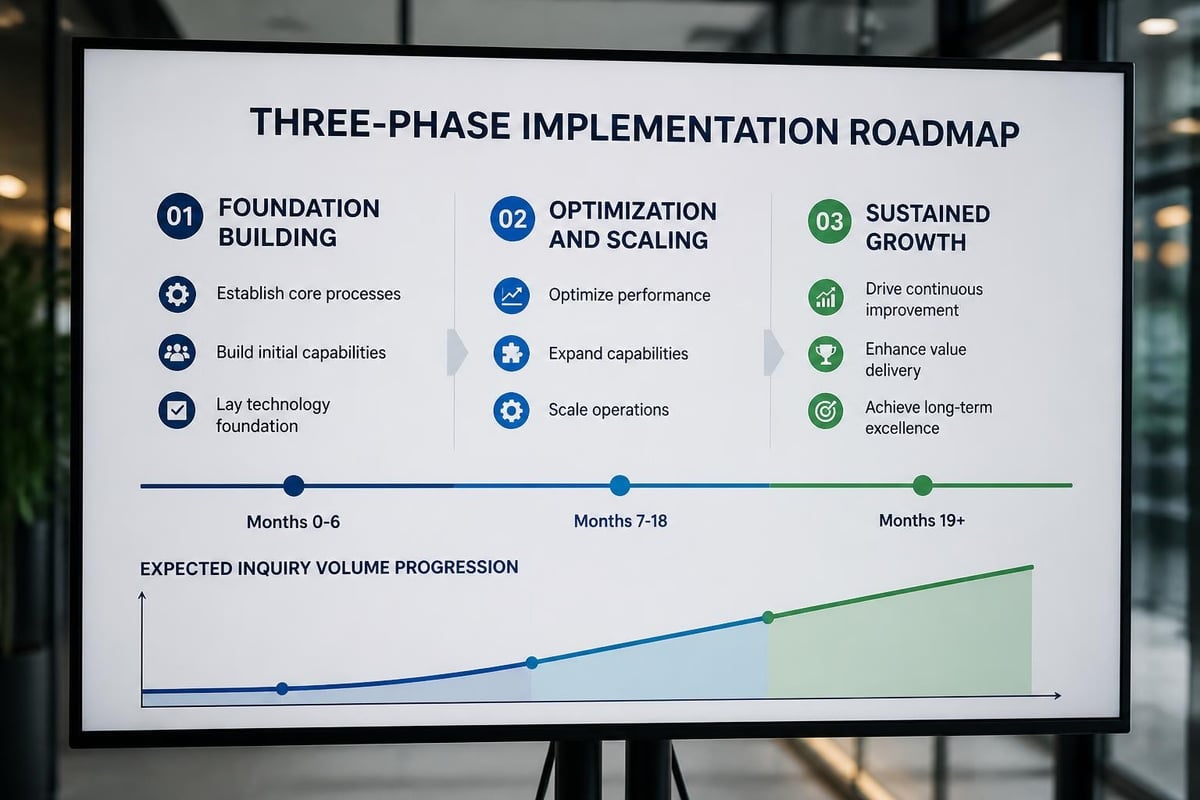
Phase One: Foundation Building (Months 1-2)
The initial phase focuses on establishing infrastructure and gathering intelligence:
- Complete market analysis identifying competitive positioning and opportunity segments
- Audit existing marketing assets, website performance, and conversion pathways
- Implement tracking systems and analytics infrastructure
- Develop initial campaign creative and messaging frameworks
- Configure automation sequences and response protocols
Limited inquiry volume occurs during this phase as campaigns launch and systems come online. Patience during foundation-building pays dividends through stronger long-term performance.
Phase Two: Optimization and Scale (Months 3-6)
As data accumulates, the agency refines targeting, messaging, and budget allocation:
- Analyze early campaign performance across channels and audience segments
- Identify highest-performing creative assets and messaging themes
- Shift budget toward best-performing channels and away from underperformers
- Expand successful campaigns to reach larger audience volumes
- Refine automation sequences based on conversion pattern analysis
Inquiry volume typically increases 30-50% during this phase as optimization improves efficiency and scaling expands reach.
Phase Three: Sustained Growth (Months 7-12)
With systems optimized and running efficiently, focus shifts to sustained enrollment growth:
- Maintain consistent inquiry flow through proven channel mix
- Continuously test new creative, audiences, and messaging variations
- Expand into additional marketing channels as primary channels mature
- Develop content libraries supporting long-term SEO growth
- Build systematic processes for ongoing campaign management
Small private college enrollment strategies require this sustained approach rather than sporadic campaign bursts, creating predictable inquiry pipelines that support enrollment planning.
Budget Considerations and Investment Models
Small colleges operate with constrained marketing budgets, making investment efficiency critical. Understanding typical agency pricing models helps institutions budget appropriately and evaluate proposals.
Common Pricing Structures
Marketing agencies for small colleges typically use one of three pricing approaches:
Monthly Retainer Models
Fixed monthly fees covering agreed-upon services and deliverables. Provides budget predictability but may include charges for services the college doesn't fully utilize during slower recruitment periods.
Performance-Based Pricing
Fees tied directly to outcomes like qualified inquiries or enrolled students. Aligns agency incentives with college goals but typically requires higher per-outcome pricing to account for agency risk.
Hybrid Arrangements
Combination of base retainer covering core services plus performance bonuses for exceeding enrollment targets. Balances predictability with outcome alignment.
Most small colleges with annual marketing budgets of $150,000-$400,000 allocate 60-70% to media spend and 30-40% to agency fees for strategy, creative, and management services.
Return on Investment Expectations
A marketing agency for small colleges should demonstrate clear ROI through enrollment economics:
- Typical cost per qualified inquiry: $75-$200 depending on program competitiveness
- Inquiry to application conversion: 15-30% with effective nurturing
- Application to enrollment conversion: 25-45% based on selectivity and yield strategies
- Blended cost per enrollment: $1,500-$4,500 across all marketing channels
For a small college with average tuition of $35,000 and a four-year lifetime value of $120,000+ per student, marketing investments producing enrollments at $3,000 per student deliver exceptional returns even in the first year.
Integration with Internal Admissions Teams
Marketing agencies don't replace admissions professionals but rather amplify their effectiveness through systematic support. Successful partnerships require clear role definition and collaborative workflows.
Complementary Responsibilities
The agency focuses on demand generation and early-stage engagement while admissions counselors own relationship development and enrollment conversion:
Agency Responsibilities:
- Generate consistent flow of qualified prospects through digital channels
- Implement automated response and nurture sequences
- Provide analytics showing source performance and conversion metrics
- Create content supporting the recruitment cycle
- Optimize campaigns based on performance data
Admissions Team Responsibilities:
- Personal outreach to high-priority prospects
- Campus visit coordination and execution
- Application completion support and troubleshooting
- Financial aid counseling and negotiations
- Yield activities converting accepted students to enrolled
School admissions automation creates leverage, allowing small admissions teams to manage larger prospect volumes without sacrificing personalization where it matters most.
Communication Protocols and Feedback Loops
Establish regular touchpoints ensuring alignment between marketing efforts and admissions intelligence:
- Weekly data reviews examining inquiry volume, quality, and conversion trends
- Monthly strategy sessions adjusting campaigns based on admissions feedback and enrollment pacing
- Quarterly planning meetings aligning marketing priorities with upcoming recruitment cycle needs
- Real-time alerts notifying admissions of high-priority inquiries requiring immediate outreach
The most effective marketing agencies for small colleges function as extensions of the admissions team rather than external vendors, developing deep institutional knowledge that informs increasingly sophisticated strategies over time.
Emerging Trends Shaping College Marketing in 2026
The higher education marketing landscape continues evolving rapidly. Small colleges partnering with agencies should ensure their strategies incorporate current best practices and emerging opportunities.
Artificial Intelligence in Recruitment Marketing
AI tools are transforming multiple aspects of enrollment marketing, from prospect identification to content personalization. Current marketing practices show increasing AI adoption across institutions of all sizes.
Progressive marketing agencies for small colleges leverage AI for:
- Predictive modeling identifying prospects most likely to inquire, apply, and enroll
- Dynamic ad creative that automatically adjusts messaging based on audience characteristics
- Chatbot systems providing instant answers to common questions outside business hours
- Content generation supporting SEO and social media presence at scale
Small colleges benefit disproportionately from these technologies since they provide enterprise-level capabilities without enterprise-level staffing requirements.
Video Content and Authentic Storytelling
Prospective students increasingly expect video content showcasing genuine student experiences rather than polished promotional materials. Effective agencies help colleges develop sustainable video production workflows that capture authentic moments throughout the academic year.
Essential video content types include:
- Student testimonial series featuring diverse perspectives and program experiences
- Virtual campus tours providing comprehensive facility overviews
- Faculty interviews explaining teaching philosophy and program distinctives
- Day-in-the-life content showing typical student schedules and activities
- Alumni success stories demonstrating career outcomes and life preparation
These assets support both paid advertising campaigns and organic content distribution across social platforms and the college website.
Channel Diversification and Portfolio Optimization
Relying exclusively on one or two marketing channels creates vulnerability to platform changes, increased competition, or shifting student behavior. Smart agencies build diversified channel portfolios that balance proven performers with emerging opportunities.
A balanced small college marketing portfolio in 2026 typically includes:
| Channel Category | Budget Allocation | Primary Function |
|---|---|---|
| Google Search | 25-35% | High-intent inquiry capture |
| Social Media (Facebook, Instagram, TikTok) | 20-30% | Awareness and consideration building |
| Display/Retargeting | 10-15% | Re-engagement and conversion support |
| SEO/Content Marketing | 15-20% | Sustainable organic visibility |
| Email/Automation | 5-10% | Nurture and conversion optimization |
| Traditional/Other | 5-15% | Supplemental reach based on market |
Regular portfolio analysis identifies channels deserving increased investment and those requiring strategic adjustments or budget reallocation.
Measuring Long-Term Partnership Success
Beyond immediate enrollment metrics, evaluate agency partnerships across dimensions indicating sustainable value creation and institutional capacity building.
Knowledge Transfer and Skill Development
Exceptional marketing agencies for small colleges don't create dependency but rather build institutional capabilities over time. Look for partners who:
- Train internal teams on marketing principles and platform management
- Document processes and strategies for institutional knowledge retention
- Share industry insights and competitive intelligence proactively
- Provide educational resources supporting professional development
This approach ensures the college develops stronger marketing sophistication even if the partnership eventually transitions or concludes.
Strategic Enrollment Planning Alignment
Marketing tactics should advance broader enrollment management goals beyond simple headcount targets. Effective agencies collaborate with enrollment leaders to achieve strategic objectives like:
Enrollment Mix Optimization
Attracting student populations aligned with institutional mission and capacity, including appropriate balances of residential/commuter, in-state/out-of-state, and traditional/non-traditional students.
Program Portfolio Development
Identifying market demand for new programs or concentrations, informing academic planning with market intelligence about employment trends and student search behavior.
Net Tuition Revenue Growth
Generating inquiry pools that support enrollment goals while optimizing the balance between enrollment volume and discount rates, contributing to financial sustainability.
Education lead generation systems designed with these strategic objectives in mind deliver more valuable results than those optimizing purely for inquiry volume metrics.
Competitive Positioning Improvement
Track how your college's market position evolves relative to peer institutions over time. Key indicators include:
- Share of search impressions for priority keywords compared to competitors
- Social media engagement rates and follower growth versus peer institutions
- Website traffic volume and quality metrics benchmarked against similar colleges
- Inquiry market share within defined geographic or demographic segments
A marketing agency for small colleges should help you gain ground against competitors in these visibility and consideration metrics, translating into enrollment advantages as your brand strengthens.
Technology Stack Considerations
The marketing technology infrastructure supporting enrollment growth significantly impacts both campaign effectiveness and operational efficiency. Small colleges should understand what systems specialized agencies provide or integrate with to ensure comprehensive capability.
Essential Platform Categories
Customer Data Platform (CDP)
Unified database consolidating prospect information from all touchpoints, creating complete profiles that enable sophisticated segmentation and personalization. CDPs designed for higher education understand the complexity of multiple inquiry sources, family relationships, and extended decision timelines.
Marketing Automation Engine
Workflow builder executing multi-step nurture sequences triggered by prospect behavior, characteristics, or timeline milestones. Advanced platforms support dynamic content insertion, A/B testing, and predictive send-time optimization.
Analytics and Attribution System
Tracking infrastructure connecting marketing activities to enrollment outcomes across the entire funnel. Should support multi-touch attribution showing how various channels work together rather than simplistic last-click models.
Communication Channels
Integration with email, SMS, voice, and chat platforms ensuring consistent prospect experience across preferred communication methods.
Agencies managing these technologies reduce the burden on small college IT departments while ensuring best-practice implementation and ongoing optimization.
Data Privacy and Compliance
Higher education marketing involves sensitive student information subject to regulations including FERPA, GDPR (for international recruitment), and various state privacy laws. A qualified marketing agency for small colleges implements systems and processes ensuring compliance across all activities.
Critical compliance considerations include:
- Secure data storage with appropriate access controls and encryption
- Clear consent mechanisms for marketing communications
- Documented data retention and deletion policies
- Vendor agreements meeting regulatory requirements
- Staff training on privacy obligations and incident response
Compliance failures create legal liability and reputational damage far exceeding any marketing performance gains, making this a non-negotiable partnership requirement.
Small colleges navigating today's competitive enrollment landscape need more than occasional marketing tactics-they require complete systems connecting digital visibility with inquiry generation, automated nurturing, and conversion optimization. Partnering with a specialized marketing agency for small colleges provides access to proven strategies, sophisticated technology, and dedicated expertise that most institutions cannot build internally. ScholarSurge delivers exactly this type of comprehensive enrollment growth system, guaranteeing increased qualified inquiries and applications through automated response protocols and systematic nurturing that keeps your admissions team focused on relationship building and enrollment conversion. When you're ready to achieve predictable, sustainable enrollment growth, ScholarSurge functions as your virtual enrollment team, bringing enterprise-level marketing capabilities tailored specifically for educational institutions.