Insights
College Recruitment Marketing Company Guide 2026
Discover how a college recruitment marketing company drives enrollment growth through automated systems, rapid response, and data-driven strategies.
READING TIME · 11 MIN · UPDATED QUARTERLY

Higher education institutions face unprecedented challenges in 2026 as demographic shifts, increased competition, and evolving student expectations reshape the enrollment landscape. A college recruitment marketing company offers specialized expertise that transforms how colleges and universities attract, engage, and convert prospective students into enrolled learners. These partnerships deliver comprehensive enrollment growth systems that combine marketing strategy, automation technology, and proven conversion tactics to fill classes with qualified students who align with institutional missions and values.
Understanding the Role of a College Recruitment Marketing Company
A college recruitment marketing company specializes in helping higher education institutions achieve sustainable enrollment growth through integrated marketing systems and proven methodologies. Unlike general marketing agencies, these specialized partners understand the unique challenges facing colleges, from lengthy decision cycles to complex stakeholder dynamics involving students, parents, and guidance counselors.
The most effective college recruitment marketing companies build systems rather than running isolated campaigns. This systematic approach addresses every stage of the student journey, from initial awareness through final enrollment. Modern recruitment marketing requires sophisticated automation, rapid response protocols, and personalized nurturing sequences that keep prospective students engaged throughout their decision-making process.
Core Components of Effective Recruitment Marketing
Successful enrollment growth systems include several interconnected elements that work together to maximize qualified inquiries and applications:
- Multi-channel marketing campaigns that reach prospects across digital and traditional platforms
- Automated inquiry management systems that capture and organize leads efficiently
- Rapid response protocols ensuring prospects receive immediate engagement
- Personalized nurturing sequences tailored to student interests, program preferences, and demographics
- Analytics and optimization frameworks that improve performance continuously
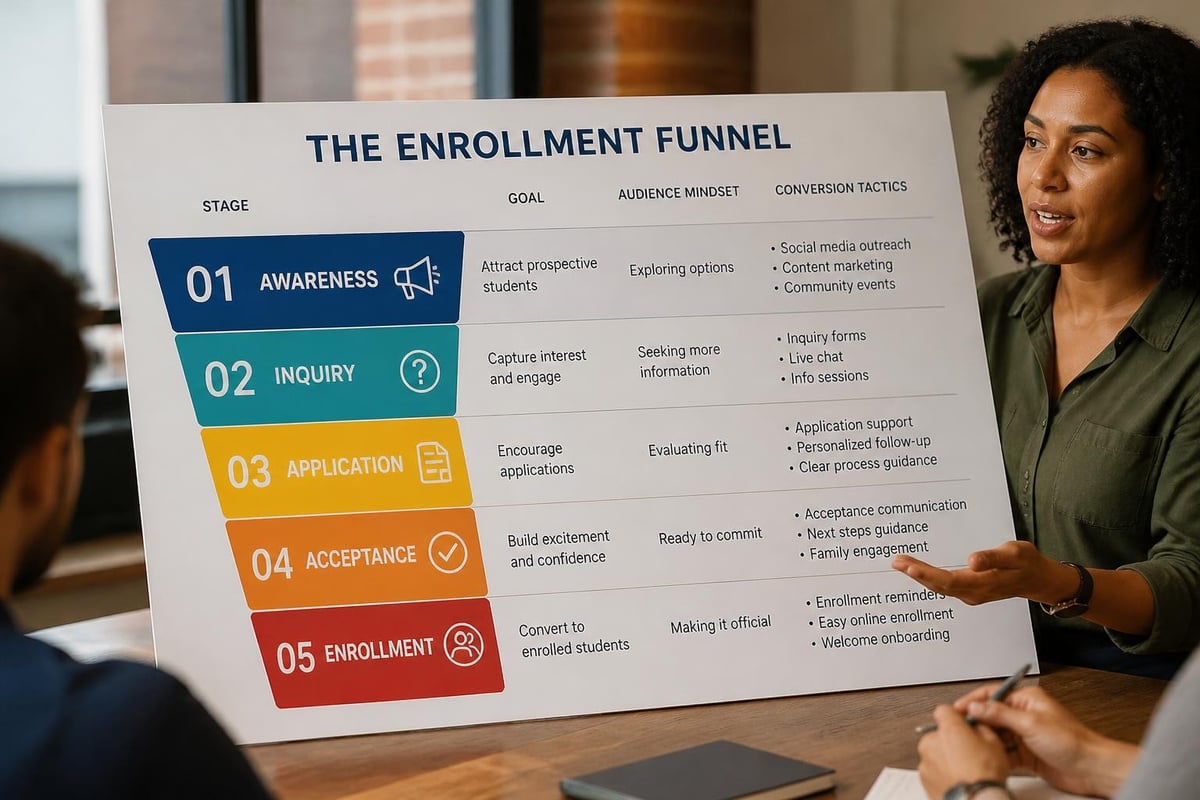
When these components function together seamlessly, institutions experience consistent inquiry flow and higher conversion rates at every funnel stage.
Key Strategies Employed by Top College Recruitment Marketing Companies
A college recruitment marketing company leverages data-driven strategies backed by industry research and proven results. According to recent recruiting benchmarks and enrollment management research, institutions that implement comprehensive digital strategies see significantly higher inquiry-to-enrollment conversion rates compared to those relying on traditional methods alone.
Audience Segmentation and Targeting
Effective recruitment begins with understanding who your ideal students are and where to find them. Advanced student demographics analysis enables precise targeting across multiple dimensions including academic interests, geographic location, socioeconomic background, and career aspirations. For a broader look at how an education recruitment marketing company drives enrollment growth with automation and data-driven systems, see our new guide.
| Segmentation Type | Data Sources | Application |
|---|---|---|
| Geographic | IP tracking, form data, enrollment history | Regional campaigns, travel recruitment |
| Academic Interest | Website behavior, inquiry forms, engagement patterns | Program-specific messaging, faculty connections |
| Demographic | Age, income indicators, family status | Financial aid messaging, parent outreach |
| Behavioral | Digital engagement, response patterns, visit behavior | Nurture sequence customization, timing optimization |
Understanding how prospective students evaluate colleges provides crucial insights into messaging priorities and channel selection. Research consistently shows that students prioritize different factors at various stages of their search process, requiring dynamic messaging strategies.
Automated Systems for Inquiry Management
The speed and quality of initial response directly impacts conversion rates. Prospective students expect immediate engagement when they express interest in your institution. A sophisticated college recruitment marketing company implements automated systems that ensure every inquiry receives personalized attention within minutes, not days.
Automation extends beyond simple auto-responders. Modern school admissions automation systems track engagement, segment prospects based on behavior, trigger appropriate follow-up sequences, and alert admissions staff when prospects demonstrate high intent signals.
Benefits of automated inquiry management include:
- Immediate response to every inquiry, regardless of time or day
- Consistent messaging aligned with institutional brand
- Reduced workload on admissions staff for routine communications
- Detailed tracking of every prospect interaction
- Scalability to handle fluctuating inquiry volumes
These systems transform how institutions manage the crucial first contact with prospective students, dramatically improving conversion from inquiry to application.
Building a Comprehensive Nurture Strategy
Student recruitment is a marathon, not a sprint. The average college search process extends across months or even years, requiring sustained engagement that keeps your institution top-of-mind without overwhelming prospects. A college recruitment marketing company designs nurture strategies that balance persistence with relevance, delivering value at each touchpoint.
Multi-Channel Engagement Tactics
Modern prospective students interact with colleges across numerous channels, from social media to email, campus visits to virtual tours. Effective nurture strategies coordinate messaging across all these touchpoints, creating a cohesive experience regardless of how students choose to engage.
- Email nurture sequences delivering educational content, program highlights, and student success stories
- SMS campaigns for time-sensitive reminders about deadlines, events, and next steps
- Social media engagement showcasing campus life, academic programs, and student achievements
- Retargeting campaigns keeping your institution visible as prospects browse other sites
- Direct mail for high-value prospects and critical decision points
- Phone outreach from current students, faculty, or admissions counselors at strategic moments
According to effective marketing and recruitment practices research, institutions that employ integrated multi-channel strategies consistently outperform those relying on single-channel approaches. The key lies in coordination and timing, ensuring messages reinforce rather than contradict each other.

Content Strategy for Different Prospect Stages
Prospective students need different information at various stages of their journey. Early-stage prospects require broad awareness content about your institution's strengths and differentiators. Mid-stage prospects seek detailed program information, outcomes data, and campus culture insights. Late-stage prospects need practical details about enrollment processes, financial aid, and housing.
A college recruitment marketing company develops content libraries that address questions and concerns at each funnel stage, ensuring prospects always receive relevant information matched to their current needs and readiness level.
Performance Measurement and Optimization
Effective enrollment marketing requires continuous measurement and optimization. Without clear metrics and regular analysis, institutions cannot identify what drives results or where opportunities exist for improvement. Leading higher education enrollment marketing programs establish comprehensive analytics frameworks from the outset.
Essential Metrics to Track
| Metric Category | Key Performance Indicators | Optimization Focus |
|---|---|---|
| Top-of-Funnel | Inquiry volume, inquiry sources, cost per inquiry | Channel allocation, campaign messaging |
| Mid-Funnel | Application rate, nurture engagement, visit conversion | Content relevance, follow-up timing |
| Bottom-of-Funnel | Acceptance rate, yield rate, enrollment cost | Financial aid strategy, enrollment communications |
| Overall Performance | Total enrollment, ROI, student quality metrics | Budget allocation, strategy refinement |
These metrics provide actionable insights only when tracked consistently and analyzed within proper context. Comparing current performance against historical trends, institutional goals, and industry benchmarks reveals where systems excel and where improvements are needed.
Testing and Continuous Improvement
The most successful college recruitment marketing companies implement structured testing programs that systematically improve performance over time. A/B testing reveals which subject lines generate higher open rates, which landing pages convert more inquiries, and which nurture sequences produce more applications.
Testing priorities should align with potential impact. Small improvements in high-volume activities generate greater results than large improvements in low-volume activities. Focus testing efforts on:
- Email subject lines and preview text
- Landing page headlines and calls-to-action
- Inquiry form length and field requirements
- Nurture sequence timing and frequency
- Ad creative and targeting parameters
Document all test results and apply learnings systematically across campaigns to compound improvements over time.
Selecting the Right College Recruitment Marketing Company
Not all enrollment marketing partners deliver equal value. Selecting the right college recruitment marketing company requires careful evaluation of expertise, methodology, technology capabilities, and cultural fit. Institutions should approach this decision with the same rigor applied to other strategic partnerships.
Evaluation Criteria for Potential Partners
When assessing potential partners, consider both quantitative credentials and qualitative factors that indicate genuine expertise and alignment with your institutional needs.
Questions to ask prospective partners:
- What enrollment growth guarantees do you provide, and what happens if targets aren't met?
- How do your automated systems integrate with our existing CRM and student information systems?
- What is your approach to rapid response, and what response time benchmarks do you maintain?
- How do you customize strategies for different institution types, program levels, and student segments?
- What reporting and analytics access will our team have throughout the partnership?
- Can you provide case studies from institutions similar to ours in size, mission, and market position?
References from current and past clients provide invaluable insights into working relationships, communication patterns, and actual results achieved. Don't hesitate to ask detailed questions about challenges encountered and how the partner responded.
Understanding Service Models and Pricing
College recruitment marketing companies typically offer several service models ranging from full-service partnerships to specialized support in specific areas. Understanding these models helps institutions select the right fit for their needs and budget constraints.
Full-service partners like ScholarSurge manage the complete enrollment marketing function, from strategy development through campaign execution, inquiry management, and conversion optimization. This comprehensive approach works well for institutions seeking to transform their entire recruitment operation or lacking internal expertise to manage sophisticated systems.
Specialized services focus on specific components such as digital advertising, marketing automation implementation, or analytics and optimization. These options suit institutions with strong internal capabilities that need expert support in particular areas.
Technology Infrastructure for Modern Recruitment Marketing
A college recruitment marketing company builds success on robust technology infrastructure that enables automation, personalization, and data-driven decision making. The technology stack typically includes customer relationship management (CRM) systems, marketing automation platforms, analytics tools, and various specialized solutions for specific functions.
Core Technology Components
Modern enrollment growth systems integrate multiple technology platforms into cohesive ecosystems that share data seamlessly and trigger actions across systems based on prospect behavior and characteristics.
Essential technology categories include:
- CRM platforms that centralize all prospect and student data
- Marketing automation software managing email, SMS, and nurture sequences
- Advertising platforms for paid search, social media, and display campaigns
- Analytics and business intelligence tools providing insight into performance
- Conversation platforms enabling chatbots, live chat, and SMS engagement
- Event management systems coordinating campus visits, virtual tours, and recruitment events
The specific platforms matter less than how effectively they integrate and enable the workflows needed to deliver exceptional prospect experiences at scale. When evaluating a college recruitment marketing company, assess their technology expertise and integration capabilities alongside their strategic and creative strengths.

Integration and Data Flow
Technology only delivers value when systems communicate effectively and data flows seamlessly between platforms. A prospect's website behavior should trigger appropriate nurture sequences, application submissions should update CRM records instantly, and engagement data should inform ongoing campaign optimization.
Effective integration eliminates manual data entry, reduces errors, and ensures every team member has access to current information about prospect status and engagement history. This operational efficiency allows admissions teams to focus on relationship building rather than administrative tasks.
Specialized Approaches for Different Institution Types
While core principles of effective recruitment marketing apply broadly, different institution types face unique challenges requiring tailored approaches. A college recruitment marketing company with deep higher education experience adapts strategies based on institutional characteristics, competitive positioning, and target student populations.
Private Colleges and Universities
Private institutions often compete based on personalized attention, distinctive academic programs, and strong campus communities. Recruitment marketing for these schools emphasizes intimate learning environments, faculty accessibility, and outcomes that justify premium tuition investments.
Strategies proven effective for small private college enrollment include storytelling that showcases transformative student experiences, faculty spotlights demonstrating teaching excellence, and alumni success narratives illustrating return on investment.
Community Colleges and Two-Year Institutions
Community colleges serve diverse student populations with varying goals, from workforce training to transfer pathways. Recruitment marketing must address multiple audiences simultaneously while emphasizing accessibility, affordability, and flexibility.
Effective campaigns segment messaging by student type-recent high school graduates, working adults seeking career advancement, and students planning to transfer to four-year institutions-while maintaining consistent institutional branding across all segments.
Graduate and Professional Programs
Graduate recruitment operates on different timelines and decision criteria compared to undergraduate recruitment. Prospective graduate students prioritize program reputation, faculty expertise, career outcomes, and flexibility to accommodate working professionals.
Marketing strategies emphasize thought leadership content demonstrating faculty expertise, detailed program information about curriculum and specializations, and outcomes data showing career advancement and salary improvements for graduates.
Implementation Timeline and Expectations
Institutions partnering with a college recruitment marketing company should understand realistic timelines for implementation and results. While some improvements appear quickly, building comprehensive enrollment growth systems requires sustained effort over multiple enrollment cycles.
Typical Implementation Phases
| Phase | Duration | Key Activities | Expected Outcomes |
|---|---|---|---|
| Discovery & Planning | 4-6 weeks | Audit current systems, set goals, develop strategy | Clear roadmap and success metrics |
| Foundation Building | 8-12 weeks | Implement technology, create content, configure automation | Core systems operational |
| Launch & Optimization | 12-16 weeks | Deploy campaigns, test variations, refine targeting | Initial inquiry growth |
| Scale & Refinement | Ongoing | Expand successful tactics, improve conversion, optimize spend | Sustained enrollment growth |
Most institutions see meaningful inquiry increases within the first 90 days of implementation as automated systems and optimized campaigns begin driving results. However, improvements in application and enrollment rates often require longer timeframes as prospects move through multi-month decision processes.
Setting realistic expectations aligned with enrollment cycles prevents frustration and enables proper evaluation of partnership performance. A college recruitment marketing company should provide clear benchmarks for expected progress at each implementation stage.
Budget Considerations and Return on Investment
Investment in professional recruitment marketing represents a strategic decision that should be evaluated based on lifetime value of enrolled students rather than simply upfront costs. When calculating potential return on investment, consider not just first-year tuition but the total revenue generated across a student's entire enrollment period.
Calculating True Enrollment Costs
Many institutions lack clear understanding of their actual cost per enrollment when accounting for all marketing expenses, admissions staff time, travel and events, and technology investments. A college recruitment marketing company brings transparency to these calculations and often reduces total cost per enrollment while increasing total enrollment volume.
Cost components to include in ROI analysis:
- Marketing and advertising expenses across all channels
- Admissions staff salaries and benefits allocated to recruitment activities
- Technology costs for CRM, automation, and analytics platforms
- Travel expenses for recruitment events and high school visits
- Event costs for campus visits, yield events, and admitted student programming
- Print materials, viewbooks, and direct mail campaigns
Comparing total recruitment costs against total enrolled students reveals true cost per enrollment. Effective systems reduce this metric while simultaneously improving student quality and institutional fit, creating compound value beyond simple enrollment numbers.
Modern college recruitment requires sophisticated systems that combine strategic marketing, automation technology, and personalized engagement to convert prospective students into enrolled learners consistently. By partnering with specialists who understand the unique dynamics of higher education enrollment, institutions can build sustainable growth systems that deliver qualified students year after year. ScholarSurge provides exactly these enrollment growth systems for colleges and universities, guaranteeing increased qualified inquiries and applications through comprehensive automated systems for inquiry management, rapid response, and personalized student nurturing.