
Insights
How to Choose a Full-Service Private School Marketing Agency
Learn which services, contract terms and accountability measures separate a full-service private school marketing agency that fills seats from one that doesn't.
READING TIME · 9 MIN · UPDATED QUARTERLY

A full-service private school marketing agency should manage every stage between a family's first search and the signed enrollment contract: advertising, website and landing pages, inquiry response, tour booking, follow-up and reporting. The right choice is the agency that is accountable for enrolled students, not one that only delivers impressions, clicks or a refreshed logo. This guide explains what to require, what to question and how to compare your options before you sign.
What "Full-Service" Should Mean for a Private School
For a private school, full-service means the agency owns the entire enrollment funnel, not a collection of disconnected marketing tasks. Many agencies use the label to describe a menu: branding, social media, a website redesign, some paid ads. The tasks are real, but nobody is responsible for how they connect.
Your market is also narrow. According to NCES, the latest enrollment year reported on its private-school indicator is fall 2021. Private schools compete for a share of families, and those families usually compare several options before they submit an inquiry.
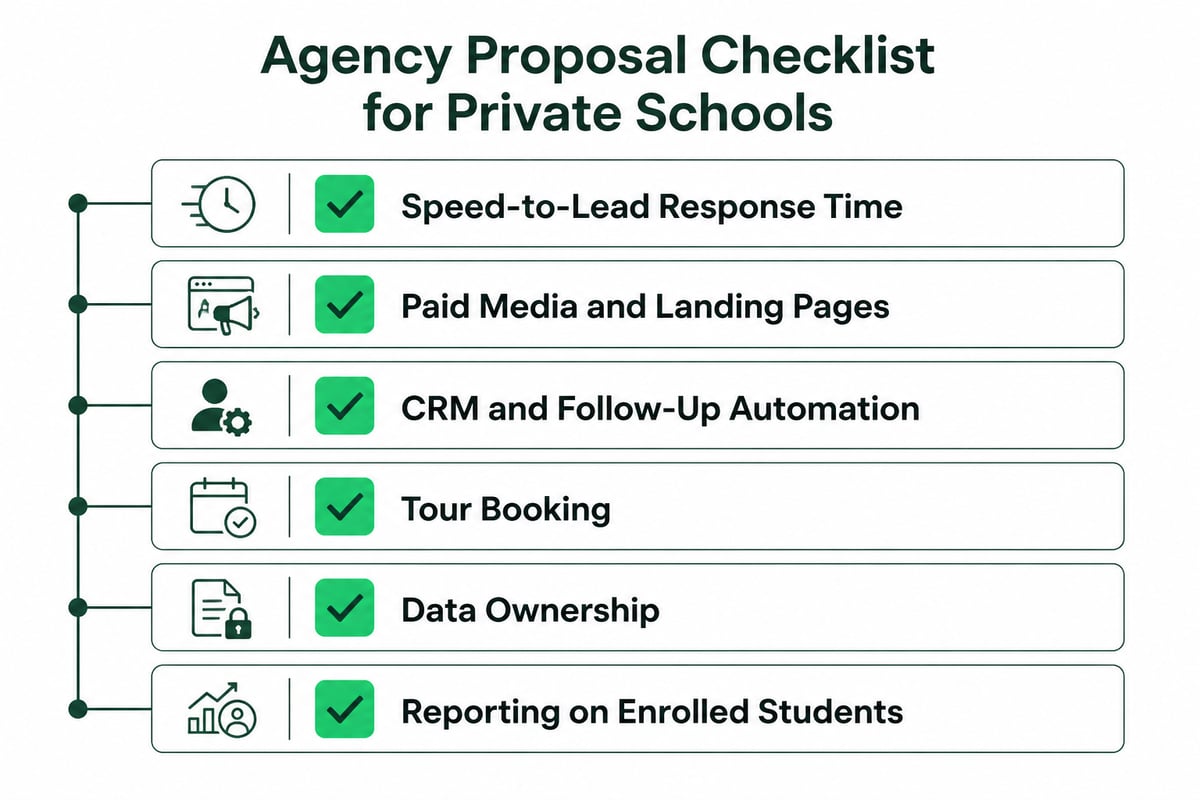
A credible full-service partner covers these functions at minimum:
- Demand generation: paid search, paid social and local search visibility aimed at families in your actual draw area
- Conversion assets: landing pages and inquiry forms built for a single action rather than general browsing
- Speed to response: immediate, personalized contact after every inquiry
- Nurture and visit booking: structured follow-up that moves a family from inquiry to campus tour to application
- CRM and reporting: one system that tracks each family from first click to enrollment
If an agency cannot show you how these pieces connect, you are buying a bundle, not a system. ScholarSurge's own overview of a full-service school marketing agency lays out the same standard from the enrollment side.
Define Your Enrollment Problem Before You Interview Anyone
Agency conversations go better when you arrive with a clear diagnosis of where seats are being lost. Marketing spend cannot fix a problem that sits in your admissions process, and a good agency will tell you so.
Pull a simple baseline from the last 12 months:
- Inquiry volume by month and by source
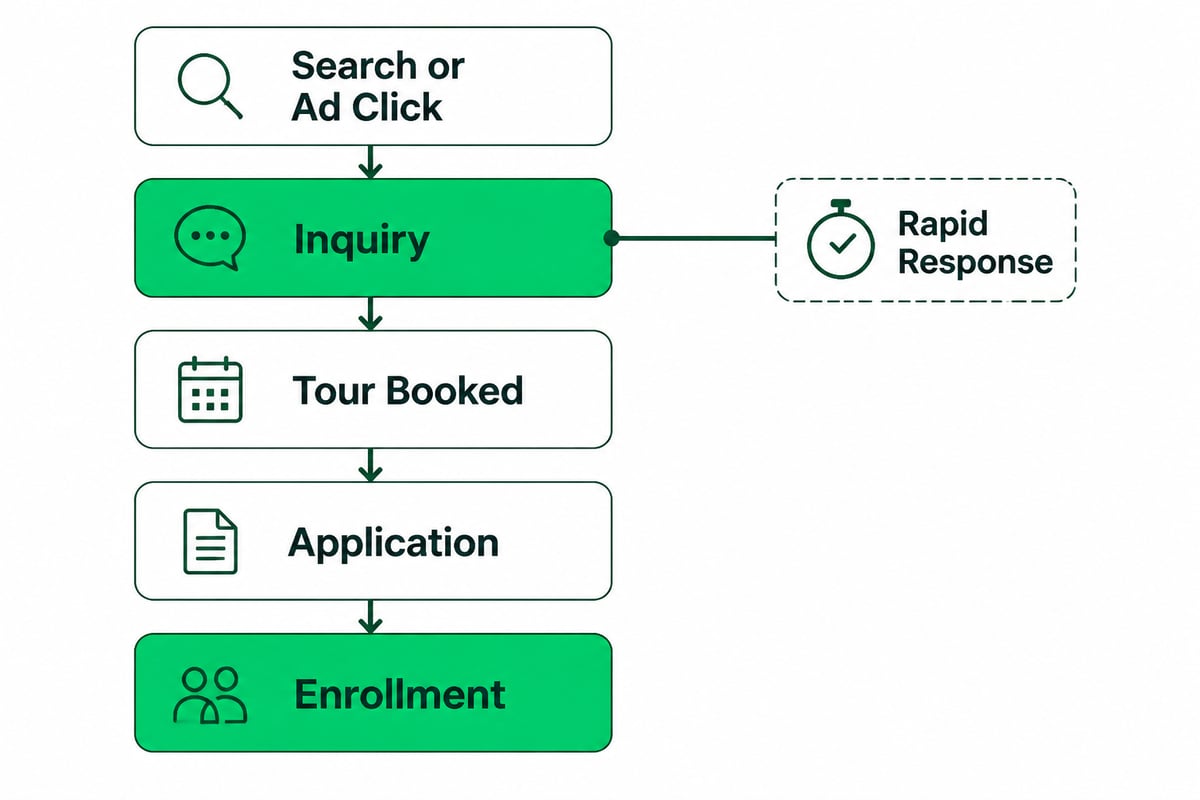
- Inquiry-to-tour rate, the share of inquiries that become scheduled visits
- Tour-to-application rate
- Application-to-enrollment rate
- Average time to first response on a new inquiry
The pattern matters more than any single number. A school with healthy tour conversion but too few inquiries needs demand generation. A school with plenty of inquiries and a weak inquiry-to-tour rate has a response and follow-up problem. Different problems call for different agencies, and you cannot evaluate a proposal without knowing which one you have.
Also decide your target. "More leads" is not a goal. "Fifty qualified inquiries per quarter and 20 additional enrolled students by next fall" is something an agency can be held to.
The Capabilities to Verify in Any Proposal
Every proposal should be tested against specific capabilities, with evidence rather than assurances. The following areas separate agencies that understand admissions from those that adapted a general marketing playbook.
Speed-to-lead and follow-up
Families who inquire at a private school are usually contacting several schools at once. The first school to respond with a real, personal reply often earns the visit. Ask any agency what happens in the first minute after an inquiry arrives, who responds, through which channels and what happens at 9 p.m. on a Sunday. Vague answers such as "we send an automated email" are a warning sign.
Some agencies publish a target response time for every inquiry. Whatever agency you evaluate, ask for its actual number and how it is measured.
Search and website fundamentals
Organic visibility still matters because families research schools by searching. Google's SEO Starter Guide explains that SEO helps search engines understand your content and helps users find your site through search. Ask the agency how it handles page structure, local listings, program pages and content that answers the questions families actually type.
Accessibility belongs in this conversation too. WCAG 2.2 became a W3C Recommendation on October 5, 2023 and extended WCAG 2.1 with additional success criteria. A school website that families with disabilities cannot use is both a reputational and a compliance risk, so confirm that any redesign or landing page work targets current standards.
Platform and ownership
Ask where your data lives. Your CRM, ad accounts, landing pages and family records should belong to your school. An agency that holds these in its own accounts can make leaving expensive.
Why Pricing Structure Reveals More Than the Price
How an agency charges tells you who carries the risk. In a traditional retainer, you pay the same monthly fee whether or not seats fill, and the agency's incentive is to keep the contract running. In a performance-based arrangement, the agency's income depends on outcomes.
| Pricing model | Who carries the risk | What to ask |
|---|---|---|
| Flat monthly retainer | The school | What deliverables are guaranteed, and what happens if targets are missed? |
| Retainer plus ad spend markup | The school | What percentage of ad budget is retained as margin? |
| Hourly or project billing | The school | Who is accountable for results across projects? |
| Performance-based | Shared | What counts as a qualified inquiry or enrollment, and who decides? |
Performance-based pricing is not automatically better, because the definitions carry the weight. A "qualified inquiry" should be defined in writing before work begins, with criteria such as grade level, location and contact verification.
Some agencies publish their terms openly. ScholarSurge uses performance-based pricing, so it is paid when students enroll, and it continues work at no charge until the agreed inquiry target is reached. For the specific contract terms that apply to your school, confirm them directly through its private school marketing agency page or a sales call rather than relying on a summary.
Questions That Expose a Weak Fit
The most useful part of an agency interview is how the team answers uncomfortable questions. Use this list in every conversation:
- Who will actually work on my account, and how many other schools do they serve?
- Which reports will I receive, and do they show enrolled students or only clicks and impressions?
- Can I speak to a current school client similar to mine in size, grade range and tuition level?
- What does the first 90 days look like, week by week?
- What happens to my accounts, data and creative assets if we part ways?
- How do you handle admissions staff who are slow to follow up on the leads you generate?
- What is your minimum contract term, and what are the exit conditions?
The sixth question matters most. Marketing that generates inquiries your team cannot answer quickly wastes budget. An agency that ignores the handoff to admissions is optimizing its own metrics, not your enrollment. For a closer look at this failure pattern, see ScholarSurge's analysis of why marketing agencies fail school enrollment.
Experience That Transfers and Experience That Doesn't
Education experience is a requirement, not a bonus. Admissions cycles, tuition decisions, family tours and the multi-stakeholder choice between parents and students do not follow retail or e-commerce patterns. A generalist agency can run a competent ad campaign, but it will not understand why a January inquiry behaves differently from an April one.
Ask for specifics on school work: grade levels served, boarding versus day, athletic programs and international recruitment. Your school type also changes the strategy. A day school drawing from a 15-mile radius needs a different approach than a boarding school marketing program recruiting across regions and countries.
Be cautious about broad claims of expertise. An agency that serves schools, hospitals, restaurants and software companies has experience in marketing but may have shallow knowledge of enrollment. If you want a field-specific partner, a private school marketing agency focused on education will typically show it in the questions it asks you.
Drawbacks to Weigh Honestly
Hiring an agency carries trade-offs, and a careful decision accounts for them. The main ones are cost, control and communication.
Cost goes beyond the fee. Add ad spend, creative production and the staff time your team will spend on onboarding, approvals and follow-up. Request a full cost projection for 12 months, not just the first quarter.
Control can feel reduced when an outside team speaks for your school. Set brand guidelines, approval rights and tone expectations in writing before launch. Parents notice when messaging feels generic.
Communication problems usually appear within the first 60 days. Agree on a reporting rhythm, a named contact and a response-time expectation for your own team's questions.
None of these drawbacks rule out an agency. They are reasons to negotiate terms carefully and to prefer a partner who is comfortable being measured. Weigh them against what you could achieve in-house, since recruiting, training and retaining a marketing and inquiry-response team is expensive for a school with limited staff.
Red Flags in the Sales Process
Some warning signs appear before any contract is signed:
- Guarantees of enrollment numbers with no stated criteria or timeline
- Case studies that report traffic and followers but no enrolled students
- Reluctance to share contract terms until late in the process
- A one-size-fits-all package offered before the agency has audited your funnel
- Long lock-in terms with penalties for early exit
- No plan for the speed and quality of response to new inquiries
A strong agency will want to audit your current funnel first. That audit should show where families drop out, how quickly your team responds and what your cost per enrolled student looks like today. Compare that with the agency's projected targets. Some agencies cite projected ROI figures, which is the kind of claim you should ask any agency to explain in terms of method and assumptions.
A Practical Way to Compare Your Shortlist
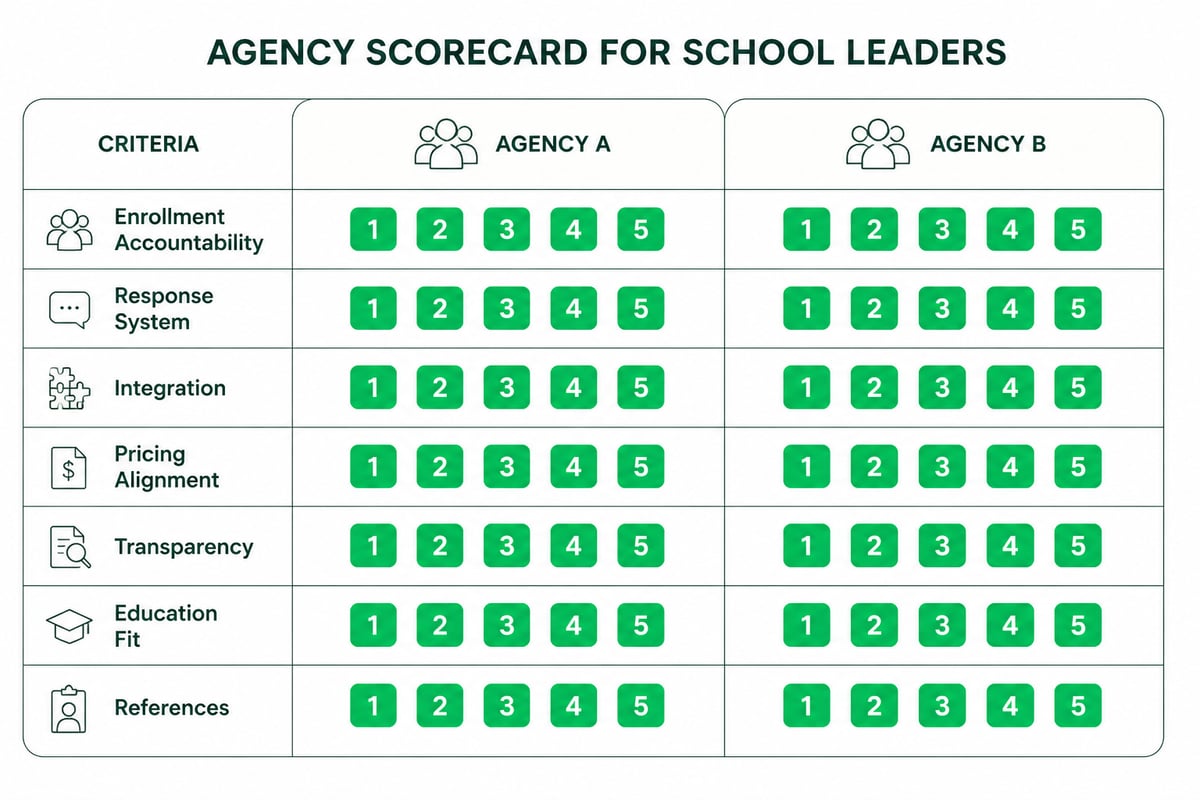
Narrow your list to three agencies, then score each against the same criteria. A simple 1-to-5 scale works well:
- Enrollment accountability: do they report on enrolled students?
- Response system: is speed-to-lead built in and measured?
- Integration: do ads, landing pages, CRM and follow-up run as one system?
- Pricing alignment: does their payment structure tie to your results?
- Transparency: do you own your data, accounts and assets?
- Education fit: do they understand your school type and calendar?
- References: can they connect you with comparable schools?
Total the scores, but also read the notes. An agency with a strong total and one serious weakness, such as no data ownership, may still be the wrong choice.
For schools that want the funnel handled as one system, The Surge System combines paid demand generation, rapid inquiry response, tour and visit booking and CRM automation under a single monthly retainer. It is one example of the integrated model described above, and you can review it alongside any other candidates on your shortlist.
Finally, run a short pilot or a defined first-quarter target before committing to long terms. A 90-day window with clear metrics gives both sides an honest read on fit. Additional comparisons are available in ScholarSurge's guides to the best marketing agencies for private schools and performance marketing for schools.
Before your next agency call, export your last 12 months of inquiries and calculate your inquiry-to-tour and tour-to-enrollment rates, because every proposal should be measured against those numbers. If you want an outside read on where families are dropping out of your funnel, Book Your Free Enrollment Audit with ScholarSurge, which provides enrollment growth systems for schools, colleges, universities and sports academies and works as your virtual enrollment team. You can also look at how The Surge System packages advertising, rapid response and CRM automation before you decide what to ask of any agency.