
Insights
Full-Service Education Marketing Agency: What to Expect
See what a full-service education marketing agency delivers, what it costs, which KPIs matter and how to vet a partner before you sign a contract.
READING TIME · 8 MIN · UPDATED QUARTERLY

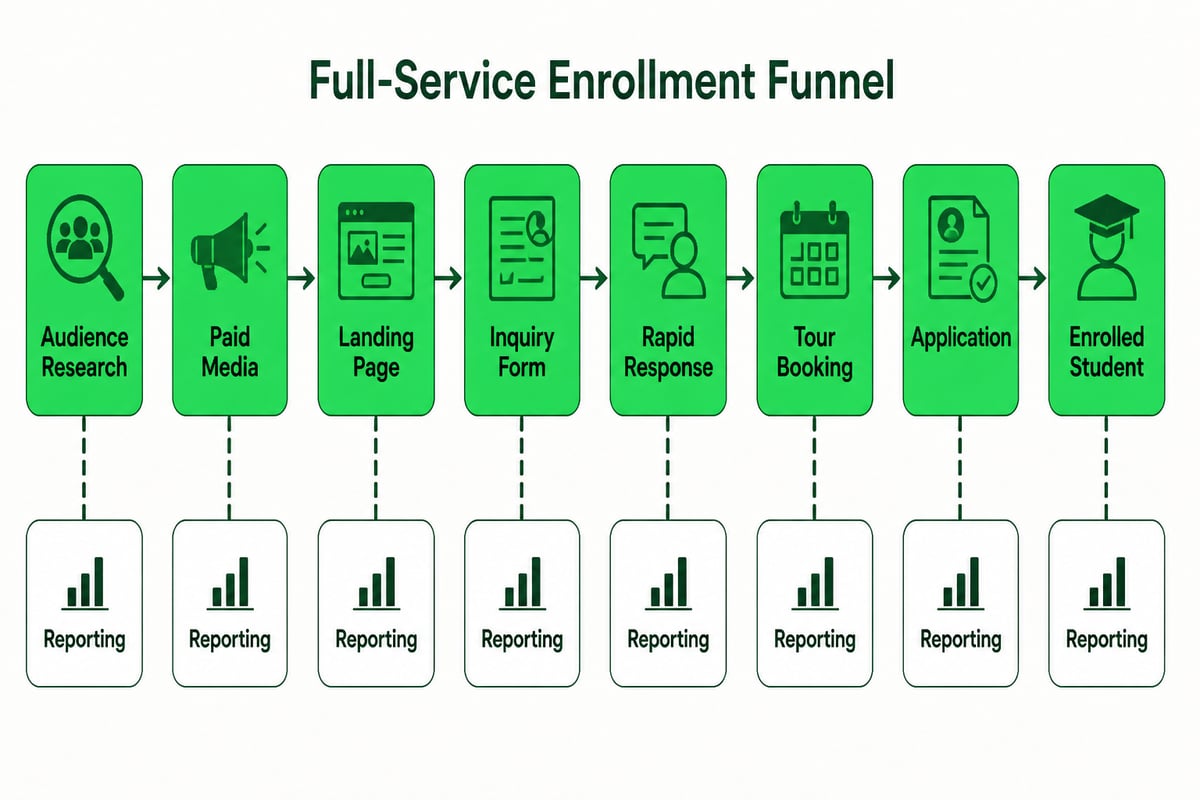
A full-service education marketing agency plans, runs and measures the entire path from first ad impression to enrolled student, covering strategy, creative, paid media, websites, inquiry follow-up and reporting under one contract. For heads of school and admissions directors, the practical question is whether that single partner actually fills seats or simply produces activity reports. This guide explains what the engagement should include, what it should cost, how to judge results and which contract terms deserve scrutiny.
What a Full-Service Education Marketing Agency Actually Does
A full-service agency owns every stage of the enrollment funnel rather than a single channel. The scope typically spans five areas:
- Strategy and positioning: audience research, competitive analysis, messaging for parents, students and athletes, and a defined enrollment target.
- Demand generation: paid search, paid social, video, email and content that attract qualified families or applicants.
- Conversion assets: landing pages, inquiry forms, virtual tours and application flows built to convert traffic into leads.
- Lead response and nurture: immediate follow-up, scheduled outreach, tour or visit booking and reminders.
- Measurement: attribution from channel to inquiry to application to enrolled student, reported against revenue.
The phrase "full-service" carries risk when the agency treats these as separate departments. An ad team that never sees admissions data cannot tell which campaigns produce families who enroll. The strongest engagements connect the pieces so one team is accountable for the outcome, not for a single deliverable.
If your institution is a private or independent school, a dedicated private school marketing agency approach accounts for tuition-sensitive audiences and longer decision cycles.
Services You Should Expect to See in the Scope of Work
A credible scope of work names specific services, volumes and owners. Vague language such as "digital presence management" makes it impossible to hold anyone to a result.
Channel and creative work
Social media remains a baseline expectation. In a 2025 survey, most responding schools said they used Instagram and YouTube, according to Marketing Advisers for Schools. Presence alone does not differentiate you, so ask how the agency turns that activity into inquiries. Strong creative is built around the questions families ask: safety, outcomes, culture, cost and daily experience. Our guide to social media marketing for schools covers the channel in more depth.
Web and conversion work
Landing pages built for a single campaign usually outperform sending paid traffic to a general homepage. Expect dedicated pages for each program, grade band or sport, with short forms, clear tour or visit calls to action and tracking on every submission.
Lead handling and CRM
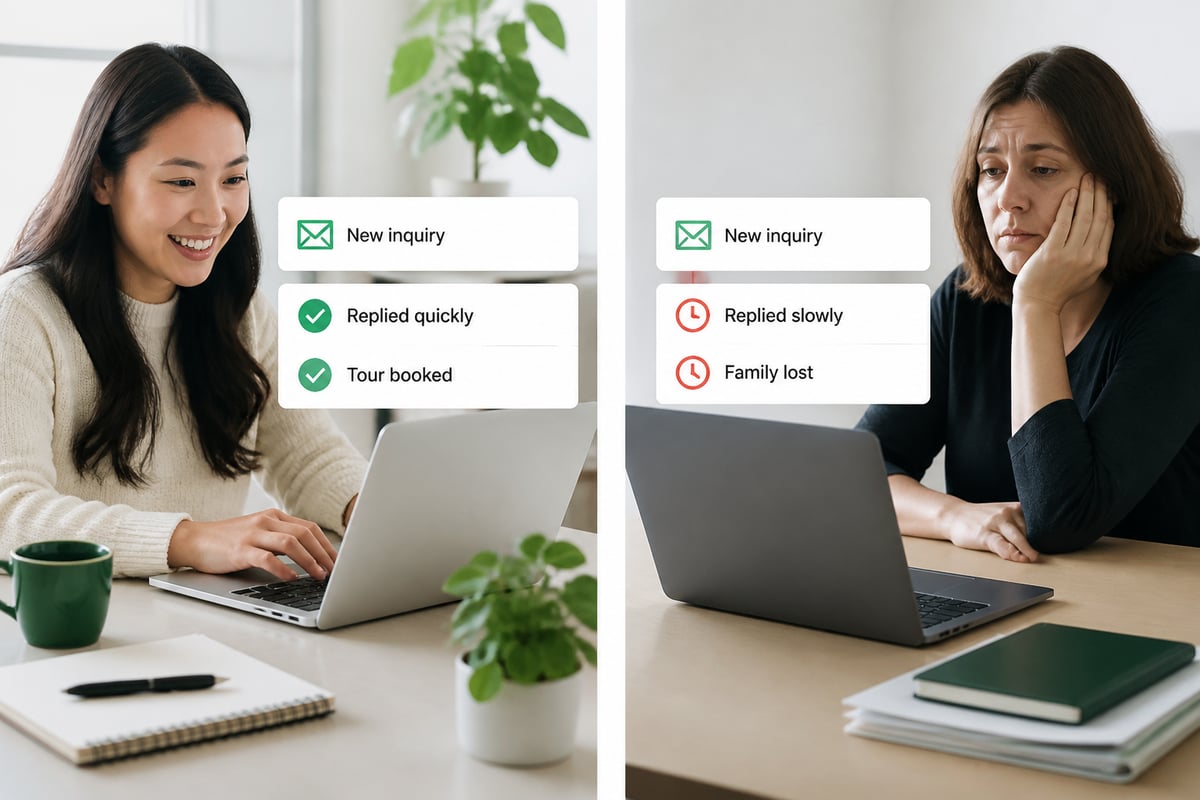
This is the most commonly under-scoped item. Ask who responds to each inquiry, how quickly, through which channels and what the sequence looks like over the following 30 days. A school enrollment marketing agency that includes follow-up in the retainer removes the gap between a lead arriving and a human reaching out.
How Education Specialists Differ From General Agencies
A specialist agency understands enrollment calendars, decision-makers and compliance obligations that a generalist has to learn on your budget. Family decisions in education involve several stakeholders, long consideration windows and emotionally weighted choices. A generalist applying e-commerce tactics tends to optimize for cheap clicks rather than for families who tour and enroll.
Look for these markers of real specialization:
- Case examples tied to enrollment or application counts, not impressions.
- Familiarity with seasonal cycles, such as fall tour season for K-12 or spring yield campaigns for colleges.
- Working knowledge of privacy rules that touch student and family data, including FERPA for institutions and COPPA for audiences under 13.
- Experience with your segment, whether independent schools, small colleges or athletic programs.
Segment experience matters because the buyer differs. A sports academy marketing agency speaks to athletes, parents and coaches in a way a higher-education recruiter would not, and a boarding school faces geographic and international considerations that day schools do not.
What a Full-Service Education Marketing Agency Costs
Pricing varies widely, and the structure of the fee matters more than the headline number. Agencies generally price in one of three ways.
| Model | How it works | Main risk to you |
|---|---|---|
| Monthly retainer | Fixed fee for defined services | Paying regardless of enrollment results |
| Ad spend percentage | Fee scales with media budget | Incentive to raise spend, not efficiency |
| Performance-based | Fee tied to inquiries or enrollments | Terms must define a "qualified" result clearly |
Separate the agency fee from media spend in every proposal. Ask for a written breakdown of management fees, creative production, software costs and any one-time setup charges. A common mistake is comparing a quote that bundles media against one that excludes it.
Performance-based structures reduce your exposure but require precise definitions. Settle in writing what counts as a qualified inquiry, who verifies it and what happens if the target is missed.
KPIs That Show the Agency Is Working
The metrics that matter follow the funnel and end in revenue. Reporting that stops at clicks, impressions or follower growth tells you little about whether seats are filling.
- Cost per qualified inquiry: the price of a lead who fits your program and can afford tuition.
- Speed to first response: how fast a family hears from a person after submitting a form.
- Inquiry-to-tour or inquiry-to-visit rate: the share of leads who take a first in-person step.
- Application and enrollment rate: the share who complete the journey.
- Cost per enrolled student: total spend divided by students who actually start.
- Return on spend: tuition revenue relative to agency fees and media cost.
Insist on seeing the full chain in one dashboard. For context on measuring outcomes, our overview of a ROI-focused education marketing agency explains how revenue-linked reporting changes the conversation.

The Speed-to-Lead Factor Most Agency Scopes Underweight
Response time after an inquiry is one of the largest controllable drivers of enrollment, yet it often sits outside an agency's remit. A family that submits a form at 8 p.m. and hears nothing until the next afternoon has probably contacted two other schools in the meantime. Advertising can generate the inquiry, but only a fast, personal reply converts it into a conversation.
When you evaluate a partner, ask these questions directly:
- Who responds to new inquiries, and during what hours?
- What is the average response time, and how is it measured?
- How many follow-up touches occur over the first month, and through which channels?
- Who books the tour or campus visit?
ScholarSurge builds its model around this gap, with rapid response to inquiries and advertising, landing pages, follow-up and CRM run as one accountable system. Its Surge System combines paid demand generation, rapid inquiry response, tour and visit booking and CRM automation under one monthly retainer, which suits teams without the staff to answer leads around the clock.
Contract Terms and Red Flags to Check Before Signing
The contract should protect your data, your accounts and your ability to leave. Review these terms line by line before you commit.
Terms worth negotiating
- Account ownership: ad accounts, analytics properties and CRM data should belong to your institution, not the agency.
- Contract length: shorter initial terms with performance review points reduce lock-in.
- Reporting rights: you should have direct, read-only access to platforms and raw data.
- Exit terms: the agency should hand over assets, creative and data cleanly if you leave.
Warning signs
- Guarantees of enrollment numbers with no definition of how they are calculated.
- Reports built around vanity metrics with no link to applications.
- Reluctance to share case studies or references from comparable institutions.
- Long auto-renewing terms with steep cancellation penalties.
- No named person responsible for lead follow-up.
Our analysis of why marketing agencies fail school enrollment details the structural reasons these engagements stall, most often a disconnect between marketing and admissions.
How Long Results Take and What a Realistic Timeline Looks Like
Early indicators such as inquiry volume and response speed can appear within weeks, while enrollment results follow the admissions calendar. Paid campaigns can begin generating inquiries in the first month once landing pages and tracking are live. Tours, applications and deposits trail those inquiries by weeks or months, depending on whether you enroll rolling or by cycle.
A sensible 90-day plan covers three phases: setup and tracking in the first few weeks, campaign launch and optimization through the middle period, and a review of inquiry quality and cost trends at the end. Judge the first quarter on lead volume, lead quality and response speed, then judge the following cycle on enrollment.
ScholarSurge guarantees 50+ qualified inquiries in the first 90 days and continues work at no charge until the 50-inquiry target is reached, with pricing tied to students who enroll. Its internal audits project a 12-month return based on recovery plan implementation. For terms specific to your institution, confirm details through the booking page.
When an Agency Beats Building In-House
An agency makes sense when you need breadth of skills faster than you can hire them. A single in-house marketer rarely covers paid media, creative, web development, analytics and lead response at professional depth. Assembling that team in-house means several salaries, software licenses and management time, often beyond what a school or small college can sustain.
Keeping work in-house suits institutions with large marketing budgets, stable staff and strong internal data capability. Many schools land in between: they retain brand and community storytelling internally and hire an agency for paid media, conversion and lead handling. Whichever route you take, one person on your side should own the relationship and review the funnel data every month.
For institutions weighing their options by segment, resources such as our guide to the best school marketing agencies and the page on education lead generation can help frame the decision.
Questions to Ask on Your First Sales Call
Prepare a short list so you compare agencies on the same terms. These questions separate operators from presenters:
- What enrollment or inquiry results have you produced for institutions similar to ours?
- Who owns the ad accounts, landing pages and lead data?
- Who answers inquiries, how fast and during what hours?
- How do you define a qualified inquiry, and how is it verified?
- What does reporting show, and can we access raw data directly?
- What happens if targets are not met?
- How do you handle FERPA, COPPA and other privacy obligations for family data?
Take notes on specificity. A strong partner answers with numbers, named processes and examples. A weak one answers with philosophy.
Your next step is to pull your last 12 months of inquiry data and calculate how many leads received a personal reply within five minutes, since that figure shows how much enrollment your current process is leaving behind. If the gap is large, ScholarSurge can run the system that closes it, with the Surge System handling ads, rapid response, tour booking and CRM as one accountable engine for schools, colleges and sports academies. To see where your funnel is losing families and what a performance-based plan would look like, Book Your Free Enrollment Audit with ScholarSurge.