
Insights
How to Choose a Full-Service School Marketing Agency
Learn how to evaluate a full-service school marketing agency, from services and pricing models to response speed and proof of enrollment results.
READING TIME · 10 MIN · UPDATED QUARTERLY

A full-service school marketing agency should manage the entire path from first impression to enrolled student: advertising, website and landing pages, inquiry follow-up, tour booking and reporting, all under one accountable team. The right choice for your school depends on how well the agency understands admissions, how quickly it responds to families, and whether its pricing ties to enrollment outcomes rather than activity.
This guide gives heads of school, admissions directors and enrollment leaders a practical framework for evaluating agencies, the questions to ask, the red flags to watch for and the metrics that separate real results from impressive-looking reports.
What Does a Full-Service School Marketing Agency Actually Do?
A full-service school marketing agency handles every marketing function that influences enrollment, so you do not have to coordinate separate vendors for strategy, creative, media, web, communications and analytics. For schools, that scope usually includes the following:
- Brand and messaging: positioning that explains why families should choose your school over the alternatives in your market.
- Paid and organic demand generation: search ads, social campaigns, local SEO and content that reach prospective families.
- Website and landing pages: pages built to convert visitors into inquiries, not simply to look polished.
- Inquiry management: response workflows, follow-up sequences and CRM setup.
- Admissions support: tour and open house promotion, application reminders and re-engagement of stalled leads.
- Reporting: cost per inquiry, inquiry-to-tour rate, tour-to-application rate and enrollment yield.
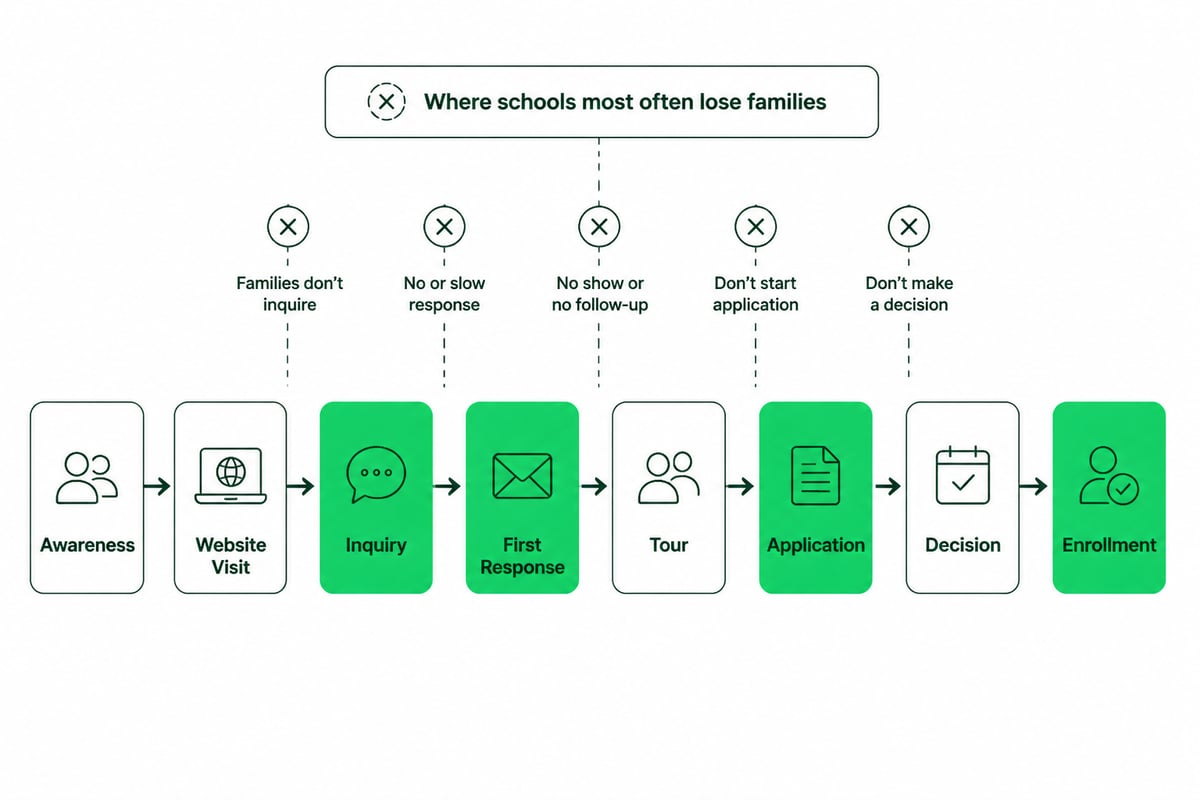
The term "full-service" is used loosely. Some agencies offer design, social media and a website build and call it full service, while leaving every step after the form submission to your admissions office. For a school, that gap is where most enrollment is won or lost. For a broader look at how these providers differ, see this overview of school marketing agencies.
Why Schools Need a Different Kind of Agency
Schools need an agency that understands admissions cycles, long decision timelines and multiple decision-makers, which a generalist firm rarely does. A family choosing a school is not making an impulse purchase. They compare options for months, tour campuses, consult spouses and grandparents, and weigh tuition against outcomes.
Three features of school marketing shape what you should expect from a partner:
- Seasonality. Enrollment demand peaks in defined windows, and a campaign that launches late can miss the cycle entirely.
- Small, high-value conversions. A single enrolled student can represent tens of thousands of dollars in tuition over several years, so the quality and speed of each inquiry follow-up matter more than raw lead volume.
- Trust-based decisions. Parents respond to clear, consistent, responsive communication. A January 2024 national survey of more than 1,050 K-12 families found that 77% considered school-home communication important to student success, and the same survey found that 53% said school information was not always easy to access and understand.
That last point applies to prospective families as much as current ones. If your inquiry process is slow or confusing, families form an opinion of your school before they ever visit.
How to Evaluate a Full-Service School Marketing Agency
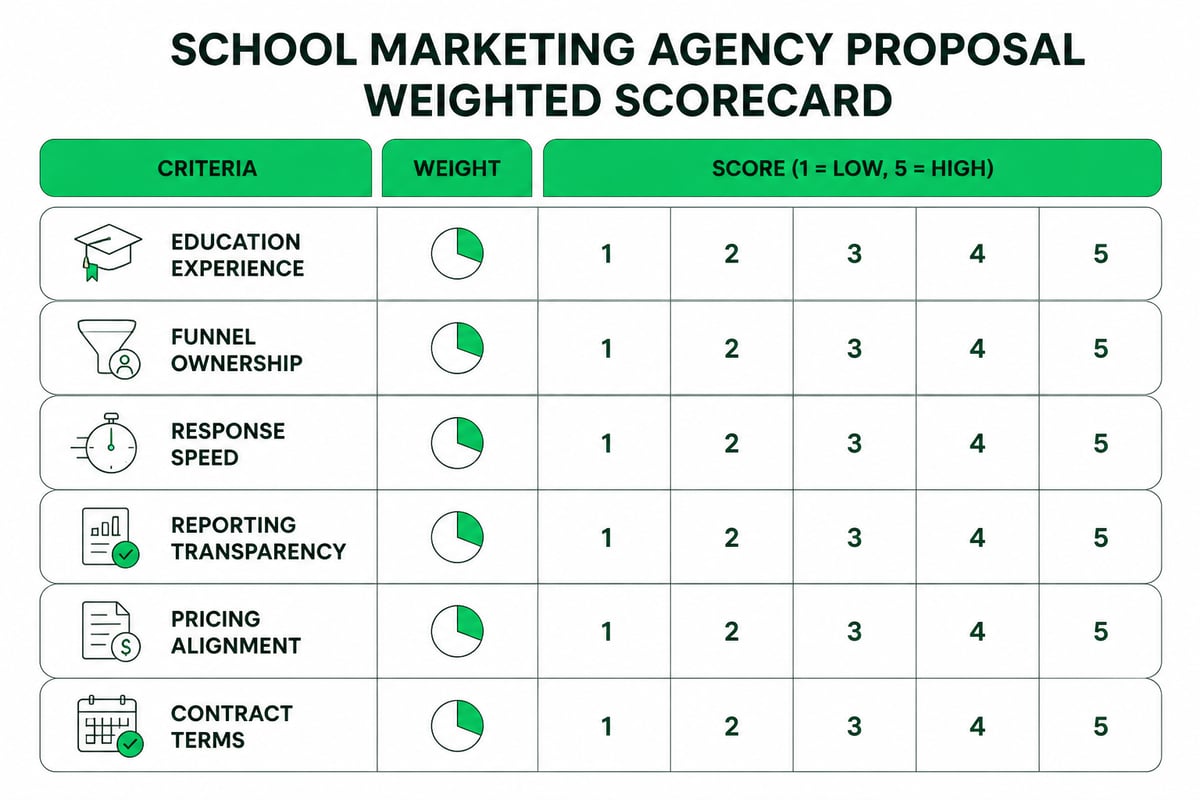
Evaluate an agency on four things: education-specific experience, ownership of the full funnel, transparency of reporting and alignment of pricing with results. Use the criteria below as a scoring sheet when comparing proposals.
Education and Admissions Experience
Ask for work with schools similar to yours in type, size and market. A K-12 independent school, a boarding school, a college and a sports academy each have different buyers and sales cycles. Request specific examples of inquiry volume, tour conversion and enrollment outcomes, not just awards or traffic charts.
If you are narrowing the field by school type, these resources cover private school marketing and sports academy marketing in more detail.
Ownership of the Entire Funnel
Many agencies stop at generating clicks and form fills. Ask who is responsible for each stage after the inquiry arrives:
- Who responds, and how fast?
- Who follows up with families who do not book a tour?
- Who tracks which campaigns produce enrolled students rather than only inquiries?
A true full-service partner connects advertising, landing pages, follow-up and CRM as one system with one accountable owner. Fragmented setups produce finger-pointing when results stall.
Reporting You Can Verify
Insist on reporting tied to your admissions pipeline. Impressions, clicks and followers are activity metrics. The numbers that matter are cost per qualified inquiry, inquiry-to-tour rate, application rate and cost per enrolled student. You should have access to the data, not only a monthly summary slide.
Pricing Aligned With Outcomes
Retainers, project fees and percentage-of-spend models all exist, and each carries different risk. The most important question is simple: what happens if the campaign underperforms? Agencies confident in their process are often willing to share that risk.
Questions to Ask Before You Sign
Ask pointed questions that expose how an agency actually works, because polished proposals tend to look alike. The following list works well in a first call:
- How quickly will every inquiry receive a response, and who handles it, a person or an automated sequence?
- What does your follow-up process look like for a family that inquires but does not book a tour?
- Which CRM or admissions platform will you work in, and who owns the data if we leave?
- How do you attribute enrollment to specific channels?
- Can you share results from a school with a similar tuition range and a similar geography?
- What is the contract length, and what are the exit terms?
- What is your plan if inquiry targets are not met?
- How will you align messaging with what our admissions team says on tours?
Pay attention to specificity. Vague answers such as "we optimize continuously" signal a lack of process. Concrete answers with numbers, timelines and named responsibilities signal operational maturity.
Why Speed to Lead Deserves Its Own Line in the Contract
Speed to lead, meaning how fast a family hears back after inquiring, is one of the most controllable factors in enrollment and one of the least discussed in agency proposals. Families typically contact several schools at once. The school that responds first, with a helpful and personal message, often shapes the rest of the conversation.
Communication expectations are also clear in the data. In the 2024 K-12 family survey, 72% of families preferred email and 70% preferred text messages for school communications. A strong agency builds follow-up around those channels rather than relying on a phone call that goes to voicemail.
Language access matters too. A September 2024 SchoolStatus survey of K-12 educators found that 32% reported language barriers as a challenge to school-family communication. If your market includes multilingual families, ask how the agency handles translated outreach and landing pages. Additional perspective on this topic appears in eSchool News' coverage of family communication.
When reviewing a proposal, look for a stated response-time standard and a described process for meeting it. If the agency cannot commit to one, your admissions team will absorb the delay.
Red Flags in Agency Proposals
Some warning signs appear repeatedly in weak proposals, and spotting them early saves a full enrollment cycle. Watch for the following:
- Guarantees on vanity metrics. Promises of traffic or followers say nothing about enrollment.
- No mention of follow-up. If the proposal ends at lead generation, you will manage the hardest part yourself.
- Long lock-in contracts with no performance terms. A twelve-month commitment without accountability places all risk on the school.
- Generic case studies. Examples from retail or software do not demonstrate admissions expertise.
- Opaque ad accounts. You should own your ad accounts, analytics and data.
- Disconnected tools. If advertising, web and CRM are managed by different parties with no shared reporting, attribution will be unreliable.
A related concern is data readiness. In the SchoolStatus report, 86% of educators felt data gaps limited their ability to support academic success and attendance. Admissions teams face a similar problem when inquiry data is scattered across forms, inboxes and spreadsheets. An agency should consolidate it, not add another silo.
Comparing Agency Models Side by Side
Agencies generally fall into three models, and each suits a different school situation. This table compares them on the attributes that matter most for enrollment.
| Attribute | Generalist marketing agency | Specialist education agency | Performance-based enrollment partner |
|---|---|---|---|
| Admissions knowledge | Limited | Strong | Strong |
| Funnel coverage | Usually stops at lead capture | Often includes web and campaigns | Covers advertising through follow-up |
| Pricing model | Retainer or project fee | Retainer, sometimes tiered | Tied to enrollment or inquiry targets |
| Risk to the school | High | Moderate | Lower |
| Typical fit | Brand refreshes, one-off projects | Ongoing marketing support | Schools that need seats filled |
Generalist firms can do excellent creative work, but a school with an enrollment target usually needs a partner built around admissions outcomes. Comparison pieces on the best school marketing agencies can help you build a shortlist, and ScholarSurge's guidance on performance marketing for schools explains how outcome-based models work.

What a Performance-Based Full-Service Model Looks Like
A performance-based model ties the agency's compensation and commitments to enrollment results, which changes the incentives on both sides. The Surge System from ScholarSurge is one example: a done-for-you enrollment engine combining paid demand generation, rapid inquiry response, tour and visit booking and CRM automation under a single monthly retainer, with advertising, landing pages, follow-up and CRM operating as one accountable system.
ScholarSurge states several commitments that illustrate what to look for in any agency of this type:
- Responses to every inquiry, with an average response time under 60 seconds across all clients.
- A guarantee of 50+ qualified inquiries in the first 90 days.
- Pricing based on results, so the school pays when students enroll.
- A projected 12-month ROI of 3.2x, based on recovery plan implementation in internal audits.
Whether you work with ScholarSurge or another provider, use these as benchmarks. Does the agency commit to a response time? Does it put a numerical target in writing? Does it describe what happens if the target is missed? Specifics like these are easy to verify and hard to fake.
How to Run the Selection Process
A structured selection process takes three to four weeks and prevents rushed decisions. Follow these steps:
- Audit your current funnel. Document inquiry volume, response times, tour rates and application rates. Without a baseline, you cannot judge any agency's claims.
- Define success in enrollment terms. Set a target for qualified inquiries, tours and enrolled students for the next cycle.
- Shortlist three to five agencies. Prioritize those with education experience in your school type.
- Request written proposals. Require each to describe response process, reporting and contract terms.
- Interview the team who will do the work. Meet account managers, not only the sales lead.
- Check references. Speak with admissions directors at comparable schools, and ask what changed in their numbers.
- Negotiate terms. Clarify data ownership, exit conditions and performance commitments before signing.
Include your admissions team throughout. They know the realities of tours and follow-up, and their buy-in determines whether the agency's leads actually convert. For a deeper look at the follow-up side, ScholarSurge's piece on school admissions marketing covers how marketing and admissions work together.
What Results to Expect and When
Realistic expectations help you judge an agency fairly. Paid campaigns can produce inquiries within weeks, while organic search and content take longer to compound. Enrollment itself follows your admissions calendar, so early metrics such as cost per qualified inquiry, response time and tour booking rate are the leading indicators to track.
Review results monthly against your baseline. If inquiry quality is low, the problem may be targeting or messaging. If inquiries are healthy but tours are not booking, the issue likely sits in follow-up speed or tone. A good agency diagnoses these patterns openly and adjusts, rather than defending the original plan.
FAQ
What is the 3-3-3 rule for marketing?
The 3-3-3 rule is a simple messaging guideline: give a prospect three seconds to grasp who you are, three key points that explain your value and three steps for what to do next. For a school, that might mean a clear homepage statement, three distinguishing strengths and an obvious path to inquire or book a tour.
What is the difference between a full-service agency and a specialist agency?
A full-service agency covers many marketing functions under one roof, while a specialist focuses on one channel such as SEO or paid social. For schools, the strongest option is often a full-service agency with deep education experience, so that strategy, advertising and follow-up work together toward enrollment.
How much does a full-service school marketing agency cost?
Costs vary widely by scope, market size and pricing model, so request written proposals and compare them against your enrollment targets. Because pricing structures differ, ask each agency what you pay if targets are not met, and consider models in which fees are tied to enrolled students.
Start by documenting your current inquiry response time, tour conversion rate and cost per enrolled student, since every agency conversation gets sharper once you have those numbers. If you want an outside view of where your funnel loses families, ScholarSurge's Surge System is built to close those gaps with rapid response, booking and CRM automation working together. You can Book Your Free Enrollment Audit to see where your school stands and what a performance-based partnership could look like.