
Insights
Performance Marketing for Education: A Practical Guide
Learn how performance marketing for education ties ad spend to enrollments, which channels and metrics matter, and how to set up compliant tracking.
READING TIME · 11 MIN · UPDATED QUARTERLY

Performance marketing for education is a model in which you pay for measurable outcomes, such as inquiries, tour bookings, applications and enrollments, rather than for impressions or reach. For admissions directors and heads of school, it replaces guesswork about which marketing dollars filled seats with a clear line from ad spend to tuition revenue.
The approach is straightforward in principle and demanding in practice. It requires clean tracking, fast follow-up and a willingness to cut what does not produce students. This guide covers what performance marketing means for schools, colleges and sports academies, which channels fit, which metrics to trust, and how to build the response and measurement systems that make the spend pay off.
What Performance Marketing Means for Schools and Academies
In an education setting, performance marketing is paid and owned promotion where every dollar is judged against a defined enrollment outcome. The unit of success is not a click or a social impression. It is a qualified family or student moving to the next step: submitting an inquiry, booking a campus visit, completing an application, or paying a deposit.
This differs from traditional brand advertising in three ways:
- Payment follows results. Spend is tied to actions such as leads or enrollments, not to exposure.
- Measurement is built in. Each campaign has a tracked conversion event, so you can compare channels on cost per outcome.
- Optimization is continuous. Budgets shift weekly toward the audiences, keywords and messages that produce students.
Brand awareness still matters, particularly for independent schools whose reputation drives word-of-mouth referrals. Performance marketing does not replace it. It adds accountability to the portion of your budget meant to generate demand you can count. For a deeper look at how this applies to K-12 specifically, see this overview of performance marketing for schools.
Why Enrollment Leaders Are Moving Toward It
Enrollment leaders are adopting performance marketing because it gives them predictable cost per enrollment, faster feedback on what works, and a defensible case for budget requests. Boards and trustees increasingly ask what a marketing dollar returns. A pay-for-outcome model answers that question with data rather than anecdotes.
The advantages are practical:
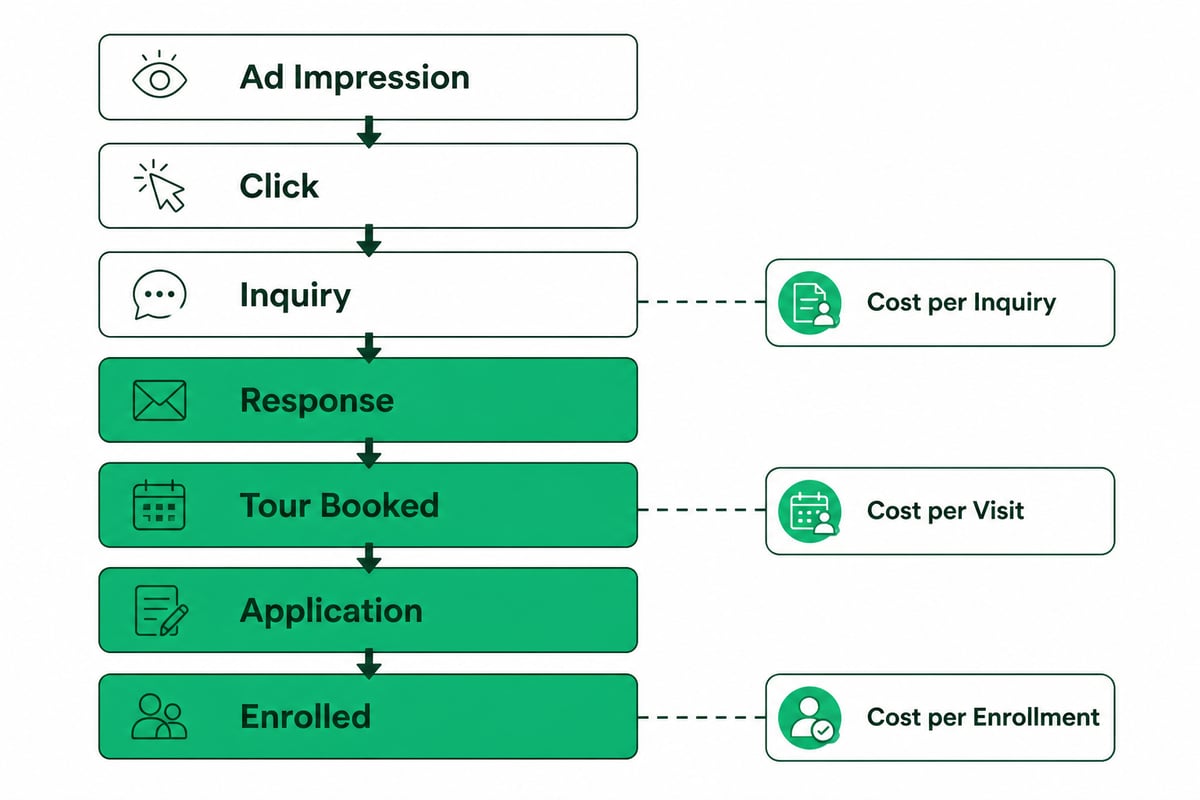
- Clear return on investment. When each inquiry is tagged to a source, you can calculate cost per inquiry, cost per visit and cost per enrolled student for every channel.
- Efficient budgeting. Money moves away from underperforming placements without waiting for the next annual planning cycle.
- Faster learning. A new message, landing page or audience can be tested in weeks. Open house season does not have to be the only time you learn.
- Alignment with revenue. Because tuition per student is known, you can set a maximum acceptable acquisition cost and manage to it.
The last point deserves emphasis. A school with an average annual tuition of $20,000 and a multi-year enrollment horizon can afford a very different acquisition cost than a short-course provider. Performance marketing forces that math into the open.
Channels That Work for Enrollment
The channels that perform best in education are those that capture existing intent or reach well-defined local audiences, and the right mix depends on whether you recruit families, adult learners or athletes. No single channel carries a whole enrollment plan.
Search advertising
Search captures families already looking for "private school near me" or "college of nursing programs." Intent is high, so conversion rates tend to be strong, though competition for the most valuable terms raises costs. Google Ads for schools works best when campaigns are segmented by program, grade level or location, and when each ad group points to a dedicated page rather than a general homepage.
Paid social
Platforms such as Facebook and Instagram reach parents by geography, interest and life stage before they begin an active search. They suit awareness-to-inquiry journeys and visit promotion. A focused approach to Facebook ads for schools typically pairs short video from real classrooms with a clear offer, such as a campus tour or an open house registration.
Video and connected TV
Video placements can build familiarity with a school before a family enters the market. Use them to feed retargeting audiences, and judge them on downstream inquiries rather than views.
Affiliate and partner referrals
Education marketplaces, school directories and feeder organizations can be paid per qualified lead or per enrollment. These arrangements fit the performance model naturally, but lead quality varies widely, so define "qualified" in writing before you start.
Email and automation
Owned channels convert the demand that paid channels create. Automated nurture sequences keep a family engaged between the first inquiry and the tour. Sports academies and colleges with longer decision cycles gain the most from this layer.
Where Most Enrollment Spend Is Lost: Speed and Follow-Up
The largest leak in many enrollment funnels is not the ad. It is the gap between a family submitting an inquiry and a person responding. A parent who fills out forms for three schools on a Sunday evening often engages with whichever school replies first.
Performance marketing programs that stop at lead delivery leave this gap unmanaged. A lead that waits a day for a reply has already cooled. Practical safeguards include:
- Automated acknowledgment within seconds of submission, with a clear next step.
- A defined response window for staff, including evenings and weekends when families browse.
- A follow-up cadence across phone, text and email, with rules for when to stop.
- Tour and visit booking links inside every message so that interest converts without extra steps.
ScholarSurge builds speed-to-lead into its model and reports an average inquiry response time under 60 seconds across all clients. Whatever tools you use, treat response time as a performance metric on par with cost per lead, because it determines how much of your paid traffic survives to a conversation.
Metrics That Matter Across the Funnel
The most useful performance marketing metrics in education are the ones tied to enrollment outcomes: cost per qualified inquiry, inquiry-to-visit rate, visit-to-application rate, application-to-enrollment rate and cost per enrolled student. Click-through rate and impressions are diagnostic signals, not goals.
Organize measurement by funnel stage:
| Funnel stage | Primary metrics | What it tells you |
|---|---|---|
| Traffic | Cost per click, click-through rate, landing page conversion | Whether ads and pages attract the right audience |
| Inquiry | Cost per inquiry, qualified inquiry rate, response time | Whether demand turns into real conversations |
| Visit and application | Inquiry-to-visit rate, visit-to-application rate | Whether follow-up and campus experience move families forward |
| Enrollment | Cost per enrollment, return on ad spend, tuition revenue per channel | Whether spend produces revenue worth its cost |
Two cautions apply. First, report on cohorts rather than calendar months, because a family that inquires in October may not enroll until spring. Second, compare channels on cost per enrollment once you have enough data, since a channel with expensive leads can still win if those leads convert at higher rates.
Setting Up Tracking and Consent Correctly
Reliable performance marketing depends on conversion tracking that respects user privacy choices. If your tags cannot see which inquiries came from which campaign, optimization stalls, and if your consent setup is wrong, measurement can degrade or create legal exposure.
Several points from Google's documentation are worth knowing. Consent Mode communicates users' cookie or app-identifier consent choices to Google, but it does not provide a consent banner or widget, so you still need a separate consent management tool. Google's reference identifies four consent types: ad_storage, ad_user_data, ad_personalization and analytics_storage. Each controls a different category of data use.
Responsibility sits with the advertiser. Google states that advertisers must obtain consent and communicate consent choices, and that for applicable users in the European Economic Area, consent signals are required to retain certain measurement, personalization and remarketing capabilities. North American schools recruiting international students may fall under those rules, so check with counsel.
For the technical build, Google Analytics' guide for marketers covers setting up events and conversions, tagging URLs for attribution, linking Google Ads and evaluating channel touchpoints. A minimal checklist for an admissions team:
- Define each conversion event: inquiry form, tour booking, application start, application submit.
- Tag every campaign URL consistently so sources appear correctly in reports.
- Link your ad platforms to your analytics property.
- Pass inquiry source data into your CRM so enrollments can be traced back to campaigns.
- Audit the setup each term, since site changes often break tags silently.

Landing Pages and Offers That Convert Families
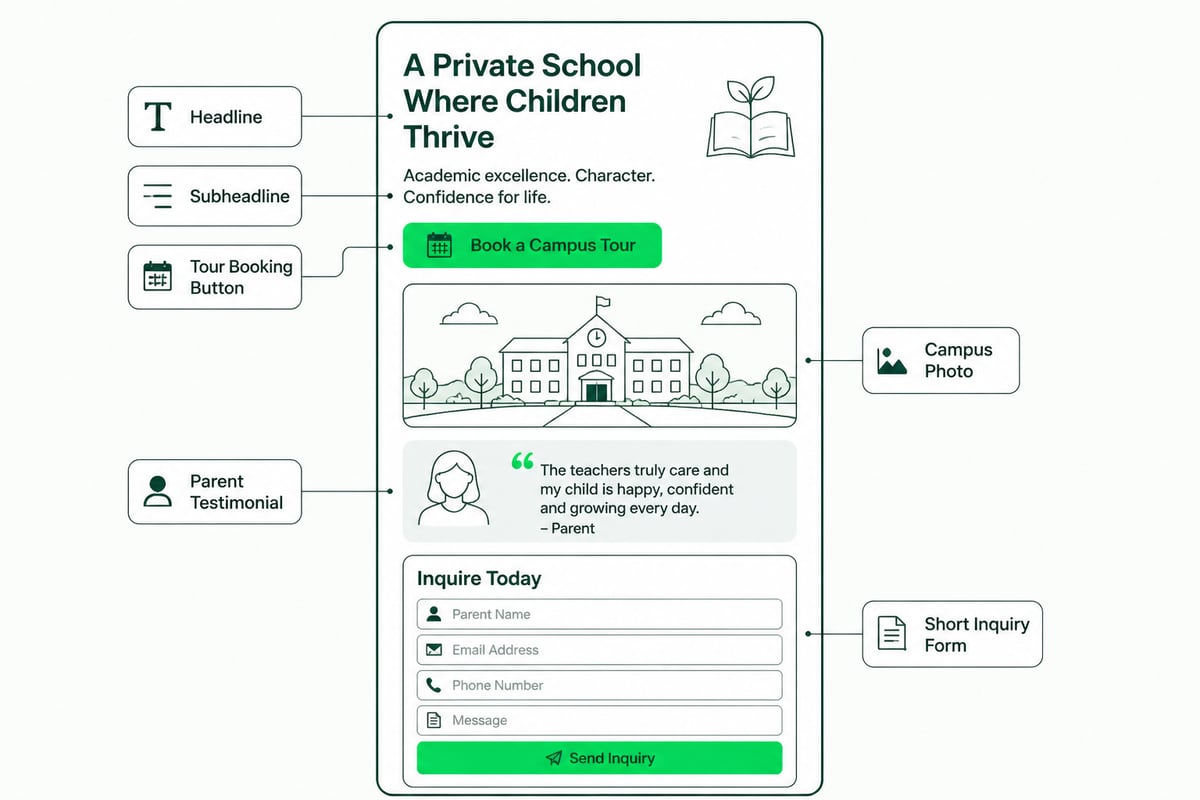
A performance campaign is only as strong as the page it sends traffic to. Families arriving from an ad want to see the specific program or grade they searched for, evidence that the school fits, and one clear action.
Effective education landing pages share a few traits:
- A headline matching the ad's promise, such as "Grade 6 admissions now open."
- Real photography and short testimonials from current parents or students.
- A single primary call to action, usually a tour request or a short inquiry form.
- Fast load times on mobile, since much of the traffic from social arrives on phones.
- Minimal form fields, with optional detail collected later in the nurture sequence.
Page builders such as Webflow let marketing teams build and publish landing pages without waiting on engineering tickets, which makes it easier to test one page per program or campaign. Test one element at a time, such as the headline or the offer, and let each test run long enough to produce a meaningful result before declaring a winner.
A Practical Starting Plan for Your First 90 Days
A sensible first 90 days focuses on one or two channels, a clean tracking setup and a defined response process, rather than launching everywhere at once. The goal is to learn your real cost per qualified inquiry and cost per enrollment quickly.
- Weeks 1 to 2: Set the economics. Calculate the lifetime tuition value of an enrolled student and set a maximum acceptable cost per enrollment. Define what counts as a qualified inquiry.
- Weeks 2 to 4: Build the foundation. Install conversion tracking, configure consent, connect your CRM and draft the follow-up sequence. Build or refine one landing page per priority program.
- Weeks 4 to 8: Launch and respond. Start with search and one paid social channel. Measure response time daily and fix delays before increasing budget.
- Weeks 8 to 12: Optimize. Review cost per inquiry and inquiry-to-visit rates by campaign. Pause weak ad sets, expand strong ones and test new messages.
Sports academies and colleges can follow the same structure with adjusted offers, such as a trial session for an academy or a virtual information session for an adult program. For program-specific guidance, resources on higher education enrollment marketing and sports academy marketing address each audience's decision cycle.
Teams short on time sometimes choose to bring in outside support. Specialist agencies such as Leadica focus on capturing, following up and converting leads through paid ads and automation, and building skills in-house is another route, for example through AI-focused training on platforms like MammothClub. Either path works if accountability for enrollment outcomes stays clear.
Choosing Between In-House, Agency and Done-for-You Models
Schools generally take one of three routes: build an internal team, hire a conventional agency, or contract an outcome-based partner. The right choice depends on your staffing, budget flexibility and appetite for risk.
An in-house team gives you control and institutional knowledge. It also requires hiring and retaining skills in paid media, analytics and CRM administration, which is difficult for small admissions offices.
A traditional agency brings expertise but usually bills on retainers or ad-spend percentages, and many stop at lead delivery. If follow-up happens in a separate system owned by someone else, accountability for enrollments is split.
A done-for-you, outcome-based model combines advertising, landing pages, follow-up and CRM under one accountable owner and ties fees to results. The Surge System is one example. It runs paid demand generation, rapid inquiry response, tour and visit booking and CRM automation as a single monthly retainer, and ScholarSurge describes its pricing as performance-based. ScholarSurge states that it guarantees 50+ qualified inquiries in the first 90 days. It also reports a projected 12-month ROI based on recovery plan implementation, drawn from internal audits.
Ask any prospective partner the same questions: who owns follow-up, how is a qualified inquiry defined, what do you pay if results fall short, and who owns the data and accounts if the relationship ends? For comparison points, this overview of an enrollment performance agency outlines what to evaluate.
Common Mistakes to Avoid
Most failed performance programs in education fail for operational reasons, not creative ones. Watch for these patterns:
- Optimizing for cheap leads. The lowest cost per inquiry often brings the lowest quality. Optimize toward visits and applications once you have the data.
- Ignoring seasonality. Enrollment decisions cluster around specific windows. Plan budget to rise ahead of open houses and application deadlines, not during them.
- Treating the website as finished. Slow, cluttered or generic pages waste paid traffic.
- Measuring only in the ad platform. Platform-reported conversions overstate results. Reconcile against your CRM's enrolled student records.
- Splitting ownership. When ads, pages and follow-up belong to different vendors, no one answers for the enrollment number.
Fixing these usually produces more gain than adding another channel.
Frequently Asked Questions
How is performance marketing different from enrollment marketing?
Enrollment marketing is the broad discipline of attracting and converting students. Performance marketing is a way of buying and measuring it, where spend is tied to defined outcomes. Many enrollment programs use performance methods for demand generation alongside brand and referral efforts. A fuller view is available in this guide to enrollment marketing for education organizations.
How long before results appear?
Early signals, such as inquiry volume and cost per inquiry, usually appear within the first few weeks. Enrollment outcomes follow the admissions calendar, so judge a program on a full cycle where possible.
Does it work for small schools and academies?
Yes, provided the budget supports enough volume to learn from and the economics hold. Tight geographic targeting and a strong follow-up process matter more than large spend.
Your next step is to calculate your current cost per enrolled student and your average response time to a new inquiry, since those two numbers show where your funnel leaks. If either figure is hard to find, that gap is itself the finding. ScholarSurge builds enrollment growth systems for schools, colleges, universities and sports academies, and its virtual enrollment team handles inquiry response, nurturing and follow-up so your staff can focus on families; start with The Surge System to see how the pieces fit together, then arrange a review of your own funnel through ScholarSurge and Book Your Free Enrollment Audit to see where your next enrolled students are being lost.