
Insights
Performance Marketing for Schools: A Practical Guide
See how performance marketing for schools ties ad spend to enrolled students, from channel selection and speed-to-lead to attribution and KPIs.
READING TIME · 11 MIN · UPDATED QUARTERLY

Performance marketing for schools is a paid, measurable approach to admissions in which every dollar of advertising is tied to an outcome such as an inquiry, a tour, an application or an enrolled student, rather than to impressions or clicks. Instead of funding a brand campaign and hoping seats fill, enrollment teams define a target cost per enrolled student, build a system that pursues it, and adjust spend based on what the data shows.
For heads of school and admissions directors, the appeal is accountability. Tuition revenue depends on a small number of high-value decisions, so a method that shows exactly which channel produced which family is far easier to defend to a board than a general awareness budget. The sections below cover how the model works, which channels belong in it, where inquiries are won or lost, and how to measure results with precision.
What Performance Marketing Means in Admissions
In an admissions context, performance marketing means paying for and optimizing against enrollment outcomes at each stage of the family journey, not against surface metrics.
A traditional school marketing plan often funds a viewbook, a few events, a billboard and a website refresh, then evaluates success by fall headcount. A performance model works backward from the number of seats to fill. If you need 40 new students and your inquiry-to-enrollment rate is 12%, you need roughly 330 qualified inquiries. That figure then sets the advertising budget, the staffing for follow-up and the pace of your campaigns.
The model rests on four principles:
- Defined outcomes. Each campaign is built around a specific action, such as booking a tour or submitting an inquiry form.
- Tracked conversions. Every action is recorded and connected to its source.
- Continuous optimization. Budgets move toward the channels, audiences and messages that produce enrolled students.
- Shared accountability. Marketing and admissions are judged on the same funnel, not on separate scorecards.
The market context matters. The most recent data from the National Center for Education Statistics show 4.7 million private K–12 students in fall 2021, about 9% of combined public and private enrollment, so private schools compete for a limited share of families. Private and independent schools compete for a limited share of families, and sports academies and colleges face similar pressure within their own categories. That scarcity is the reason measurable acquisition has moved from optional to expected.
Why Traditional School Marketing Falls Short
Traditional school marketing falls short because it separates promotion from measurement, so leaders cannot tell which activity produced which family.
Three patterns recur. The first is the brochure website: a polished site that describes the school well but gives a visiting parent no clear next step, no fast way to ask a question and no reason to leave contact details. The second is channel sprawl, where a school runs social posts, a local mailer, a search campaign and an event sponsorship at once with no common tracking. The third is slow follow-up. A family that submits an inquiry on a Sunday evening and hears back on Wednesday has often already spoken with two other schools.
Performance marketing addresses each of these directly. Landing pages are built to convert, tracking is applied from the first click, and response time becomes a managed metric. The goal is a system in which no inquiry is wasted, because a school that pays to attract a family should be equally disciplined about what happens in the first minutes after that family reaches out.
The Enrollment Funnel Behind Every Campaign
A school enrollment funnel moves a family from awareness to inquiry, tour, application, offer and enrollment, and performance marketing assigns a measurable target to each step.
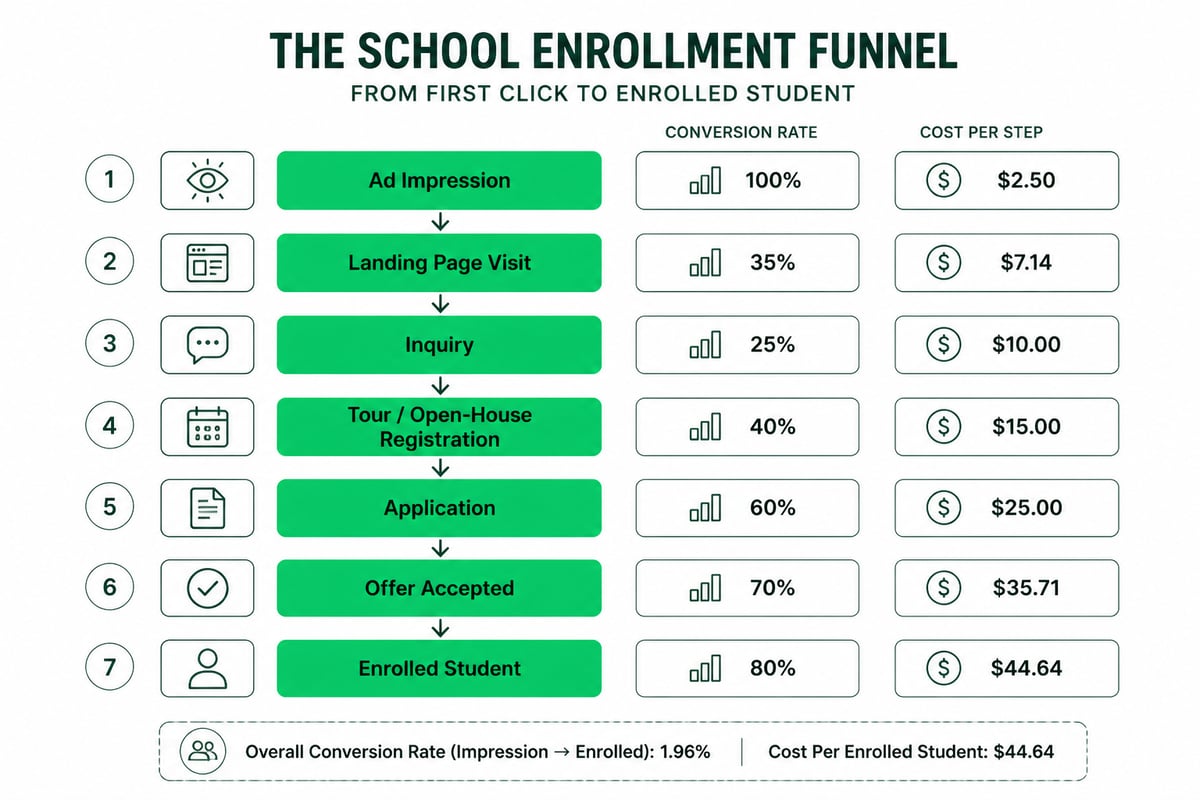
Mapping the funnel exposes where money leaks. A school might generate plenty of inquiries yet convert few to tours, which signals a follow-up problem rather than an advertising problem. Another might book many tours but lose families at the application step, which points to pricing communication or process friction. Without stage-level numbers, both schools would simply spend more on ads.
A practical starting point is to record, for the last two admissions cycles, the number of families at each stage and the source of each. Even rough figures reveal which stage deserves attention first. Enrollment cycles are long, often stretching over many months, so stage-to-stage conversion rates tell you far more in the short term than final headcount does.
Channels That Drive Qualified Inquiries
The most dependable channels for performance marketing for schools are paid search, paid social, local search presence and email or text nurture, each serving a different moment in a family's decision.
Paid search
Families actively searching for a private school, a grade-specific program or a sports academy are expressing high intent. Search campaigns capture that demand with ads matched to queries such as "private school near me" or "middle school admissions." Geographic targeting should reflect your real draw area, and campaigns should be structured by grade level or program so the landing page matches the search. For deeper guidance, see this overview of Google Ads for schools.
Paid social
Social platforms create demand rather than simply capturing it. Parents of younger children are often not yet searching, but they respond to well-targeted campaigns showing campus life, outcomes and student voices. Facebook and Instagram remain central for reaching parents, and Facebook ads for schools work best when paired with a lead form or landing page that asks for very little information up front.
Local search and reputation
Google Business Profile accuracy, review volume and local landing pages influence both organic and paid results. Families check reviews before they inquire, so reputation work lowers the cost of every other channel.
Email and text nurture
Most families do not enroll after one contact. Automated sequences that share relevant content, invite them to events and prompt a tour booking keep a school present during a long decision window. Teams building out this layer can review how school digital marketing fits together across channels.
A simple comparison helps allocate effort:
| Channel | Primary role | Typical intent | Main metric |
|---|---|---|---|
| Paid search | Capture active demand | High | Cost per qualified inquiry |
| Paid social | Create demand | Medium | Cost per inquiry and tour booking rate |
| Local search and reviews | Build trust | Medium to high | Review volume, profile actions |
| Email and text nurture | Convert and retain interest | Existing leads | Inquiry-to-tour rate |
Speed-to-Lead: Where Most Enrollment Value Is Won or Lost
Speed-to-lead is the time between a family submitting an inquiry and receiving a meaningful human or automated response, and it is one of the most controllable factors in converting paid traffic into tours.
Advertising spend is wasted when inquiries sit unanswered. A family comparing three schools will typically favor the one that responds first with a clear, helpful message and an easy way to book a visit. Admissions offices that work standard hours miss evenings and weekends, which is precisely when many parents browse and submit forms.
Closing the gap involves several steps:
- Automate an immediate reply by email and text that acknowledges the inquiry and offers a booking link.
- Route every lead to a named person with a clear target response window.
- Follow up across channels with a call, a text and an email within the first day.
- Track response time as a reported metric alongside cost per inquiry.
This is the part of the funnel ScholarSurge builds around. Its speed-to-lead process aims to respond to every inquiry quickly, and the company reports an average inquiry response time under 60 seconds across its clients. Because advertising, landing pages, follow-up and CRM run as one accountable system, there is no handoff between agencies where leads go cold.
Measurement: Attribution, Tracking and KPIs
Measuring performance marketing for schools requires connecting ad clicks to enrolled students through consistent tracking, a chosen attribution model and a short list of funnel KPIs.
Choosing an attribution model
Attribution determines which touchpoint receives credit for an enrollment. Google Analytics 4 offers three reporting attribution models: data-driven attribution, paid and organic last click, and Google paid channels last click. Administrators and editors can also configure the reporting attribution model, eligible channels and the key-event lookback window. That lookback setting deserves attention in admissions, where a family may first click an ad and return weeks later to inquire.
Connecting offline outcomes
Tours, applications and enrollments usually happen offline or inside a student information system, not on your website. Google Ads enhanced conversions help bridge that gap. They hash first-party customer data with SHA-256 before sending it to Google, which allows conversions to be matched without exposing raw contact details. For uploads through the API, Google recommends sending conversion data within 24 hours of the conversion. Plan for patience as well: Google notes that enhanced conversions may need up to 30 days to train before their impact appears in reporting, so results can take time to show.
KPIs worth tracking
- Cost per qualified inquiry
- Inquiry-to-tour rate
- Tour-to-application rate
- Application-to-enrollment rate
- Cost per enrolled student
- Average response time to new inquiries
- Lifetime tuition value relative to acquisition cost
Cost per enrolled student is the headline figure. It should be compared against tuition revenue over the expected length of attendance, which is how a school decides how aggressively it can afford to invest.
Building Landing Pages and Offers That Convert
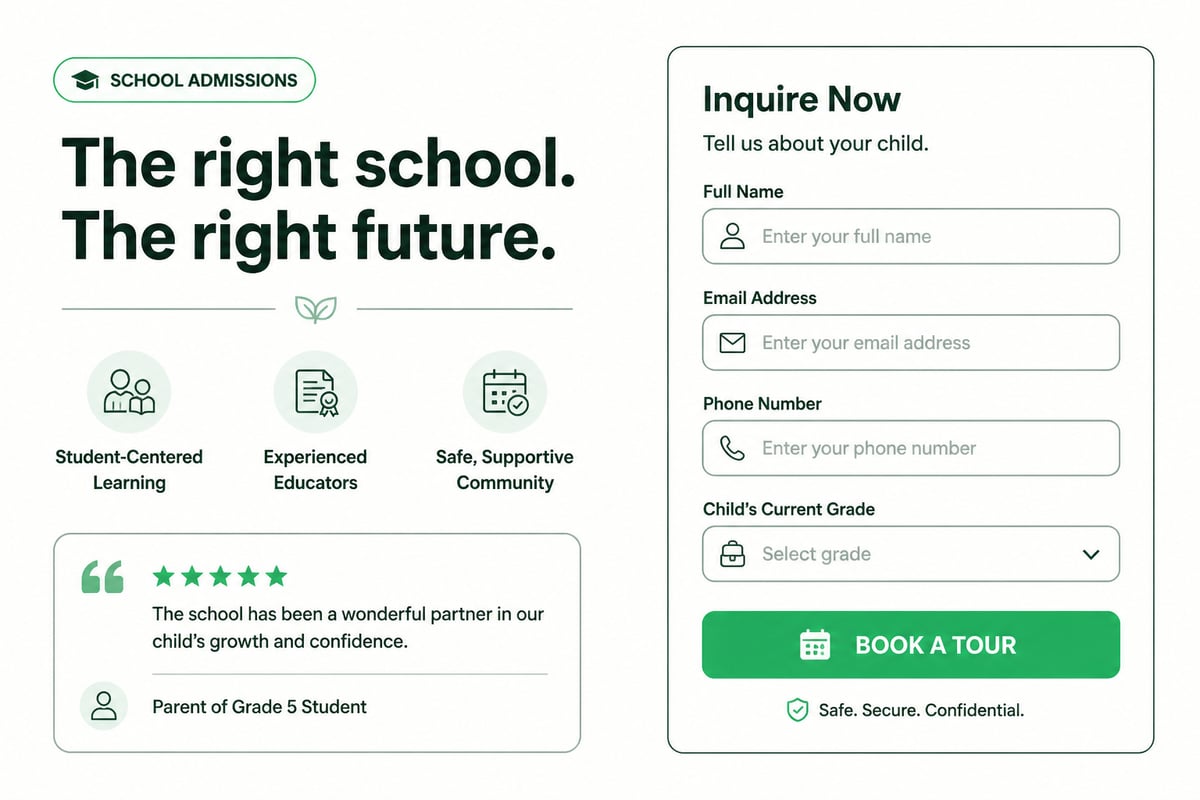
High-converting school landing pages offer one clear action, match the ad that brought the visitor, and remove the friction of a long inquiry form.
A visitor who clicks an ad for a Grade 6 open house should land on a page about that open house, not on the generic homepage. The page needs a short headline, two or three proof points such as class size, outcomes or a short parent testimonial, and a form asking for only the essentials: name, email, phone and child's grade. Every additional field lowers completion.
Offers matter as much as design. Common high-performing offers include:
- Open-house and campus-tour registration
- A shadow day for prospective students
- A short admissions guide delivered by email
- A trial practice or showcase session for sports academies
Grade-specific campaigns tend to outperform generic ones because they speak to a parent's immediate decision. This is the logic behind ScholarSurge for K–12 Schools, which pairs grade-level campaigns with open-house registration systems and admissions follow-up aimed at specific open seats.
Teams that lack web resources internally can use a maintenance and setup partner such as ETERNHA to keep landing pages fast and reliable, since slow or broken pages quietly inflate cost per inquiry.
Budgeting and Pricing Models for Performance Work
Schools can fund performance marketing through monthly retainers, ad-spend-plus-fee arrangements or results-based pricing, and the right structure depends on how much acquisition risk the school wants to carry.
Retainer models pay for effort and expertise regardless of outcome. Ad-spend-plus-fee models add a management percentage to media costs, which can align poorly with efficiency because a higher spend raises the fee. Results-based models tie compensation to outcomes, which shifts risk toward the provider.
ScholarSurge uses performance-based pricing, in which it is paid when students enroll. It guarantees 50+ qualified inquiries in the first 90 days, and work continues free until the 50-inquiry target is reached. Its internal audits project a 12-month ROI of 3.2x based on recovery plan implementation, a projection drawn from its own audits rather than an independent study. When comparing any partner, ask for the definition of a "qualified" inquiry in writing, because the term varies widely between providers.
For schools weighing options, these resources compare approaches: enrollment performance agencies and the broader set of private school marketing strategies.
Building Your Internal Capacity and Partners
Most schools succeed with performance marketing by pairing a small internal owner with specialist partners for media buying, automation and creative.
Even with outside help, someone inside the school must own the funnel. That person approves messaging, joins weekly pipeline reviews, ensures tour slots exist and confirms that admissions staff follow up on the schedule agreed. Without that ownership, even well-run campaigns stall at the handoff.
Some schools also add specialist support around the edges of the core system. An automation-focused consultancy such as JMP Solutions can help with workflow design, and a boutique agency like Sparrow Digital Consulting offers Meta advertising and email expertise that some teams use for creative testing. Outbound outreach to institutional partners, such as feeder schools or club networks, is another area where an automation provider like Samplead can support targeted LinkedIn prospecting.
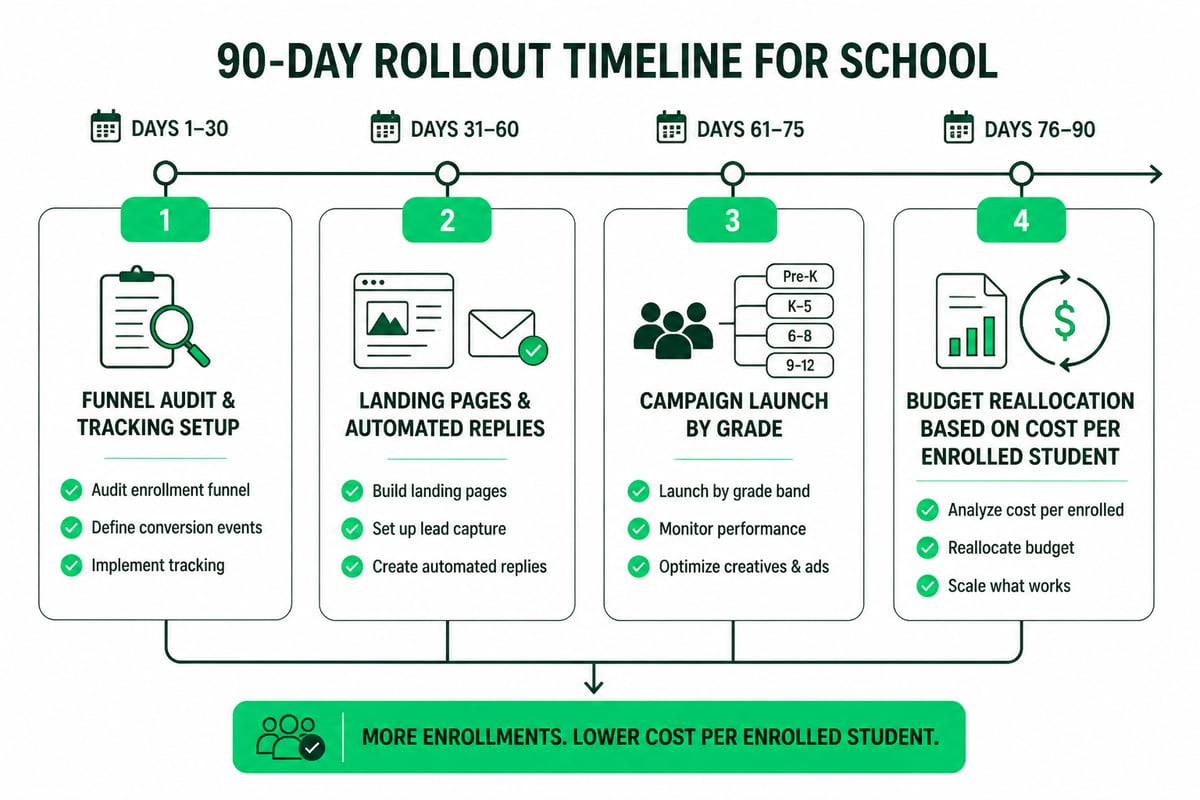
A realistic first-90-day plan looks like this:
- Weeks 1 to 2: Audit current funnel numbers, tracking and response times.
- Weeks 3 to 4: Build landing pages, forms, automated replies and CRM pipeline stages.
- Weeks 5 to 8: Launch search and social campaigns for the grades with the most open seats.
- Weeks 9 to 12: Review stage conversion, reallocate budget and refine messaging.
Schools evaluating outside help can also review how a school enrollment marketing agency structures its engagements, which clarifies what belongs in-house and what does not.
Common Mistakes to Avoid
The most frequent mistakes in performance marketing for schools are optimizing for cheap inquiries, ignoring follow-up capacity and judging results too early.
- Chasing the lowest cost per inquiry. Cheap leads that never tour are expensive. Optimize toward tours and enrollments.
- Scaling spend before fixing response time. More traffic into a slow process increases waste.
- Treating all grades equally. Budget should follow open seats and tuition value, not an even split.
- Stopping tracking at the form submission. Without offline conversion data, platforms optimize toward the wrong people.
- Judging a campaign in two weeks. Admissions decisions take time, so evaluate stage-level movement while waiting for enrollment data.
Avoiding these keeps the focus where it belongs: on filled seats and sustainable tuition revenue.
Your next step is to pull the last cycle's numbers for inquiries, tours, applications and enrollments by source, and note how long each inquiry waited for a first response. That single exercise shows whether your constraint is lead volume, follow-up speed or conversion further down the funnel. ScholarSurge builds the full system for this work, including grade-specific campaigns through ScholarSurge for K–12 Schools, and the clearest way to see where your funnel leaks is to book your free enrollment audit and review the findings with a team that is paid when students enroll.