Insights
Performance Marketing for Colleges: A Practical Guide
Learn how performance marketing for colleges ties ad spend to inquiries, applications and enrollments, with a clear framework for channels and measurement.
READING TIME · 10 MIN · UPDATED QUARTERLY

Performance marketing for colleges is a paid-acquisition approach in which every dollar is tied to a measurable outcome, such as a qualified inquiry, a campus visit, a completed application or an enrolled student, rather than to impressions or reach. For admissions directors and enrollment leaders, it replaces the question "How many people saw our ads?" with "What did it cost to enroll one student, and where did that student come from?"
The model suits colleges because the enrollment cycle is long, the tuition value of each student is high, and small improvements in conversion rates compound quickly. It also exposes weak points that brand-focused campaigns hide, particularly slow follow-up and gaps between the ad click and the admissions office.
What Performance Marketing Means in College Admissions
Performance marketing in admissions means paying for, optimizing and reporting on results at each stage of the enrollment funnel, not on exposure. The core idea is accountability: every channel, campaign and message must be traceable to an inquiry, an application or an enrolled student.
Traditional college advertising often relies on billboards, viewbooks, sponsorships and general awareness campaigns. Those tactics have a role, but they are difficult to attribute and slow to adjust. Performance marketing works differently:
- Outcome-based goals. Campaigns are built around qualified inquiries, campus visit bookings and applications.
- Continuous optimization. Budgets move toward the keywords, audiences and creative that produce enrollments.
- Closed-loop reporting. Admissions data flows back to the ad platforms so that spend follows real student outcomes.
- Speed and process. Follow-up systems matter as much as the ads, because a lead that waits days for a reply rarely converts.
For a closer look at how this approach applies across education, see ScholarSurge's overview of performance marketing for education.
The Enrollment Funnel Metrics That Matter
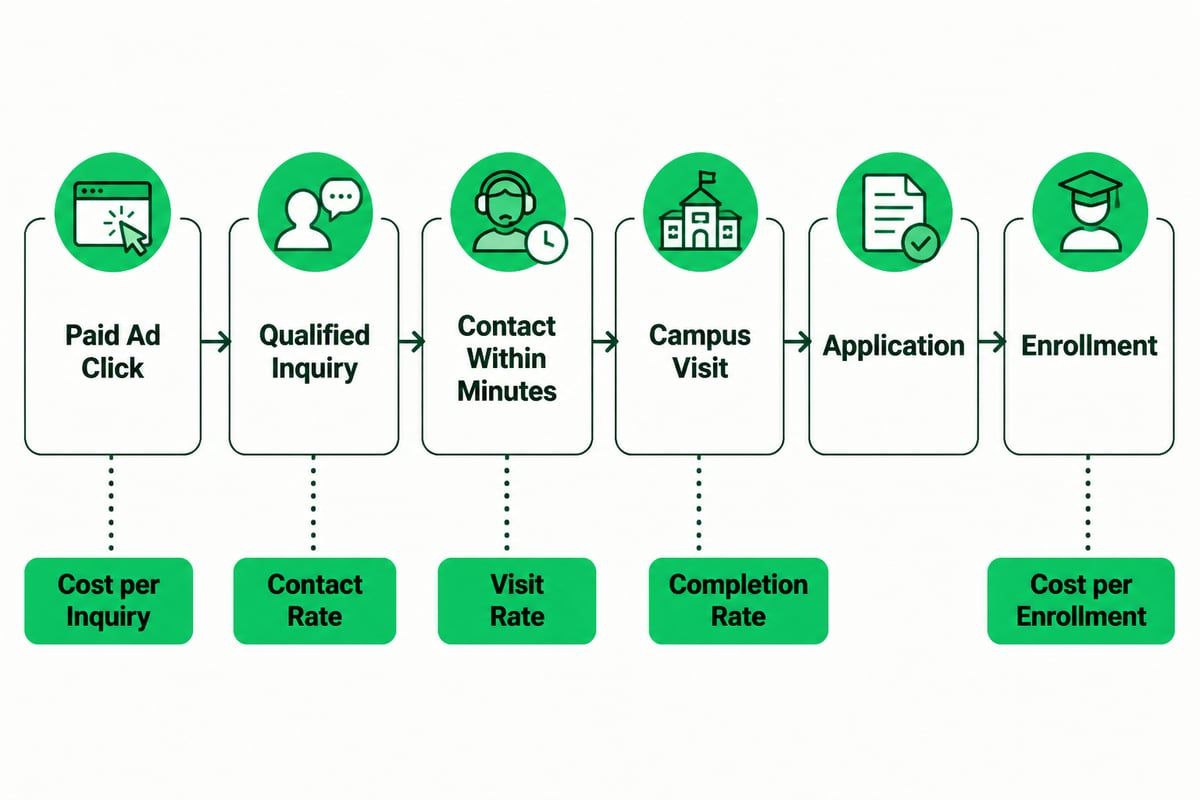
The metrics that matter in college performance marketing are those that connect spend to enrolled students, not those that measure clicks or reach. Tracking a small set of funnel metrics gives enrollment leaders a clear view of where money is working and where it leaks.
| Funnel stage | Primary metric | What it tells you |
|---|---|---|
| Awareness to interest | Cost per qualified inquiry | Whether targeting and messaging attract the right students |
| Interest to contact | Speed-to-lead and contact rate | Whether your team reaches inquiries while intent is high |
| Contact to visit | Visit booking rate | How well nurture sequences move students toward campus |
| Visit to application | Application completion rate | Whether the application experience supports conversion |
| Application to enrollment | Yield and cost per enrollment | The true return on every dollar spent |
Cost per click and click-through rate are useful diagnostics, but they are not outcomes. A campaign with a low cost per click that produces unqualified inquiries is more expensive in practice than one with a higher click cost that produces applicants.
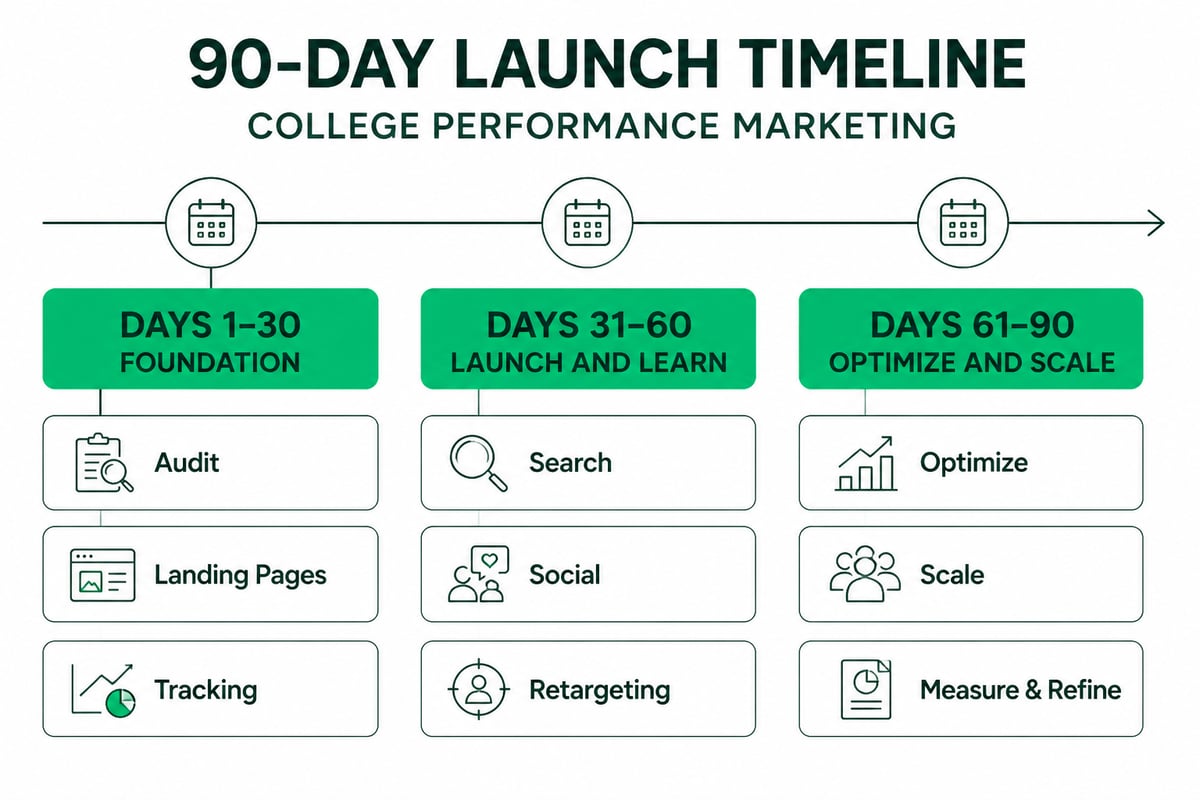
The most important single figure is cost per enrollment, calculated by dividing total acquisition spend by the number of students who enroll. Pair it with projected lifetime tuition value to judge how much you can afford to invest in each channel.
Channels That Drive Qualified Inquiries and Applications
The channels that most reliably produce college inquiries are paid search, paid social, retargeting and, for some programs, connected TV and email. Each captures a different type of student intent, and each should be judged on cost per qualified inquiry and downstream enrollment, not on volume alone.
Paid search
Search captures students who are already looking for a program, a degree or a college type. Program-specific keywords tend to outperform broad institutional terms because they signal clear intent. Pair each ad group with a dedicated landing page that matches the search query. ScholarSurge covers the mechanics in its guide to Google Ads for schools.
Paid social
Social platforms reach students and parents before they begin an active search. They work well for building a prospect pool, promoting open houses and retargeting website visitors. Creative that shows real campus life, specific programs and clear next steps generally outperforms generic brand messaging. For tactics specific to these platforms, see social media marketing for schools.
Retargeting and email
Most prospective students do not convert on the first visit. Retargeting keeps your college visible to students who viewed a program page or started an application, while email and text nurture sequences answer questions and prompt the next step. These channels are inexpensive relative to cold acquisition and often have the highest conversion rates in the funnel.
Video and creative production
Short video built around student stories, program outcomes and campus visits consistently strengthens paid campaigns on social platforms. Creative studios such as 3318, a full-service studio focused on video and social content, show the kind of production support that can supply fresh ad assets without straining an internal marketing team.
Conversion Tracking and Attribution Setup
Accurate conversion tracking is what separates performance marketing from ordinary advertising, because it lets the ad platforms learn which clicks produce real students. A reliable setup records website actions, phone calls and offline admissions steps as separate conversions.
Start with the foundation. Google Ads conversion measurement can track website actions such as sign-ups, as well as phone calls, which helps identify the campaigns and keywords driving valuable activity. Because inquiry forms, calls and application starts have very different values, Google Ads supports separate conversion actions for website actions, phone calls and offline conversions. Setting these up individually allows you to weight them in reporting rather than treating every lead as equal.
Next, connect your analytics. In Google Analytics, events can be marked as key events and then used to create Google Ads conversions, which lets you optimize campaigns around form submissions, visit bookings or application starts.
Finally, close the loop with your admissions process. Google Ads can use qualified-lead and converted-lead goals to connect ad-generated leads with offline qualification and later steps in a school's lead process. For a college, this means uploading information about which inquiries became applicants and enrolled students, so the platform optimizes toward students who actually enroll rather than toward form fills alone.
A practical checklist for your setup:
- Define the conversion events: inquiry submitted, visit booked, application started, application submitted, deposit paid.
- Assign each a value that reflects its likelihood of leading to enrollment.
- Tag every campaign with consistent source and campaign parameters.
- Sync your CRM so that downstream stages are reported back to ad platforms.
- Review attribution monthly against actual enrollment records.
Speed-to-Lead: The Hidden Variable in Cost per Enrollment
Speed-to-lead, the time between a student's inquiry and your first meaningful response, directly affects whether paid traffic turns into enrollments. When a prospective student submits a form, their interest and attention are at their peak, and every hour of delay gives competing colleges an opening.
Many enrollment teams invest heavily in acquisition and then lose a large share of that investment to slow follow-up. A student who inquires at 9 p.m. on a Sunday and hears back Tuesday afternoon has probably already spoken with another admissions office. Improving response time is often the lowest-cost way to reduce cost per enrollment, because it raises conversion from inquiries already paid for.
Strong follow-up systems typically include:
- Automatic acknowledgment by email and text within seconds of an inquiry
- A personal outreach attempt by phone or text, ideally within minutes
- Multi-touch nurture sequences over several weeks, tailored by program
- Clear, low-friction paths to book a campus visit or speak with an advisor
- Routing rules so no inquiry sits unassigned after hours or on weekends
ScholarSurge builds this into its model, with advertising, landing pages, follow-up and CRM run as one accountable system. That structure matters because gaps between separate vendors are where leads tend to disappear.
Compliance and Truthful Advertising Claims
Performance marketing for colleges must follow advertising law and use claims that can be substantiated, because aggressive conversion tactics can drift into misleading territory. Outcome claims about graduation, employment and salary draw the most scrutiny.
The FTC's Guides for Private Vocational and Distance Education Schools define deceptive advertising, for covered schools, as including misrepresentation of graduation or employment outcomes, expected salaries or the time required to complete a program, according to 16 CFR Part 254. Note the scope: the guides do not apply to institutions of higher education offering at least a two-year accredited college-level program generally acceptable for bachelor's-degree credit. Even where those guides do not formally apply, general consumer protection standards still do, and accreditors and state regulators often hold colleges to similar expectations.
A sensible internal policy:
- Substantiate every outcome statistic with current institutional data
- State the cohort, time period and methodology behind any placement or salary figure
- Avoid guaranteeing jobs, salaries or admission outcomes
- Keep program length and cost statements consistent across ads, landing pages and catalogs
- Have admissions and compliance staff review new creative before launch
Clear, accurate claims also tend to convert better with parents and students who have learned to distrust inflated promises.
Measuring ROI and Choosing a Pricing Model
Return on investment in college performance marketing is best measured as the lifetime tuition value of enrolled students divided by the total cost of acquiring them, and the pricing model you choose affects how much risk you carry. Fixed-fee retainers reward activity, while performance-based arrangements tie vendor compensation to results.
When evaluating a partner or an in-house plan, ask these questions:
- Is spend reported by outcome (inquiries, applications, enrollments) or only by clicks and impressions?
- Who owns the ad accounts, landing pages and data?
- How quickly are inquiries contacted, and is that measured?
- How are results verified against your own student information system?
- What happens if targets are not met?
ScholarSurge uses a performance-based model in which it is paid when students enroll, and work continues at no charge until its inquiry target is reached. Results depend on each institution, so confirm expectations for your own school during a discovery conversation rather than assuming outcomes transfer directly.
For small and mid-sized private institutions that want program-level recruitment, campus visit booking and application nurture handled as one system, ScholarSurge for Colleges is built for that purpose. If you are comparing outside help more broadly, the guides to a marketing agency for small colleges and college recruitment marketing companies outline what to look for.
A Practical 90-Day Plan for Launching Performance Marketing
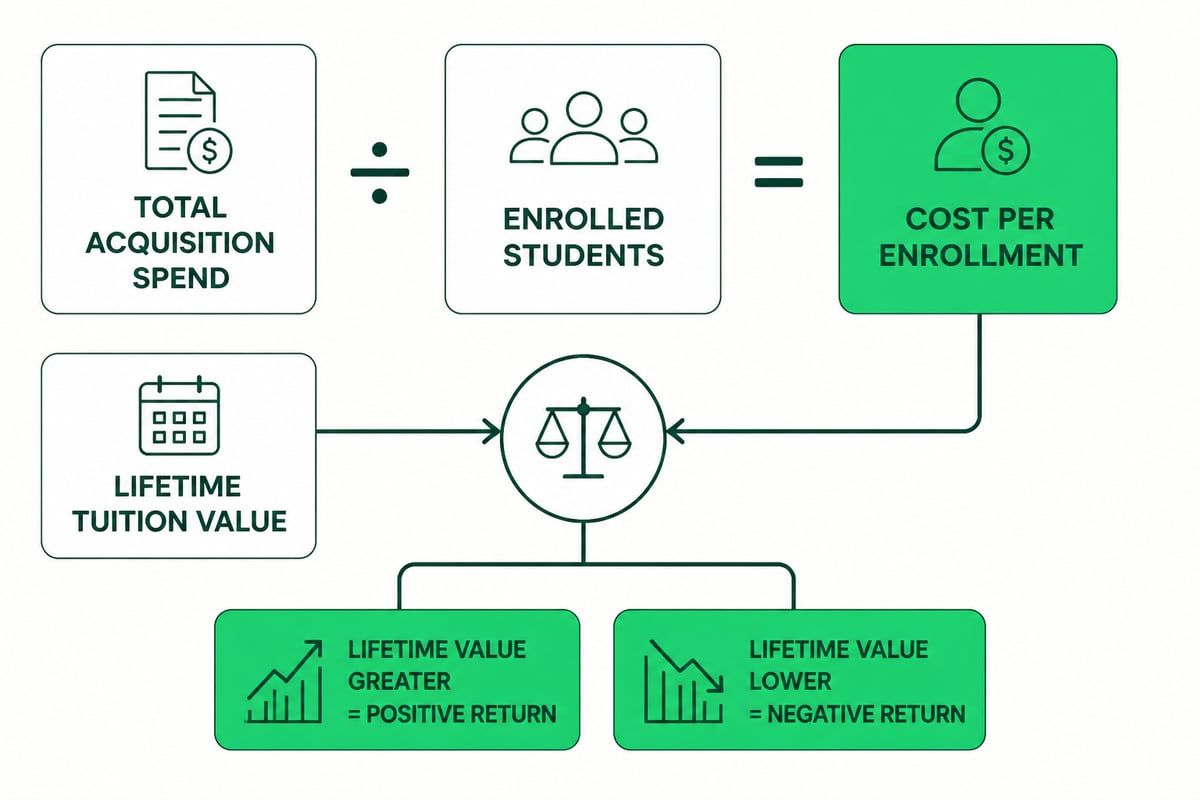
A 90-day launch plan lets a college build tracking, test channels and tighten follow-up before scaling spend. The goal of the first quarter is not maximum volume but reliable data on cost per qualified inquiry and cost per enrollment.
Days 1 to 30: Foundation
- Audit current inquiry sources, response times and conversion rates
- Define priority programs and the student profiles most likely to enroll
- Build program-specific landing pages with one clear action each
- Configure conversion tracking for forms, calls and application steps
- Set up automated acknowledgment and routing for every new inquiry
Days 31 to 60: Launch and learn
- Launch paid search on program-level keywords and a small paid social test
- Start retargeting for visitors who viewed programs or began applications
- Run two or three creative variations per campaign and review weekly
- Measure speed-to-lead daily and fix any routing gaps immediately
Days 61 to 90: Optimize and scale
- Shift budget toward the campaigns with the lowest cost per qualified inquiry
- Pause or rework ad groups that generate volume without visits or applications
- Feed application and enrollment data back to the ad platforms
- Set targets for the next quarter based on actual funnel conversion rates
Colleges serving specific audiences can adapt this plan. Programs with strong athletic components, for example, may benefit from the approaches in best sports academy marketing strategies, while institutions comparing their options can review top higher education marketing companies.
Lead intelligence tools can also add context to website traffic. Platforms such as WebsiteLead, which identifies organizations visiting a site and passes warm visitors into a CRM, illustrate how visitor-level signals can be connected to follow-up workflows, though a college would need to confirm privacy and consent requirements before using any similar approach with prospective students.
Your next step is to pull your last 90 days of inquiry data and measure how long it took your team to respond to each one, since that single number often shows the fastest path to a lower cost per enrollment. From there, ScholarSurge can help you build a connected system of advertising, landing pages, rapid follow-up and CRM, and for small private colleges its ScholarSurge for Colleges service covers program-level recruitment, campus visit booking and application nurture. To see where your funnel is losing students and what a performance-based plan would look like, Book Your Free Enrollment Audit with the ScholarSurge team.