
Insights
Results-Driven Education Marketing Agency: How to Choose One
Learn how to evaluate a results-driven education marketing agency, from pricing models and speed-to-lead to tracking, so your school fills its seats.
READING TIME · 10 MIN · UPDATED QUARTERLY

A results-driven education marketing agency ties its fees and its reporting to enrollment outcomes such as qualified inquiries, booked tours, applications and enrolled students, rather than to impressions, clicks or hours worked. For heads of school and admissions directors, the practical task is separating agencies that can prove that standard from those that only describe it. This article gives you the criteria, the questions and the red flags to do that.
What a Results-Driven Education Marketing Agency Actually Delivers
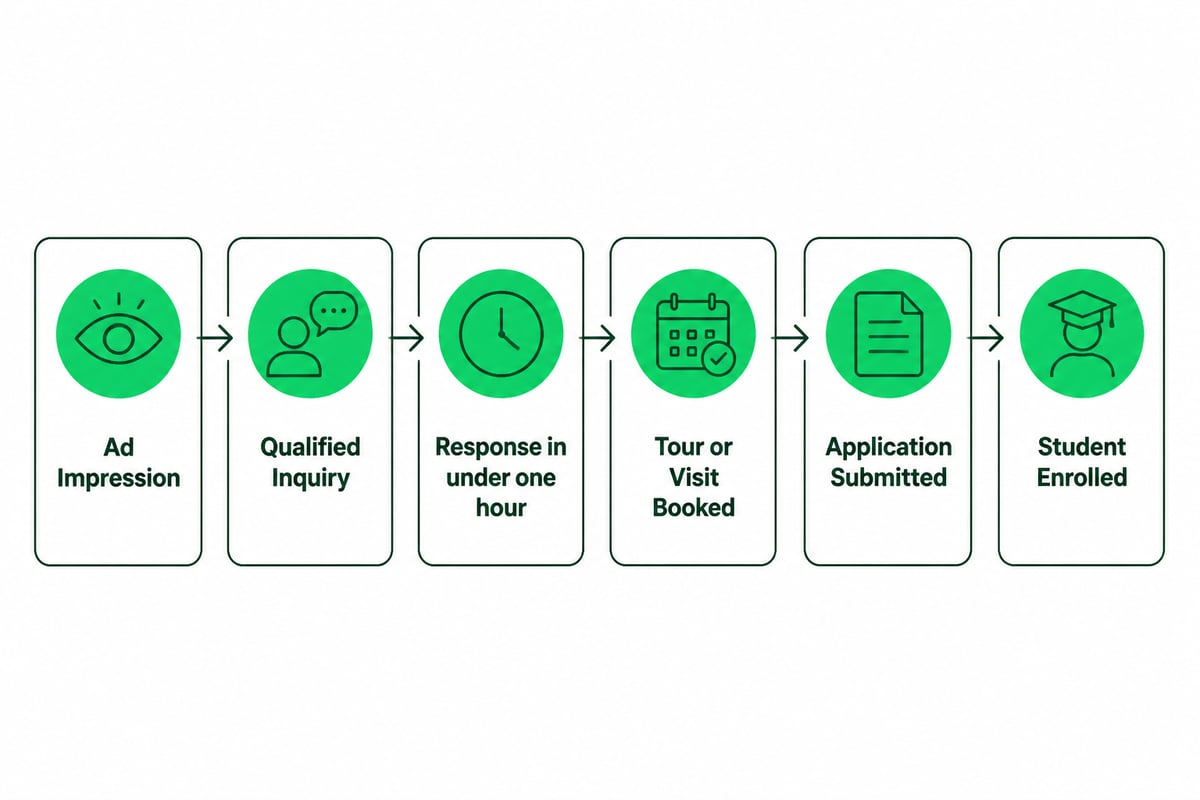
A results-driven agency owns the full path from first ad impression to enrolled student and reports on that path in admissions terms. Traffic and social engagement can support that goal, but they are not the goal.
In practice, that means the agency can answer four questions with data:
- How many qualified inquiries did we receive, and from which channels?
- How quickly did each inquiry get a response?
- How many inquiries became tours, visits or trials?
- How many of those became applications and enrollments?
If an agency can answer only the first question, it is a traffic vendor. If it can answer all four, it is acting as an extension of your admissions office. That distinction matters because most enrollment losses happen after the inquiry arrives, in slow follow-up and weak nurturing, not at the ad itself.
The market conditions reward this discipline. According to the National Student Clearinghouse Research Center, spring 2025 postsecondary enrollment reached 18.4 million, up 3.2% (562,000 students) from spring 2024. Demand is recovering, but it is not evenly distributed, and families now compare several programs before they ever submit a form. The institution that responds first and follows up consistently tends to win the conversation.
Why Enrollment Leaders Are Moving Away From Retainers Built on Activity
Activity-based retainers reward effort, while enrollment leaders need outcomes. Many schools have paid monthly fees for blog posts, social calendars and reports full of reach metrics, then found their inquiry-to-enrollment numbers unchanged.
Three patterns explain the shift:
- Budgets are tighter and scrutinized by boards. A head of school presenting to trustees needs to connect marketing spend to tuition revenue, not to follower counts.
- Lead volume is not the constraint for most schools. The constraint is response speed, qualification and follow-up. An agency that adds more unqualified leads to a slow admissions process makes the problem worse.
- Channels are fragmented. Search, paid social, referral and email each play a role, and only a unified view shows which combination fills seats.
The demand picture varies by segment, too. The same Clearinghouse research reports that community-college undergraduate enrollment grew 5.4%, or 288,000 students, compared with the prior spring. Growth is concentrated in specific program types, which rewards agencies that can target by program and audience rather than run broad awareness campaigns.
Eight Criteria for Evaluating an Education Marketing Partner
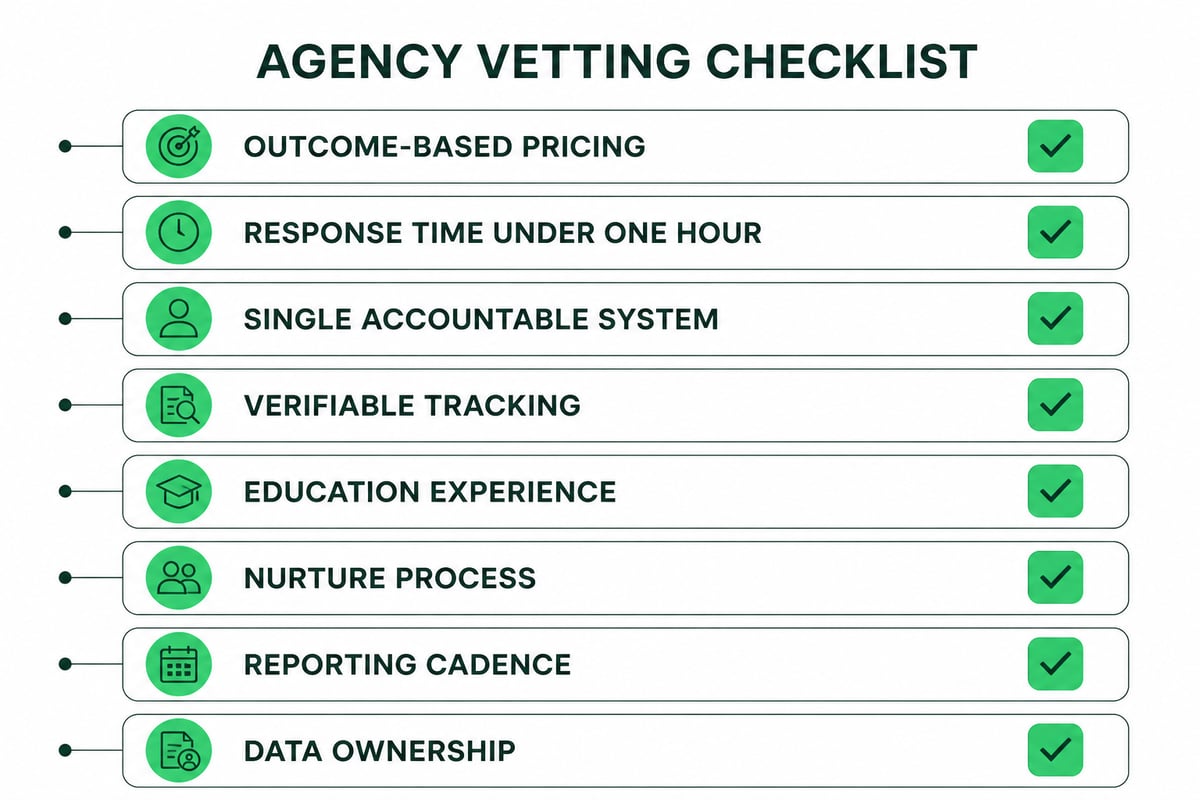
The strongest evaluation method is to score each candidate against the same eight criteria. Weak answers on the first four are usually disqualifying.
1. Pricing tied to outcomes
Ask how much of the fee depends on results. Performance-based structures, where the agency is paid when students enroll, move risk from your school to the agency. Fully fixed retainers are not automatically bad, but the agency should explain what specific outcome it commits to and what happens if it misses. For a deeper look at this model, see this overview of performance marketing for education.
2. Speed-to-lead
Ask what happens in the first minutes after a family submits an inquiry. A results-driven agency should have a documented process for immediate acknowledgment and a human follow-up within a defined window. Hours or days is a red flag, because inquiry quality decays quickly once a family has contacted several schools.
3. Ownership of the whole system
Advertising, landing pages, follow-up and CRM should work as one system with one accountable party. When ads come from one vendor, the website from another and the CRM from a third, nobody owns the conversion rate between them, and every gap becomes someone else's problem.
4. Measurement you can verify
Request access to the underlying accounts, not only a monthly PDF. Google's own guidance on data foundations recommends sitewide tagging, consent collection through Consent Mode, linking Google Ads with Google Analytics, and enhanced conversions to improve conversion measurement. An agency that cannot describe its tracking setup in those terms probably cannot report accurately on what drives enrollments.
5. Education-specific experience
Admissions cycles, tour-driven decisions, parent and student dual audiences, and seasonal deadlines differ from retail or B2B patterns. Ask for examples in your segment, whether independent K-12, a private college or a sports academy. Segment-specific guidance exists for private school marketing and sports academy marketing, and an agency should speak that language fluently.
6. Nurture and follow-up capability
Most families do not enroll after one contact. Ask how the agency handles inquiries that go quiet, how it books tours and how it keeps families engaged between the inquiry and the application deadline.
7. Transparent reporting cadence
Look for weekly or biweekly reporting on pipeline metrics, with a monthly strategic review. Reports should show cost per qualified inquiry, tour rate and enrollment attribution, not just spend and clicks.
8. Clear exit terms
Confirm you own your ad accounts, data, landing pages and CRM records if the relationship ends. Contracts that trap your data are a risk regardless of how good the early results look.
Comparing Pricing and Accountability Models
The model an agency uses reveals how much confidence it has in its own work. The table below summarizes the three structures you are most likely to encounter.
| Model | How you pay | Who carries the risk | Watch for |
|---|---|---|---|
| Fixed retainer | Flat monthly fee regardless of results | Your school | Vague deliverables, activity reporting |
| Hybrid | Lower retainer plus a bonus for results | Shared | Bonus tied to leads rather than enrollments |
| Performance-based | Fee tied to enrolled students or defined targets | Mostly the agency | Narrow definitions of a qualified inquiry |
No model is right for every school. A large university with an internal admissions team may prefer a retainer for specialist work, while an independent school or sports academy with a small team often benefits from a structure where payment follows enrollment.
How a Results-Driven Education Marketing Agency Proves Its Claims
Proof comes from documentation you can inspect, not from testimonials alone. When you interview candidates, request the following and treat refusal to share as information.
- Anonymized funnel data from a comparable school, showing inquiries, tours, applications and enrollments over a full cycle.
- A written definition of a qualified inquiry that matches your admissions criteria.
- A sample 90-day plan with milestones, not just channel recommendations.
- References from admissions directors, not marketing contacts, who can speak to follow-up quality.
- A description of the guarantee, including what counts, when it is measured and what happens if the target is missed.
Guarantees deserve particular scrutiny. A guarantee on traffic or impressions is easy to meet and means little. A guarantee on qualified inquiries, with free continued work until a stated target is reached, puts the agency's effort behind the outcome you actually need. Compare how different providers structure these commitments using resources such as this overview of the best school marketing agencies.
The Hidden Variable: Tracking Across Domains and Systems
Attribution breaks most often where a family moves between your website, an application portal and a scheduling tool. Many schools run their inquiry form on one domain, their application on another and their tour booking on a third, which causes conversions to be credited to the wrong source or lost entirely.
Google's guidance addresses this directly, recommending cross-domain linking to measure customer journeys across multiple domains and using measured conversion events to inform bidding strategies. The implication for admissions teams is straightforward. If your agency optimizes ad bidding toward form fills rather than toward tours booked or applications started, the algorithm learns to find people who fill out forms, not people who enroll.
Ask any candidate these three questions:
- Which conversion events are passed back to the ad platforms, and are they deeper than the form submission?
- How is the journey tracked across our website, application portal and booking tool?
- How do you reconcile platform-reported conversions with our actual enrollment records?
An agency that answers confidently and specifically has built this before. One that responds with general statements about "full-funnel tracking" has likely not.

Red Flags That Signal an Activity-First Agency
Some warning signs appear early in the sales process. Watch for these:
- Proposals led by deliverable counts such as posts per week or ads produced, with no target for inquiries or enrollments.
- Case studies that cite reach, impressions or followers as the primary result.
- No named owner for response time after a form is submitted.
- Reluctance to grant you admin access to ad accounts and analytics.
- A generalist portfolio with no education clients, since an agency treating schools like any other retail account will miss the dynamics of tours, deadlines and parent decision-making.
- Long lock-in contracts paired with soft guarantees.
Also be cautious of agencies that promise full enrollment without asking about capacity, tuition, program fit or current admissions workflow. Credible partners ask hard questions before they quote.
What a Done-for-You Enrollment System Looks Like
A done-for-you system packages demand generation, rapid response, visit booking and CRM automation under one accountable team, so your admissions staff spend time on conversations with families rather than on stitching tools together. The Surge System from ScholarSurge follows this model, combining paid advertising, landing pages, follow-up and CRM as one monthly retainer, with speed-to-lead response that the company says averages under 60 seconds across clients.
ScholarSurge's stated commitments illustrate the kind of accountability to look for in any provider: a guarantee of qualified inquiries in the first 90 days, work that continues free until the target is reached, and performance-based pricing in which payment follows enrollment. Its internal audits project a 12-month ROI of 3.2x based on recovery plan implementation. These figures come from the company's own audits, so verify any projection against your own tuition levels and capacity before relying on it. For specifics on terms, scope and fit for your institution, review the details on its school enrollment marketing page or contact the team directly.
This approach is built for schools, colleges, universities and sports academies. It is not designed for institutions seeking scholarship or financial aid services, or for organizations that want a generalist marketing agency outside education.
A Practical Selection Process You Can Run in Four Weeks
A structured process prevents the most common mistake, which is choosing the most polished presentation instead of the most accountable partner.
Week 1: Define your baseline. Document current inquiry volume, response time, tour conversion, application rate and enrollment yield. Without a baseline, no agency's results can be judged fairly.
Week 2: Shortlist three to five candidates. Prioritize agencies with education clients in your segment. Request their written definition of qualified inquiry and a sample reporting dashboard.
Week 3: Run structured interviews. Use the eight criteria above and ask every candidate the same questions. Include someone from admissions, not only marketing or the head's office, because the agency's follow-up process will land on their desks.
Week 4: Check references and negotiate terms. Speak with admissions directors at current clients. Negotiate data ownership, reporting access, guarantee definitions and exit terms before you sign.
Institutions with an international or boarding component may want additional diligence on regional targeting and visa-related timelines. Schools such as the British School of Lisbon illustrate how an internationally minded curriculum shapes the audiences and messages an agency has to understand. Likewise, vocational and training providers such as Summit Institute, an NZQA-accredited provider, show how accreditation and pathway clarity influence what prospective learners need to see before they inquire.
Questions to Ask Before You Sign
These questions work well in a final interview and usually surface the differences between agencies quickly:
- What is your average response time to a new inquiry, and who measures it?
- What exactly counts as a qualified inquiry, and who decides?
- Which of our systems will you connect to, and who owns them afterward?
- What happens to our fee if the target is not met in 90 days?
- Can we speak with an admissions director at a current client?
- How do you handle inquiries after hours and on weekends?
- What would make you advise us not to hire you?
The last question is the most revealing. A credible agency can name the situations where it is not the right fit, such as when a school lacks capacity, has an unclear value proposition or needs a service the agency does not provide.
Start by pulling your last twelve months of inquiry, tour and enrollment data into one sheet, because that baseline will make every agency conversation sharper. If you want an outside read on where your pipeline is leaking, ScholarSurge builds enrollment growth systems specifically for schools, colleges, universities and sports academies, acting as your virtual enrollment team through automated inquiry handling, rapid response and student nurturing. Its The Surge System packages that work into a single accountable engagement, and you can Book Your Free Enrollment Audit to see what a results-driven approach would look like for your school.