
Insights
ROI-Focused Education Marketing Agency: A Guide
See how a ROI-focused education marketing agency ties spend to enrolled students, which metrics prove returns, and how to vet partners before you sign.
READING TIME · 9 MIN · UPDATED QUARTERLY

A ROI-focused education marketing agency measures its work by enrolled students and tuition revenue rather than clicks, impressions or form fills, and it ties its fees and reporting to those outcomes. For heads of school, admissions directors and enrollment leaders, that means every dollar of ad spend can be traced through inquiry, response, visit, application and enrollment. This guide explains what such an agency does, which numbers prove it is working, and how to choose a partner without taking on avoidable risk.
What a ROI-Focused Education Marketing Agency Actually Does
A ROI-focused education marketing agency builds and runs the full path from first impression to enrolled seat, then reports on revenue produced instead of activity completed.
Traditional agencies often stop at the lead. They deliver traffic, impressions and form submissions, then hand the follow-up problem back to your admissions office. A results-driven partner treats the handoff as part of the job, because a lead that never gets a timely reply has no value. You can see how this distinction plays out in this look at a results-driven education marketing agency.
In practice, the work covers five connected layers:
- Demand generation: paid search, social and display campaigns aimed at families and students who match your enrollment profile.
- Conversion assets: landing pages built for a single action, such as booking a tour or requesting a prospectus.
- Speed-to-lead response: immediate, personal contact after an inquiry arrives.
- Nurture and follow-up: structured outreach that keeps a prospect moving toward a visit and an application.
- Attribution and reporting: a CRM that records the source of every enrolled student.
When these layers are run by separate vendors, nobody owns the result. When they run as one accountable system, the agency can be held to a single number: enrolled students at an acceptable acquisition cost.
Why ROI Is Harder to Prove in Education Than in Retail
Enrollment ROI is harder to prove than retail ROI because the buying cycle is long, the decision involves several people, and the final outcome happens months after the first ad impression.
A family might first see your school in a search result in October, attend an open house in January, submit an application in February and sign an enrollment contract in April. A last-click report would credit whichever channel touched them last, which is rarely the one that created the interest. That gap is where budgets get misallocated.
Reputation and fit also carry real weight. A 2025 report from EducationDynamics, drawn from responses by more than 3,000 students, found that reputation was a major factor for many traditional undergraduates in deciding where to apply. The same report found that affordability influenced program choice for a smaller share of students, while most prioritized other factors such as career outcomes and program benefits. Those figures describe higher education audiences, but the lesson carries to K-12 and sports academies: families weigh outcomes and credibility alongside price, so your marketing has to communicate proof, not only offers.
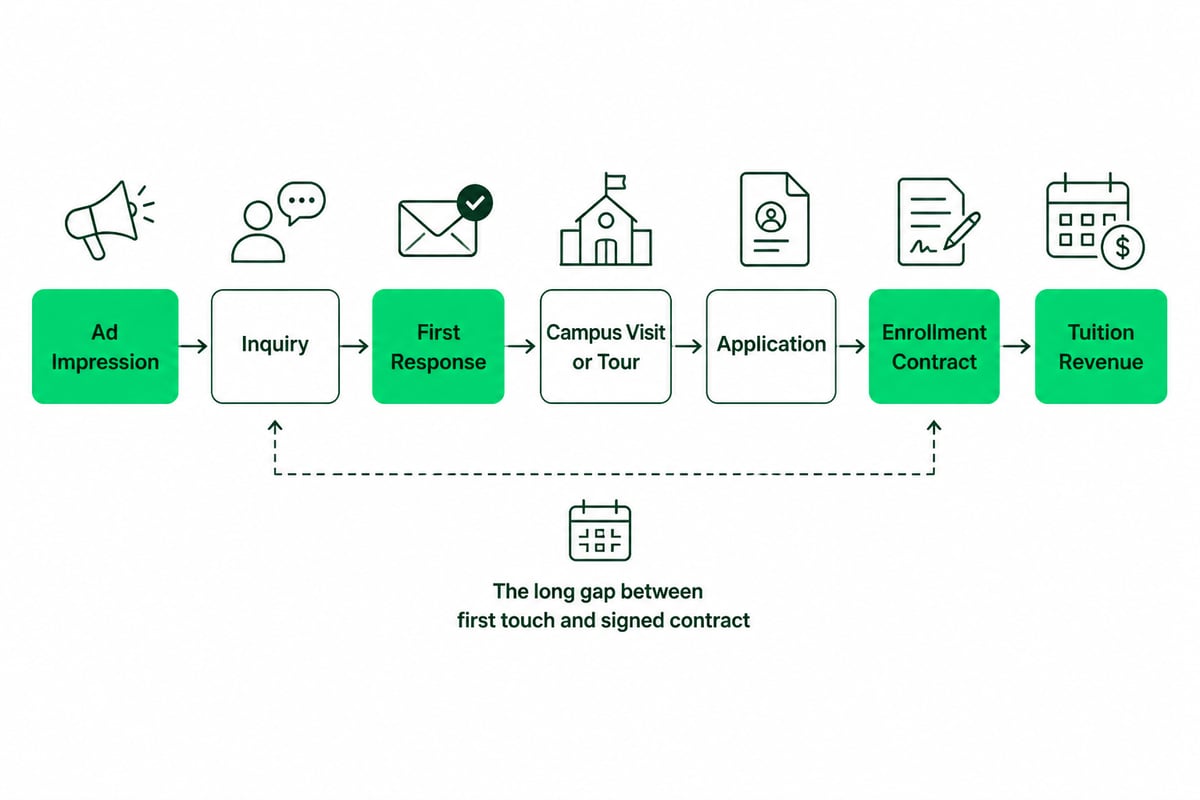
For an admissions leader, this means a reporting model must follow a family across months and several touchpoints. A dashboard that stops at cost per click cannot do that.
The Metrics That Separate Real ROI From Vanity Numbers
The metrics that prove ROI are those that connect spend to enrolled students: cost per qualified inquiry, inquiry-to-visit rate, visit-to-application rate, cost per enrolled student and projected tuition return.
Vanity metrics such as impressions, click-through rate and raw lead counts describe activity. They are useful for diagnosing a campaign, but they cannot show whether the school is growing. Ask any agency to report the following instead:
- Cost per qualified inquiry. Google Ads distinguishes between qualified and converted leads, which is a useful reminder that lead volume and lead quality are different measures. Define "qualified" with your admissions team before the campaign starts.
- Response time. Minutes between inquiry and first personal contact. This is the most controllable driver of conversion.
- Inquiry-to-visit rate. The share of inquiries that book a tour, shadow day or trial session.
- Visit-to-application and application-to-enrollment rates. These show where the funnel leaks.
- Cost per enrolled student. Total marketing and follow-up cost divided by confirmed enrollments.
- Return on spend. Lifetime or multi-year tuition from enrolled students compared with total cost.
Every figure should be traceable to a source in your CRM. If an agency cannot show you the path from a specific campaign to a specific enrolled family, the reported ROI is an estimate at best.
How to Build Attribution You Can Trust
Trustworthy attribution comes from tagging every campaign, recording the source of each inquiry in a CRM, and comparing more than one attribution model before moving budget.
Start with tracking. Google's guidance on generating leads and tracking website conversions explains how the Google tag records conversions and campaign performance, and it is a reasonable baseline for any school running paid search. Next, check how your analytics tool credits channels. Google Analytics lets you compare data-driven attribution with last-click models and review key-event paths across channels, which helps you see whether a channel that looks weak on last-click is actually starting many enrollment journeys. Google also publishes a guide to using advertising reports to assess media-spend ROI and compare attribution models before allocating budget.
Three habits keep the data honest:
- Ask every inquiring family how they heard about you, then compare the answer with the tracked source.
- Keep one CRM as the system of record, so ad data and enrollment outcomes live in the same place.
- Review attribution quarterly, not only at the end of an enrollment cycle.
Your website matters here too. A slow, confusing or poorly tracked site undermines everything upstream, and specialists such as Harley Oliver focus on website design and branding that support conversion. Whatever platform you use, confirm that forms, call tracking and booking tools all feed back into your reporting.
Speed-to-Lead: The Overlooked Revenue Lever
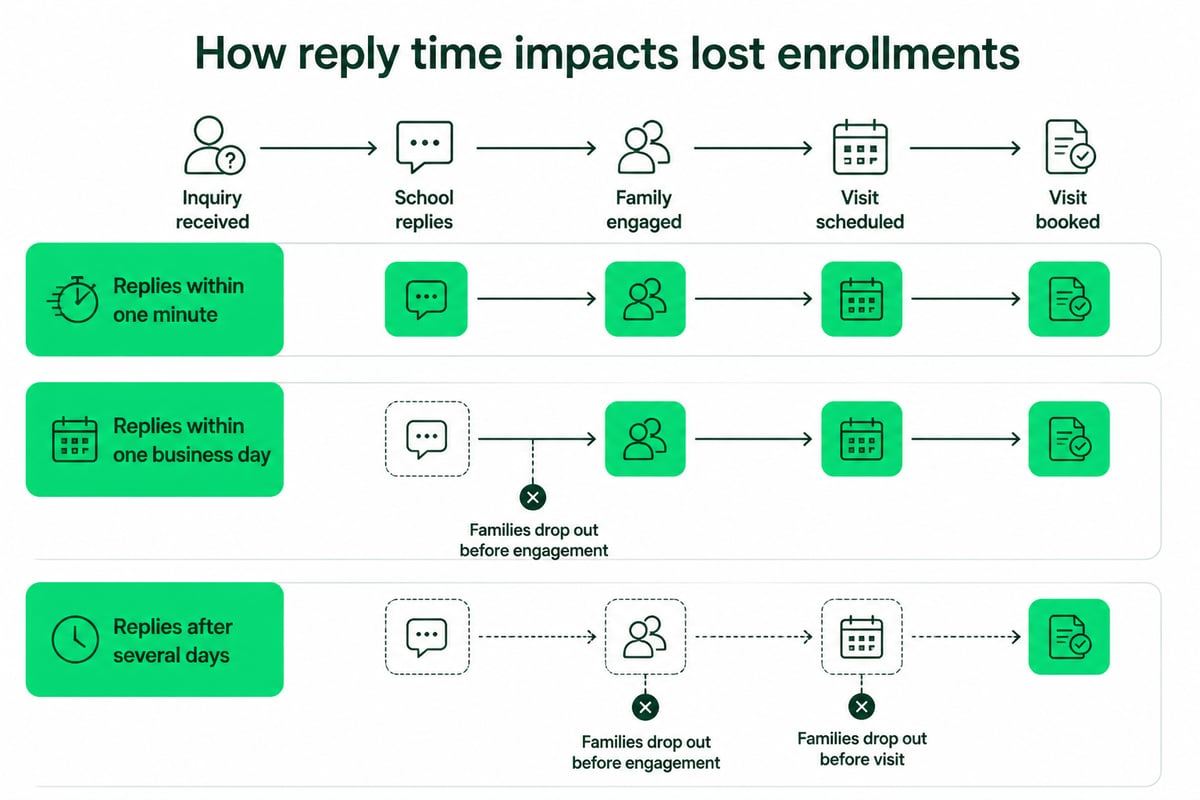
Speed-to-lead is the time between an inquiry and a real human response, and shortening it is often the fastest way to raise return on spend without increasing the ad budget.
Families inquiring about schools typically contact several institutions in the same week. The first to respond personally, with useful information and a clear next step, tends to shape the rest of the conversation. A reply that arrives the next business day competes against schools that answered within minutes.
Most admissions offices are not set up for this. Staff are in tours, meetings and events during the hours when families are browsing, and evenings and weekends go unanswered. The result is predictable: paid inquiries arrive, sit in an inbox and cool off.
An automated first response, followed by personal outreach, closes that gap. ScholarSurge, for example, sets a goal of fast inquiry response, which illustrates the standard worth asking any agency about. If a partner cannot state a response-time commitment, treat that as a gap in the system.
Pricing Models That Align Agency Incentives With Yours
The pricing model reveals whether an agency shares your risk: performance-based and guarantee-backed structures tie the agency's income to your enrollment results, while flat retainers and ad-spend percentages do not.
| Pricing model | How it works | Risk to the school |
|---|---|---|
| Flat monthly retainer | Fixed fee regardless of results | High: you pay whether or not students enroll |
| Percentage of ad spend | Fee rises with budget | High: the agency benefits from spending more, not from enrolling more |
| Per-lead pricing | Fee for each lead delivered | Medium: quality and follow-up are not guaranteed |
| Performance-based | Fee tied to enrolled students | Lower: payment follows the outcome you want |
ScholarSurge describes its fees as tied to enrollment results and guarantees 50+ qualified inquiries in the first 90 days. Treat any projected return as a planning figure and ask to see the assumptions behind it, which is good practice with any agency.
Whatever model you choose, read the contract for minimum terms, ownership of ad accounts and data, and what happens when targets are missed.

Matching the Agency to Your Type of Institution
A strong agency tailors its approach to your institution type, because a day school, a boarding program, a university and a sports academy each recruit different audiences through different channels.
Independent and private schools depend on parent trust, visit experiences and local reputation, so campaigns lean on proof, testimonials and tour booking. This overview of private school marketing strategies covers that dynamic in more detail. Colleges and universities face longer consideration windows and multiple stakeholders; best higher education marketing strategies outlines how that changes channel mix. Sports academies recruit both athletes and parents, and trial sessions often replace campus tours as the key conversion event.
When you evaluate agencies, ask for examples from institutions of your size and category in North America. Experience with a similar admissions calendar, tuition structure and competitive set will shorten the learning curve considerably. Generalist agencies that also serve retail, SaaS or hospitality clients rarely understand the pacing of an admissions season.
Compliance and Claims: Protect Your Reputation
Compliant marketing avoids misleading statements about outcomes, costs, accreditation and completion, and a ROI-focused agency should review every claim before it goes live.
Aggressive conversion tactics can create risk when they overstate results. The Federal Trade Commission's rules for private vocational and distance-education schools, found in 16 CFR Part 254, prohibit misleading advertising about outcomes, costs, accreditation and completion. Not every school falls under that specific rule, but it is a useful benchmark for honest claims in any education advertising.
Practical safeguards include:
- Substantiate every statistic, ranking and outcome claim with a source you can produce on request.
- Keep tuition, fee and aid language consistent across ads, landing pages and follow-up messages.
- Make sure automated messages identify your school clearly and offer an easy way to opt out.
Ethical marketing also protects the long-term metric that matters most: families who enroll with accurate expectations stay longer and refer others.
Questions to Ask Before You Hire
Before you hire, ask direct questions about measurement, ownership, response time and accountability, and expect specific answers rather than general assurances.
- How do you define a qualified inquiry, and who agrees to that definition?
- Which system records the source of every enrolled student?
- What is your response-time standard, and how is it measured?
- Who owns the ad accounts, landing pages and data if we end the engagement?
- How is your fee tied to enrollment outcomes?
- What happens if the inquiry or enrollment targets are not met?
- Can you show results from institutions similar to ours in size and region?
A partner confident in its system will answer each of these plainly. Hesitation on ownership, definitions or targets deserves follow-up before you sign. For a broader comparison of what the category offers, this guide to the education marketing agency landscape is a useful reference.
Where ScholarSurge Fits
ScholarSurge fits schools, colleges, universities and sports academies in North America that want paid demand generation, fast inquiry response and CRM automation run as one accountable system. Its Surge System is a done-for-you enrollment engine that combines paid demand generation, rapid inquiry response, tour and visit booking and CRM automation under a single monthly retainer, so one team owns the path from ad to enrolled student. It is built for enrollment growth, so schools looking for scholarship or financial aid services, or a generalist marketing agency outside education, will find a better match elsewhere.
Your next step is simple: pull your last 12 months of inquiries, count how many received a personal reply within an hour, and note how many became enrolled students. That baseline shows exactly where your return is leaking and gives you a concrete benchmark for any agency you speak with. If you want an outside read on those numbers, ScholarSurge can walk through them with you in a conversation where you can Book Your Free Enrollment Audit and see where faster response and tighter follow-up would recover seats.