Insights
Student Admissions: Proven Systems to Fill Enrollment
Master student admissions with data-driven strategies, automation, and systems that convert inquiries into enrolled students in 2026.
READING TIME · 10 MIN · UPDATED QUARTERLY

The landscape of student admissions has transformed dramatically over the past decade, with institutions facing unprecedented challenges in attracting and converting qualified applicants. Schools, colleges, universities, and sports academies now compete in an increasingly digital marketplace where prospective families expect instant responses, personalized communication, and seamless enrollment experiences. The institutions that thrive in 2026 are those that have moved beyond traditional recruitment methods to implement systematic, data-driven approaches that guarantee results. Understanding how to optimize every stage of the admissions funnel-from initial inquiry to final enrollment-separates schools that struggle to fill seats from those that consistently meet or exceed their enrollment targets.
The Evolution of Student Admissions in 2026
Student admissions processes have undergone radical transformation driven by technological advancement and changing family expectations. Traditional paper applications and weeks-long response times no longer meet the standards prospective students demand. According to the National Student Clearinghouse Research Center, enrollment patterns have shifted significantly, with institutions needing to adapt quickly to demographic changes and competitive pressures.
Modern families research educational options extensively online before making any direct contact with an institution. They compare programs, read reviews, watch virtual tours, and evaluate social media presence-all before submitting an inquiry. This shift means the student admissions journey begins long before an application form is completed.
Key factors driving admissions changes include:
- Increased price sensitivity and demand for clear value propositions
- Expectations for immediate, personalized communication
- Greater reliance on peer reviews and social proof
- Preference for digital-first engagement over phone calls
- Demand for transparency around outcomes and career placement
The most successful institutions have recognized that student admissions is no longer a seasonal activity managed by a small team during specific months. Instead, it requires year-round, systematic effort with multiple touchpoints designed to build relationships with prospective families over time.
The Critical First Response Window
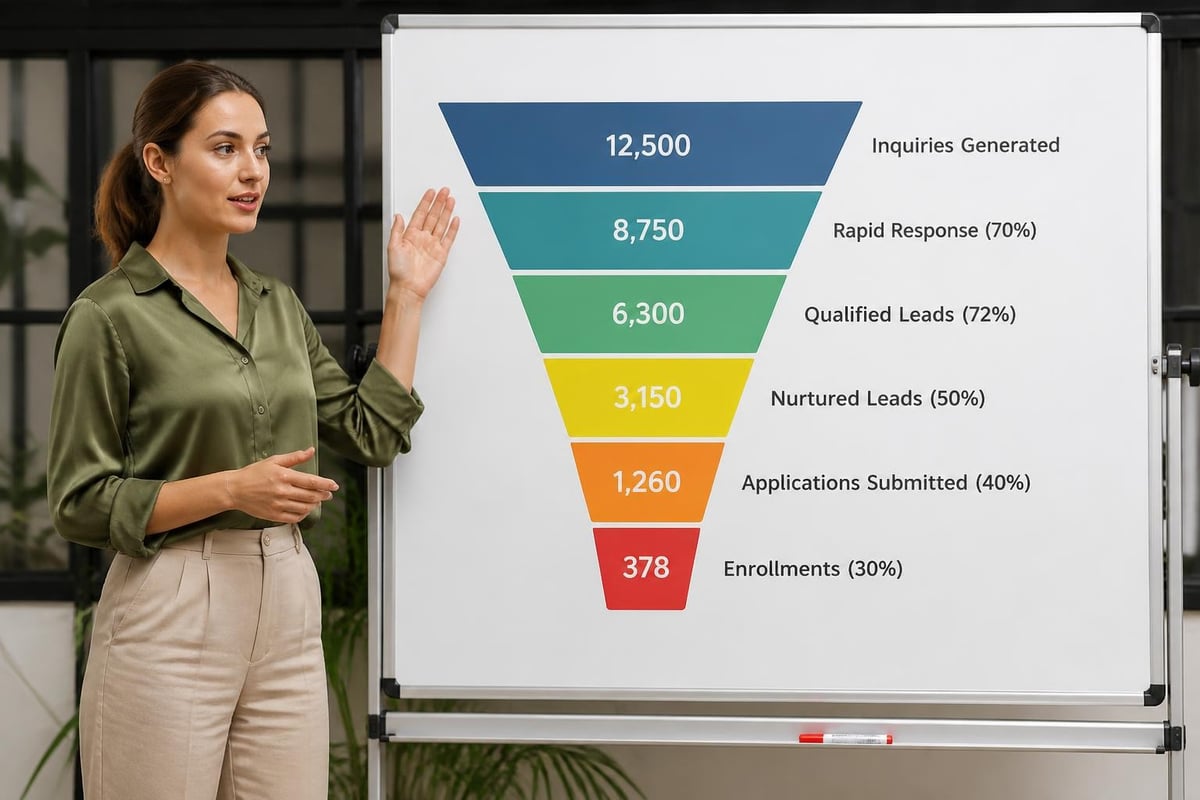
Research consistently demonstrates that response speed dramatically impacts conversion rates in student admissions. When a prospective family submits an inquiry, they typically contact multiple institutions simultaneously. The first school to respond professionally and helpfully establishes an immediate competitive advantage.
Data shows that inquiries responded to within five minutes are 21 times more likely to convert than those receiving responses after 30 minutes. Yet many institutions still operate with 24-48 hour response windows, unknowingly eliminating their chances with the majority of prospects.
Implementing school admissions automation systems addresses this challenge by ensuring immediate acknowledgment, scheduling follow-up conversations, and routing inquiries to appropriate team members based on program interest, location, or other qualifying factors.
Building a Systematic Approach to Student Admissions
A systematic student admissions process treats enrollment growth as a predictable, measurable outcome rather than hoping for sufficient applications each cycle. This approach requires clear metrics, defined processes, and accountability at every stage.
Essential Components of an Effective System
| Component | Purpose | Key Metrics |
|---|---|---|
| Lead Generation | Attract qualified prospects | Cost per inquiry, inquiry volume, source quality |
| Rapid Response | Engage prospects immediately | Response time, contact rate, conversation booking rate |
| Qualification | Identify fit and readiness | Qualification rate, application timeline, financial capacity |
| Nurturing | Build relationships over time | Engagement rate, email opens, content consumption |
| Application Support | Guide through completion | Application start rate, completion rate, submission time |
| Enrollment Conversion | Secure commitment | Acceptance to enrollment ratio, deposit rate, yield |
Each component requires specific strategies, tools, and team responsibilities. Many institutions excel at generating inquiries through marketing but fail to convert them due to weak response systems or insufficient nurturing. The education lead generation process must connect seamlessly to enrollment systems to maximize return on investment.
Qualifying Prospects Effectively
Not all inquiries represent equally qualified prospects. Effective student admissions systems include qualification frameworks that help teams prioritize efforts toward families most likely to enroll. This prevents wasting resources on prospects who lack genuine interest, cannot afford the program, or don't meet basic eligibility requirements.
Key qualification criteria include:
- Timeline for enrollment decision
- Financial capacity and aid requirements
- Academic or athletic fit with program requirements
- Geographic considerations and relocation willingness
- Level of engagement and responsiveness
- Decision-maker involvement in the process
Schools serving different segments need tailored approaches. For example, K-12 enrollment marketing requires engaging both students and parents, while higher education enrollment marketing often focuses primarily on the student as the decision-maker, though family influence remains significant.
Leveraging Data and Analytics in Student Admissions
Data-driven decision-making separates high-performing student admissions operations from those relying on intuition and tradition. Institutions must track, analyze, and act on metrics throughout the enrollment funnel to identify bottlenecks, optimize processes, and forecast results accurately.
The NACAC State of College Admission report provides valuable benchmarks for institutions to compare their performance against sector trends. Understanding where your conversion rates, yield, and other metrics stand relative to peers helps identify improvement opportunities.
Critical Metrics to Monitor
Effective student admissions teams establish dashboards tracking leading and lagging indicators. Leading indicators predict future enrollment outcomes, while lagging indicators confirm results after the fact.
Leading indicators include:
- Inquiry volume by source and week
- Initial response time averages
- Qualification-to-application conversion rate
- Engagement with nurture communications
- Campus visit or virtual event attendance
Lagging indicators include:
- Total applications submitted
- Acceptance to enrollment yield
- Final enrollment against target
- Cost per enrolled student
- Revenue per enrollment cohort
Advanced institutions segment this data by program, geography, student type, and acquisition source to understand which marketing investments and recruitment strategies deliver the strongest returns. This granular analysis enables budget reallocation toward high-performing channels and elimination of ineffective spending.

Automation's Role in Modern Admissions
Automation technology has become essential infrastructure for competitive student admissions operations. Manual processes cannot deliver the speed, consistency, and personalization that modern prospects expect at scale.
Strategic automation handles repetitive tasks while enabling human team members to focus on high-value activities like relationship building, complex questions, and final enrollment conversion conversations. The school enrollment services landscape has evolved significantly, with sophisticated platforms now available to institutions of all sizes.
Addressing Test-Optional Policies and Holistic Review
The shift toward test-optional admissions policies represents one of the most significant changes in student admissions practices over recent years. The College Board's 2024 SAT Suite Annual Report documents declining test-taking rates as more institutions eliminate standardized testing requirements.
This transition requires admissions teams to evaluate applicants using broader criteria and more holistic review processes. While this approach can promote access and diversity, it also increases the complexity of student admissions decisions and the time required to review each application thoroughly.
Implementing Holistic Review Effectively
Holistic review examines applicants' full profiles rather than relying primarily on test scores and GPA. This approach considers academic achievement within context, extracurricular involvement, personal qualities, recommendation strength, and demonstrated interest.
Components of effective holistic review:
- Clear rubrics ensuring consistent evaluation standards
- Training for all admissions staff on evaluation criteria
- Multiple readers for applications to reduce individual bias
- Documentation of decision-making rationale
- Regular calibration sessions to maintain standards
Research from the National Bureau of Economic Research on test-optional policies suggests that while these policies can broaden applicant pools, institutions must design them carefully to avoid unintended consequences for disadvantaged or high-achieving students.
Managing Compliance and Student Privacy
Student admissions processes handle sensitive personal information requiring strict compliance with privacy regulations. The U.S. Department of Education's Student Privacy Policy Office provides comprehensive guidance on FERPA requirements and best practices for protecting applicant and student records.
Institutions must implement secure systems for collecting, storing, and sharing admissions data. This includes ensuring proper consent for marketing communications, limiting data access to authorized personnel, and maintaining audit trails of who accesses applicant information.
| Privacy Consideration | Implementation Requirement |
|---|---|
| Data collection | Clear disclosure of what's collected and how it's used |
| Storage security | Encrypted databases with access controls |
| Third-party sharing | Written agreements and limited data transfer |
| Applicant rights | Process for reviewing and correcting records |
| Retention policies | Defined timelines for destroying old records |
Beyond legal compliance, privacy protection builds trust with prospective families. Transparent communication about how student admissions teams use personal information and strong security practices differentiate professional institutions from those with lax data handling.
Optimizing the Application Experience
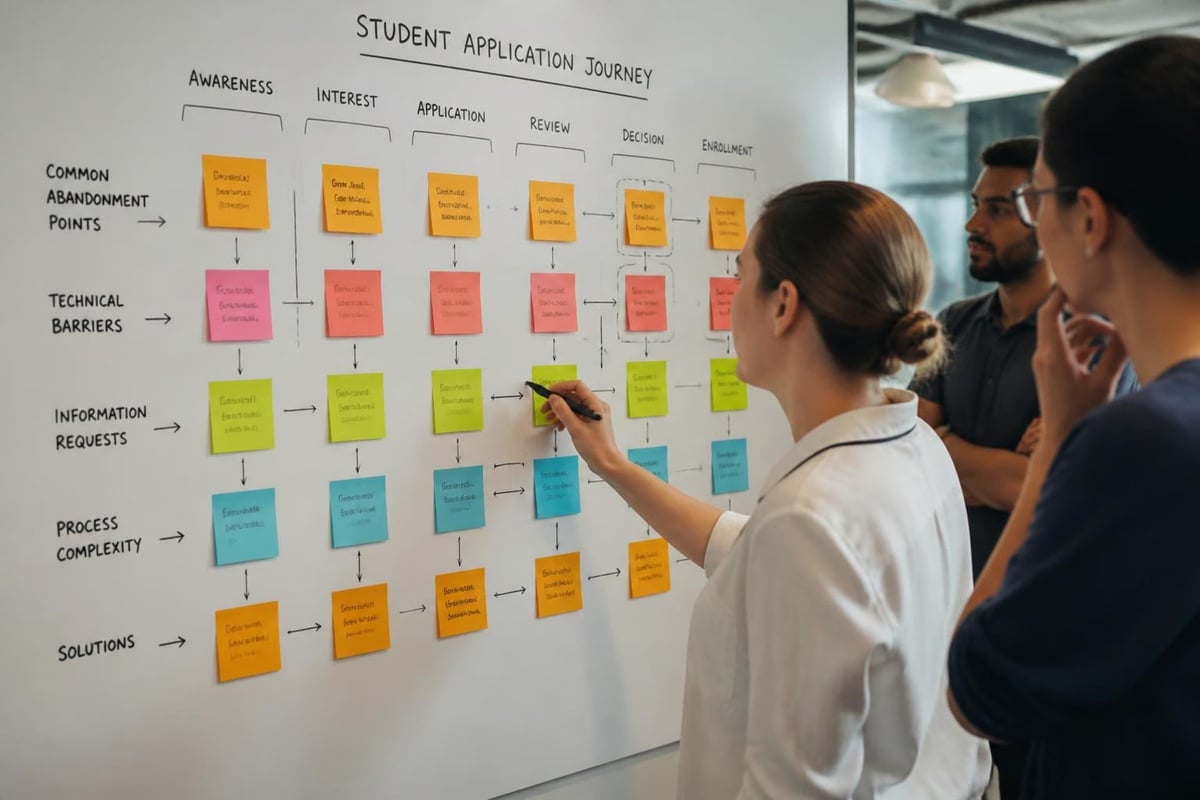
The application itself represents a critical conversion point in the student admissions funnel. Many qualified prospects begin applications but abandon them due to excessive length, technical problems, or unclear instructions.
Analysis of application abandonment patterns reveals specific friction points where prospects disengage. Common issues include requiring information applicants don't have readily available, confusing navigation between application sections, and unclear fee payment processes.
Strategies to Improve Application Completion
- Simplify information requests: Only collect truly necessary data at the application stage. Additional details can be gathered after acceptance.
- Enable save-and-return functionality: Allow applicants to complete applications over multiple sessions without losing progress.
- Provide clear progress indicators: Show applicants how much remains and estimated time to completion.
- Offer multiple payment options: Accept various payment methods for application fees and provide fee waiver processes.
- Include contextual help: Provide explanations and examples for questions that commonly confuse applicants.
- Optimize for mobile devices: Ensure applications function properly on phones and tablets, not just computers.
- Send abandonment reminders: Automatically follow up with applicants who start but don't complete applications.
Schools implementing these improvements typically see 15-30% increases in application completion rates from the same inquiry volume, directly impacting enrollment without additional marketing spend.
Nurturing Long-Term Relationships
Student admissions rarely converts prospects instantly. Most families research options for months before making enrollment decisions, particularly for significant investments like boarding schools, colleges, or specialized sports academies.
Systematic nurturing keeps your institution top-of-mind throughout the decision process. This involves strategic communication sequences delivering value, answering common questions, and building emotional connections to the school community.
Effective nurture content includes:
- Student and alumni success stories demonstrating outcomes
- Behind-the-scenes content showcasing campus culture
- Expert insights from faculty on relevant topics
- Virtual events enabling prospect interaction with current families
- Personalized program information based on expressed interests
The student recruitment services approach recognizes that different prospects require different nurture sequences based on their timeline, interests, and stage in the enrollment journey.
Segmentation Strategies for Personalization
Generic mass communications no longer engage sophisticated education consumers. Prospects expect relevant, personalized content addressing their specific situations and interests.
Effective segmentation divides prospect databases into meaningful groups receiving tailored messaging. Common segmentation approaches include program interest, geographic location, inquiry source, timeline to enrollment, academic level, and engagement history.
Advanced institutions create buyer personas representing typical family profiles, then develop content and communication strategies specifically for each persona. A family researching boarding schools for athletic development requires different messaging than one seeking advanced academic programs, even though both might attend the same institution.
The Role of Virtual and In-Person Experiences
Campus visits remain powerful conversion tools in student admissions, with prospects who visit enrolling at significantly higher rates than those who don't. However, geography, schedules, and cost constraints prevent many qualified prospects from visiting in person.
Virtual experiences have evolved beyond simple video tours to include interactive sessions, live Q&A with current students, virtual open houses, and one-on-one video consultations with admissions counselors. These digital touchpoints extend reach while preserving much of the relationship-building value of in-person interactions.
Best practices for virtual engagement:
- High-quality production values that reflect institutional standards
- Interactive elements allowing prospects to ask questions
- Current students and alumni as primary presenters
- Recordings available on-demand for those unable to attend live
- Clear next steps and calls-to-action following each experience
Schools serving international students particularly benefit from robust virtual engagement programs, as geography often prevents multiple in-person visits before enrollment decisions.
Converting Applications to Enrollments
Student admissions success ultimately depends on converting accepted applicants into enrolled students. The period between acceptance and enrollment deposit represents the final critical phase where institutions compete for prospect commitment.
Yield rates-the percentage of accepted students who enroll-vary significantly across institution types and selectivity levels. Understanding your historical yield patterns and the factors influencing prospect decisions enables strategic intervention to improve conversion.
Yield Enhancement Strategies
Accepted students require different communication than applicants under review. Post-acceptance nurturing should shift from persuading prospects to apply toward helping them envision themselves as successful members of your community.
Tactics that improve yield include:
- Personalized acceptance packages with program-specific information
- Financial aid award presentations emphasizing total value beyond sticker price
- Connection opportunities with current students in similar programs
- Admitted student events (virtual and in-person) building community
- Department-specific outreach from faculty and program directors
- Clear deadline communication and streamlined enrollment processes
- Proactive addressing of common concerns and objections
Research from the Brookings Institution on supporting students through college emphasizes that reducing complexity in application and enrollment processes significantly improves outcomes, particularly for first-generation and underrepresented students.
Addressing Equity and Access in Student Admissions
Modern student admissions must balance institutional enrollment goals with commitments to equity, diversity, and access. Recent legal and policy changes, including restrictions on race-conscious admissions, require new approaches to building diverse student bodies.
Institutions committed to diversity now emphasize socioeconomic factors, first-generation status, geographic diversity, and holistic review of applicants' experiences overcoming challenges. According to Inside Higher Ed's analysis of affirmative action changes, schools are experimenting with various strategies to maintain diverse enrollments within new legal frameworks.
Practical Access Initiatives
Beyond admissions policy, operational practices significantly impact which students ultimately enroll. Application fee waivers, simplified financial aid processes, translation of materials for non-English-speaking families, and targeted outreach to underrepresented communities all expand access.
Private school marketing strategies increasingly emphasize affordability messaging and financial aid availability to reach families who might otherwise assume programs are financially out of reach. Clear communication about scholarship opportunities and payment plans removes psychological barriers to inquiry and application.
Effective student admissions in 2026 requires systematic approaches combining rapid response, strategic nurturing, data-driven decision-making, and optimized processes at every funnel stage. Institutions that implement these proven strategies consistently fill enrollment targets while their competitors struggle with unpredictable results. ScholarSurge specializes in building complete enrollment growth systems for schools, colleges, universities, and sports academies, guaranteeing increased qualified inquiries and applications through automated systems that function as your virtual enrollment team.