Insights
School Enrollment Consulting: A Complete Guide
Discover how school enrollment consulting transforms admissions strategies with data-driven systems, automation, and proven growth tactics.
READING TIME · 11 MIN · UPDATED QUARTERLY

Educational institutions face mounting pressure to maintain healthy enrollment numbers in an increasingly competitive marketplace. Declining birth rates, shifting demographics, and evolving family expectations have fundamentally altered the landscape for schools, colleges, universities, and specialized programs. School enrollment consulting has emerged as a critical service that helps institutions develop systematic approaches to attract, engage, and convert prospective students and families through data-driven strategies and automated processes.
Understanding the Modern Enrollment Challenge
The enrollment environment in 2026 presents unique obstacles for educational leaders. According to federal enrollment data from the National Student Clearinghouse, postsecondary institutions continue to experience volatility in student numbers, with some sectors seeing consistent declines while others show modest growth. Meanwhile, demographic projections from the U.S. Census Bureau indicate ongoing shifts in school-age populations that vary dramatically by region and community type.
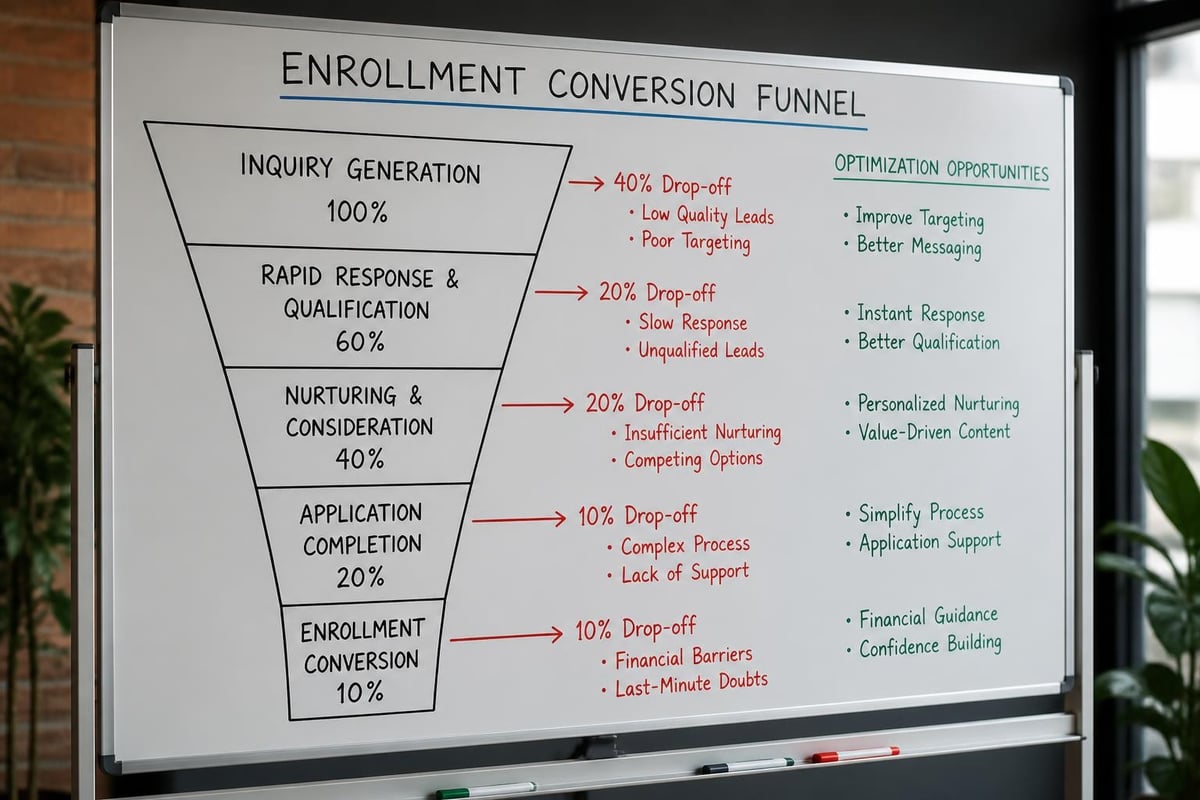
School enrollment consulting addresses these challenges by transforming how institutions approach the entire enrollment funnel. Rather than relying on traditional marketing tactics or reactive admissions processes, professional consultants build comprehensive systems that generate predictable inquiry volumes, nurture relationships systematically, and convert prospects at higher rates.
The Gap Between Inquiry and Enrollment
Most educational institutions struggle with a critical weakness: the journey from initial inquiry to completed enrollment. Families research multiple options simultaneously, expect immediate responses, and abandon the process when schools fail to provide timely, personalized engagement.
Research from the National School Public Relations Association on K-12 customer experience reveals that communication speed and consistency directly impact family satisfaction and enrollment decisions. Schools that implement rapid response protocols and systematic follow-up dramatically outperform competitors who rely on manual, inconsistent processes.
Core Components of Effective School Enrollment Consulting
Professional school enrollment consulting encompasses multiple strategic elements that work together to create sustainable enrollment growth. Each component addresses specific weaknesses in traditional admissions approaches while building institutional capacity for long-term success.
Strategic Enrollment Audits and Planning
Every engagement begins with comprehensive analysis of current enrollment performance. Consultants examine historical data, conversion metrics, inquiry sources, response times, communication workflows, and competitive positioning. This diagnostic phase reveals exactly where prospects exit the funnel and which processes require immediate attention.
| Audit Component | Key Metrics Analyzed | Common Findings |
|---|---|---|
| Inquiry Generation | Volume, sources, cost-per-lead, quality scores | Overreliance on referrals, missed digital opportunities |
| Response Systems | Time-to-contact, response rates, channel mix | Delays beyond 24 hours, no automated acknowledgment |
| Nurture Sequences | Email open rates, engagement, touchpoint frequency | Inconsistent follow-up, generic messaging |
| Conversion Performance | Application rates, completion rates, yield | Drop-off at application stage, no abandonment recovery |
The audit creates a baseline for measuring improvement and identifies quick wins that generate immediate results. Schools implementing enrollment growth strategies based on thorough diagnostics typically see measurable improvements within the first enrollment cycle.
Automated Inquiry Management Systems
Manual inquiry handling creates inevitable delays, inconsistencies, and missed opportunities. School enrollment consulting prioritizes implementation of automated systems that acknowledge every inquiry instantly, route prospects appropriately, and trigger systematic follow-up sequences without requiring staff intervention.
Modern school admissions automation platforms integrate with existing student information systems, CRM databases, and communication tools. When a family submits an inquiry form, completes a download, or attends a virtual event, the system immediately captures their information, sends personalized acknowledgment, assigns to appropriate staff, and initiates tailored nurture sequences based on program interest, grade level, and engagement behavior.
These automated workflows ensure no prospect falls through cracks while freeing admissions teams to focus on high-value personal interactions. Schools can maintain consistent communication standards even during peak inquiry periods when manual processes would inevitably fail.
Building High-Conversion Enrollment Funnels
School enrollment consulting transforms the traditional admissions process into a structured funnel with defined stages, clear success metrics, and systematic advancement mechanisms. This approach applies proven marketing and sales principles to educational enrollment while respecting the unique considerations families face when choosing schools.
Rapid Response Protocols That Convert
Speed matters dramatically in enrollment outcomes. Families contacting multiple schools simultaneously typically engage most seriously with institutions that respond first. Yet most schools average 48-72 hours for initial contact, effectively eliminating themselves from consideration before conversations begin.
Professional consultants implement rapid response systems ensuring contact within minutes for digital inquiries. This combines automated acknowledgment with real-time notifications to admissions staff and scheduled follow-up tasks. For K-12 institutions, this might mean immediate text confirmation followed by phone outreach within two hours. For higher education programs, it could involve instant resource delivery with scheduled advisor connection.
Essential rapid response elements include:
- Automated email or text acknowledgment within 60 seconds
- Real-time alert to appropriate admissions staff member
- Scheduled follow-up tasks with specific deadlines
- Escalation protocols for high-value prospects
- Multi-channel contact attempts (email, phone, text)
- Documented interaction history for seamless handoffs
Schools implementing these protocols consistently achieve 40-60% higher conversion rates from inquiry to application compared to institutions with traditional response patterns.

Specialized Consulting for Different Educational Sectors
School enrollment consulting adapts strategies and tactics based on institutional type, target demographics, and competitive dynamics. What works for private K-12 schools differs significantly from effective approaches for community colleges, specialized academies, or graduate programs.
Private and Independent School Enrollment
Private schools face unique enrollment challenges including tuition sensitivity, competitive local markets, and family expectations for personalized service. Effective private school enrollment strategies emphasize differentiation, community building, and financial aid transparency.
Consultants working with independent schools typically focus on creating exceptional inquiry experiences that reflect institutional values, developing targeted campaigns for specific grade entry points, and building referral systems that leverage current families. The Education Trust's recent research on equity and access provides valuable context for schools working to expand access while maintaining financial sustainability.
Higher Education Enrollment Systems
Colleges and universities require sophisticated enrollment systems managing multiple programs, diverse student segments, and complex decision journeys. Higher education enrollment marketing involves coordinating undergraduate recruitment, graduate program promotion, adult learner engagement, and continuing education offerings.
Professional consultants help institutions segment audiences effectively, personalize communication based on program interest and student characteristics, and create appropriate nurture sequences for different decision timelines. Traditional-age undergraduates require different approaches than working adults pursuing graduate degrees or career changers exploring certificate programs.
Sports Academy and Specialized Program Consulting
Sports academies and specialized training programs face distinct enrollment dynamics. Families evaluate these programs based on coaching quality, athlete development track records, facility quality, and competitive opportunities. School enrollment consulting for these organizations emphasizes showcasing outcomes, leveraging alumni success stories, and creating clear pathways from inquiry to enrollment.
Video content, virtual facility tours, and coach introductions become critical conversion tools. Automated systems can trigger personalized coach outreach based on sport interest, competitive level, and geographic location, creating connections that traditional marketing cannot achieve.
Technology Infrastructure for Enrollment Growth
Modern school enrollment consulting relies heavily on technology platforms that enable automation, personalization at scale, and data-driven optimization. Consultants assess existing technology stacks, identify gaps, and implement integrated systems that support sustainable enrollment growth.
Essential Technology Components
| System Type | Primary Function | Integration Requirements |
|---|---|---|
| CRM Platform | Centralized prospect database, interaction tracking | Student information system, email, phone |
| Marketing Automation | Email sequences, behavioral triggers, lead scoring | CRM, website, forms, event registration |
| Communication Tools | Multi-channel outreach, SMS, call tracking | CRM, calendar, task management |
| Analytics Dashboard | Performance monitoring, funnel analysis, attribution | All inquiry sources, CRM, enrollment system |
The right technology stack varies by institutional size, budget, and existing infrastructure. Small independent schools might implement all-in-one platforms like HubSpot or Salesforce Education Cloud, while larger universities often use specialized enrollment management systems integrated with enterprise CRM solutions.
Effective education lead generation depends on seamless data flow between marketing channels, inquiry capture mechanisms, and enrollment systems. Consultants ensure technical integration supports rather than hinders enrollment team workflows.
Data-Driven Optimization and Continuous Improvement
School enrollment consulting extends beyond initial system implementation to ongoing performance monitoring and optimization. The most successful institutions treat enrollment as a continuous improvement process, testing new approaches, measuring results, and refining based on data.
Key Performance Indicators for Enrollment Systems
Professional consultants establish clear metrics aligned with institutional goals and enrollment targets. These KPIs provide objective measures of system performance and highlight opportunities for improvement.
Critical enrollment metrics include:
- Inquiry volume by source - Tracks which marketing channels generate prospects
- Cost per inquiry - Measures efficiency of paid acquisition channels
- Inquiry-to-application conversion rate - Indicates nurture system effectiveness
- Application completion rate - Reveals friction points in application process
- Yield rate - Measures acceptance-to-enrollment conversion
- Time in funnel - Identifies process delays and bottlenecks
- Net enrollment growth - Ultimate measure of system success
Monthly dashboard reviews enable enrollment teams to identify trends, celebrate wins, and address underperforming areas quickly. According to AACRAO's consulting best practices, regular performance analysis separates high-performing enrollment operations from those struggling to meet targets.

Family Engagement as Enrollment Strategy
Forward-thinking school enrollment consulting recognizes that enrollment success depends on authentic family engagement throughout the prospect journey. Research from Carnegie Corporation on family engagement demonstrates that meaningful family partnerships improve outcomes across educational settings.
Enrollment systems should facilitate rather than complicate family engagement. This means creating multiple entry points for questions, providing transparent information about programs and costs, and demonstrating institutional culture through every interaction. The GreatSchools analysis of family engagement barriers reveals common obstacles that enrollment processes can either exacerbate or eliminate.
Creating Personalized Family Experiences
Automation enables rather than replaces personalization when implemented thoughtfully. School enrollment consulting helps institutions use technology to deliver individually relevant experiences based on expressed interests, student characteristics, and engagement behaviors.
A family researching middle school options should receive content focused on that specific transition, highlighting relevant programs, introducing grade-level teachers, and addressing common parent questions about the middle school experience. Meanwhile, families exploring early childhood programs need entirely different information addressing developmental philosophy, daily schedules, and early learning approaches.
Sophisticated segmentation allows schools to maintain this relevance across hundreds or thousands of concurrent prospects without overwhelming staff. Automated sequences deliver appropriate content while flagging high-engagement prospects for personalized outreach from admissions counselors.
Building Sustainable Enrollment Systems
The ultimate goal of school enrollment consulting extends beyond immediate enrollment gains to building institutional capacity for sustained growth. This requires developing internal expertise, establishing clear processes, and creating accountability structures that outlast consultant engagements.
Staff Training and Development
Successful consulting engagements include comprehensive training ensuring enrollment teams can operate and optimize systems independently. This covers CRM usage, communication best practices, data analysis, and continuous improvement methodologies. Schools investing in student recruitment services gain both immediate results and long-term capabilities.
Documentation becomes critical for sustainability. Process maps, response templates, sequence workflows, and decision trees enable consistent execution even as staff members change roles or new team members join.
Enrollment Team Structure and Roles
Many schools struggle with unclear enrollment responsibilities distributed across multiple departments without coordination. Professional consultants help define clear ownership, establish collaboration protocols, and create accountability for specific outcomes.
Effective enrollment team structure includes:
- Dedicated inquiry management responsible for initial contact and qualification
- Admissions counselors focused on relationship building and conversion
- Marketing specialists generating qualified inquiry volume
- Enrollment operations ensuring system functionality and data integrity
- Leadership providing strategic direction and resource allocation
Role clarity eliminates gaps where prospects fall through organizational cracks while preventing duplicative effort that wastes resources and confuses families.
Measuring Return on Investment
School enrollment consulting requires investment of both financial resources and leadership attention. Institutions rightfully expect measurable returns justifying these commitments. Professional consultants establish clear ROI frameworks before engagement begins, tracking both quantitative outcomes and qualitative improvements.
The most direct ROI calculation compares incremental tuition revenue from additional enrollments against consulting fees and implementation costs. Schools enrolling ten additional students at $20,000 annual tuition generate $200,000 in revenue. If consulting investment totals $50,000, the first-year ROI exceeds 300% before considering retention and referral benefits.
| Investment Category | Typical Range | Expected Outcomes |
|---|---|---|
| Initial consulting engagement | $25,000-$75,000 | System design, implementation, training |
| Technology platforms (annual) | $5,000-$50,000 | Automation, CRM, analytics capabilities |
| Staff time and training | Variable | Internal capacity building |
| Total first-year investment | $30,000-$125,000 | 15-50+ incremental enrollments |
Beyond direct enrollment gains, effective systems reduce cost-per-enrollment by improving conversion efficiency, decrease staff time spent on manual tasks, and improve family satisfaction scores. The Condition of Education data provides broader context for enrollment trends informing realistic growth expectations.
Selecting the Right Enrollment Consulting Partner
Not all school enrollment consulting services deliver equal value. Institutions should evaluate potential partners based on relevant experience, methodology, technology capabilities, and cultural fit with institutional values.
Critical Evaluation Criteria
Experience and track record - Request specific case studies from similar institutions including baseline metrics, interventions implemented, and measurable outcomes achieved. Generalist marketing agencies often lack the specialized enrollment expertise required for educational contexts.
Methodology and approach - Understand the consultant's process from audit through implementation and ongoing optimization. Avoid partners promising quick fixes without systematic approaches or those offering one-size-fits-all solutions without customization.
Technology expertise - Verify familiarity with education-specific platforms and integration capabilities. The best strategies fail without proper technical implementation.
Training and sustainability focus - Ensure the engagement includes knowledge transfer enabling independent operation after formal consulting concludes.
Schools can benefit from exploring comprehensive enrollment growth systems that combine strategic consulting with implementation support and ongoing optimization.
Integrating Enrollment with Institutional Strategy
School enrollment consulting delivers maximum impact when aligned with broader institutional strategy rather than treated as isolated marketing function. Enrollment goals should reflect mission, support financial sustainability, and enable programmatic excellence.
Strategic enrollment management considers capacity constraints, desired student body composition, geographic diversity, and financial aid budgets. Consultants help institutions define ideal enrollment profiles balancing mission fulfillment with operational realities.
This strategic approach prevents the common mistake of maximizing enrollment volume at the expense of student fit, program quality, or financial health. A boarding school with 300-student capacity gains nothing from generating 500 applications if facilities cannot accommodate growth. Better outcomes come from optimizing yield among ideal-fit prospects while maintaining selectivity standards.
Policy and Compliance Considerations
School enrollment consulting must navigate complex regulatory environments affecting recruitment practices, data privacy, and communications. Federal laws including FERPA, state-level education regulations, and platform-specific policies all constrain enrollment activities.
The National Association of State Boards of Education guidance on family engagement policies provides useful context for understanding policy environments affecting enrollment practices. Consultants ensure recommended strategies comply with applicable regulations while maximizing effectiveness within legal boundaries.
Data privacy deserves particular attention given increasing scrutiny of how institutions collect, store, and use prospect information. GDPR principles, though European in origin, influence best practices globally. Enrollment systems should include clear consent mechanisms, data minimization practices, and transparent privacy policies families can easily understand.
School enrollment consulting transforms how educational institutions attract, engage, and convert prospective students through systematic approaches combining strategic planning, automated workflows, rapid response protocols, and continuous optimization. The most successful schools recognize enrollment as a comprehensive institutional function requiring specialized expertise, appropriate technology infrastructure, and ongoing commitment to improvement. ScholarSurge provides enrollment growth systems specifically tailored for schools, colleges, universities, and sports academies, guaranteeing increased qualified inquiries and applications through comprehensive automated systems that function as your virtual enrollment team. By implementing proven strategies grounded in data and best practices, institutions can achieve predictable enrollment growth that supports their educational mission and financial sustainability.