
Insights
Education Growth Agency: Complete Guide for 2026
Discover how an education growth agency helps schools, colleges, and academies fill enrollment seats through proven systems, automation, and data.
READING TIME · 13 MIN · UPDATED QUARTERLY

Educational institutions across the United States face unprecedented challenges in maintaining and growing student enrollment. Declining birth rates, shifting demographics, increased competition, and evolving student expectations have created a complex landscape where traditional recruitment methods no longer deliver consistent results. An education growth agency specializes in solving these exact challenges, deploying integrated systems that transform how schools, colleges, universities, and sports academies attract, engage, and convert prospective students. These specialized agencies combine marketing expertise with enrollment science, automation technology, and proven conversion frameworks to guarantee measurable growth in qualified inquiries and completed applications. Understanding how these agencies operate and the specific value they deliver has become essential for enrollment leaders seeking sustainable growth in 2026 and beyond.
Understanding the Education Growth Agency Model
The core distinction of an education growth agency lies in its focus on measurable enrollment outcomes rather than vanity metrics. Unlike traditional marketing agencies that prioritize website traffic or social media followers, a specialized education growth agency structures every campaign, system, and touchpoint around a single objective: filling enrollment seats with qualified students.
This outcome-driven approach requires deep expertise in the unique enrollment journey across different educational segments. The decision-making process for a parent evaluating K-12 options differs dramatically from a traditional college-bound student or an athlete considering sports academies. An effective agency understands these nuances and tailors strategies accordingly.
The Virtual Enrollment Team Approach
Modern education growth agencies operate as virtual enrollment teams, extending institutional capacity without the overhead of full-time hires. This model includes:
- Automated inquiry capture systems that respond instantly to prospective families 24/7
- Multi-channel nurture sequences customized to enrollment stage and student profile
- CRM integration and management ensuring no prospect falls through communication gaps
- Performance analytics dashboards tracking every step from first touch to enrollment deposit
- Dedicated growth strategists who function as external enrollment partners
The virtual team model delivers particular value for institutions facing budget constraints or lacking specialized enrollment marketing expertise. Rather than hiring multiple staff members with different skill sets, schools gain access to a complete team of specialists focused exclusively on enrollment growth.

Strategic Components of Education Enrollment Growth
An education growth agency deploys multiple integrated systems working in concert to drive enrollment results. Each component serves a specific function within the broader enrollment conversion framework.
Qualified Inquiry Generation
The foundation begins with generating inquiries from families and students who match institutional profiles. This requires sophisticated targeting across multiple channels:
| Channel | Primary Value | Best Application |
|---|---|---|
| Paid Search (Google/Bing) | High intent, active searchers | Immediate enrollment windows, competitive markets |
| Social Media Advertising | Detailed demographic targeting | Building awareness, nurturing consideration |
| Programmatic Display | Retargeting and frequency | Keeping institution top-of-mind throughout decision cycle |
| SEO and Content | Long-term organic visibility | Establishing authority, capturing early-stage research |
| Partnership Marketing | Trusted referral pathways | International recruitment, niche program growth |
According to EAB's research on college search trends, prospective students now engage with an average of 17 touchpoints before submitting an application. This reality demands multi-channel strategies rather than reliance on any single tactic.
Effective education lead generation goes beyond volume, prioritizing quality through precise targeting parameters. A sports academy seeking elite athletes requires fundamentally different prospecting than a liberal arts college recruiting first-generation students.
Rapid Response Systems
Speed-to-lead represents one of the most critical yet overlooked factors in enrollment conversion. Research consistently shows that inquiry response time directly correlates with conversion probability, with dramatic drop-offs after the first hour.
An education growth agency implements automated response systems that:
- Acknowledge inquiries instantly via personalized email confirming receipt
- Initiate immediate follow-up through SMS or phone outreach within minutes
- Route inquiries intelligently to appropriate admissions team members by program or geography
- Trigger nurture sequences customized to inquiry source and expressed interest
These systems ensure that no prospective family experiences the frustration of submitting information only to wait days for a response. The perception of responsiveness directly influences how families view institutional culture and student support.
For institutions serving multiple segments, K-12 enrollment marketing requires different response protocols than higher education enrollment marketing, with K-12 families expecting more immediate parent-focused communication.
Data-Driven Enrollment Optimization
The most sophisticated education growth agency partners leverage comprehensive data analytics to continuously improve enrollment performance. This goes far beyond basic website analytics to include full-funnel conversion tracking and predictive modeling.
Key Performance Indicators for Enrollment Growth
Tracking the right metrics enables institutions to identify bottlenecks and optimize resource allocation:
- Cost per qualified inquiry by channel and campaign
- Inquiry-to-application conversion rate segmented by source and demographics
- Application-to-enrollment conversion rate with cohort analysis
- Time-to-decision averages identifying friction points in the enrollment journey
- Lifetime student value calculations informing sustainable acquisition cost thresholds
These metrics provide the foundation for evidence-based decision making. When a school enrollment agency identifies that inquiries from Facebook convert at 22% while Google inquiries convert at 38%, budget reallocation becomes straightforward.
Advanced agencies also incorporate external market data, including enrollment projections from NCES and demographic trends from WICHE's high school graduate projections, to inform long-term strategy and realistic growth targets.
Attribution and ROI Measurement
Multi-touch attribution models reveal which marketing touchpoints deserve credit for enrollment outcomes. Simple last-click attribution misses the reality that enrollment decisions involve multiple interactions over extended timeframes.

An education growth agency implements tracking infrastructure that follows prospects through their entire journey, assigning appropriate value to early-stage awareness efforts, mid-funnel consideration content, and late-stage conversion tactics. This visibility enables more accurate ROI calculations and smarter budget optimization.
Automation and Technology Infrastructure
Modern enrollment growth depends on sophisticated technology stacks that automate repetitive tasks while enabling personalization at scale. An education growth agency typically deploys and manages these systems on behalf of partner institutions. Our new guide explains how an education recruitment marketing company builds these systems and tracks results across the funnel.
Essential Technology Components
The baseline technology stack includes:
Customer Relationship Management (CRM) platforms purpose-built for education (Salesforce Education Cloud, Slate, TargetX) that track every prospect interaction and enrollment stage progression. Proper CRM configuration and ongoing management often determine whether institutions successfully nurture prospects or lose them to competitor institutions.
Marketing automation platforms (HubSpot, Marketo, Pardot) that execute sophisticated email sequences, behavior-triggered communications, and lead scoring models. These systems enable personalized communication with thousands of prospects simultaneously, something impossible through manual processes.
Conversation intelligence tools including chatbots, SMS platforms, and voice AI that provide instant engagement when prospects visit websites or submit inquiries outside business hours. For institutions recruiting internationally or serving working adult populations, 24/7 availability transforms conversion rates.
Analytics and business intelligence dashboards consolidating data from multiple sources into unified reporting. Custom dashboards enable enrollment teams to monitor real-time performance and identify issues before they compound.
For schools implementing school admissions automation, the integration quality between these systems matters as much as the individual platform capabilities. Disconnected systems create data silos and communication gaps that prospective families experience as institutional disorganization.
Segment-Specific Growth Strategies
Different educational sectors require customized approaches reflecting their unique market dynamics, decision-making processes, and competitive landscapes. A sophisticated education growth agency develops specialized expertise across multiple segments rather than applying generic strategies universally.
K-12 Private and Independent Schools
The K-12 private school market faces distinctive challenges including tuition sensitivity, geographic constraints, and family-based decision making involving multiple stakeholders. According to NAIS research on independent schools, enrollment volatility has increased significantly, making proactive recruitment systems essential.
Effective strategies for private school enrollment growth include:
- Hyper-local geographic targeting focusing on specific zip codes and neighborhoods within reasonable commuting distance
- Parent-focused messaging emphasizing outcomes, values alignment, and community
- Virtual and in-person event sequences designed to move families from awareness to campus visit
- Financial aid transparency addressing affordability concerns early in the consideration process
- Referral programs activating current families as enrollment ambassadors
International schools require additional layers including visa support communication, cultural adaptation messaging, and often, recruitment in multiple languages across global markets.
Higher Education Institutions
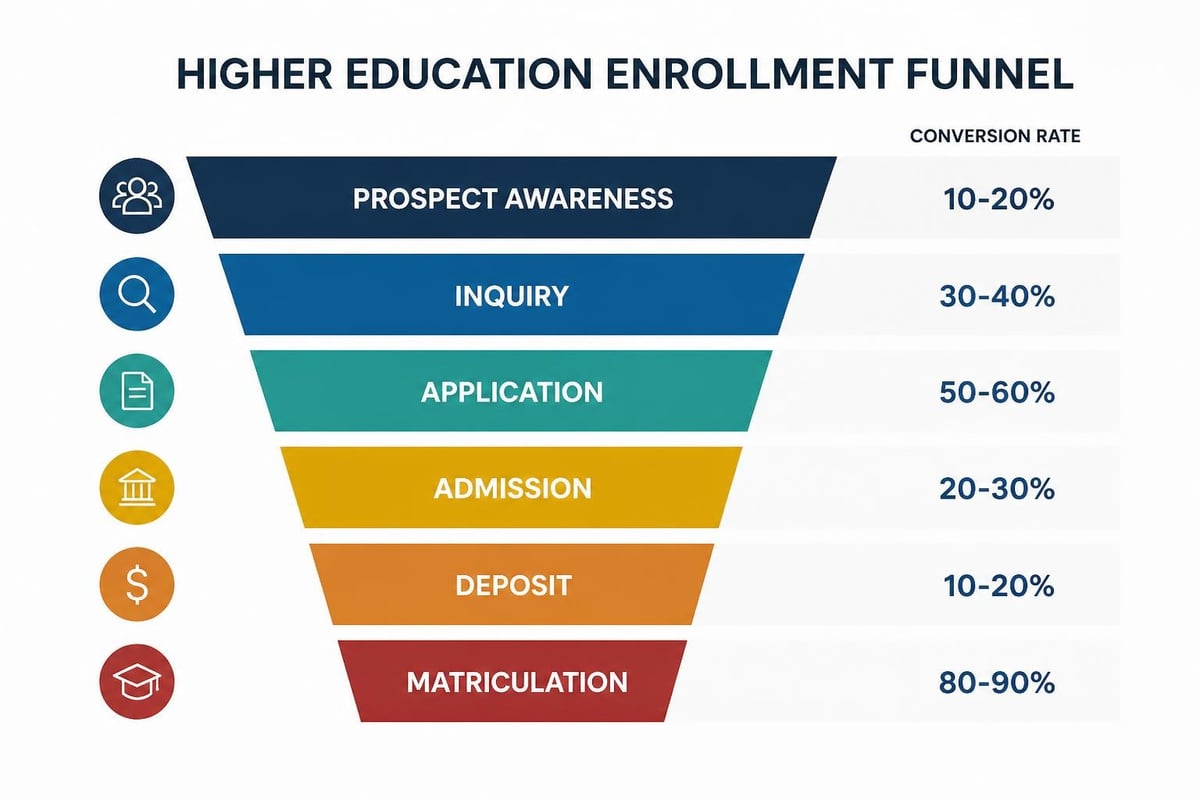
Colleges and universities navigate intense competition, demographic headwinds, and declining confidence in higher education ROI. Brookings research on education access highlights how equity considerations increasingly shape institutional strategy and public policy.
Growth strategies for higher education institutions emphasize:
| Strategy Element | Implementation Approach | Expected Impact |
|---|---|---|
| Program-specific positioning | Separate campaigns for high-demand majors vs general institutional brand | 30-45% improvement in inquiry quality |
| Adult learner pathways | Evening, online, and accelerated program marketing | Expansion into growing non-traditional segments |
| Transfer student recruitment | Community college partnerships and articulation agreements | 15-25% enrollment boost in underserved segment |
| Enrollment yield optimization | Deposit deadline campaigns and admitted student engagement | 8-12% improvement in matriculation rates |
Small private colleges particularly benefit from education growth agency partnerships, as they often lack the in-house enrollment marketing capacity of larger institutions while facing the most severe competitive pressures.
Sports Academies and Specialized Programs
Sports academies occupy a unique niche combining athletic development with academic instruction. An education growth agency serving this sector must understand both competitive athletics recruiting and educational enrollment dynamics.
Successful sports academy enrollment strategies incorporate:
- Showcase event promotion driving registrations for evaluation camps and tournaments
- Alumni athlete success stories demonstrating pathway to college recruitment and professional opportunities
- Facility and coaching staff showcases differentiating competitive advantages in crowded markets
- Parent education content addressing academic-athletic balance concerns and college placement support
- Partnership development with club teams, travel leagues, and coaching networks
These institutions benefit from specialized sports academy marketing approaches that blend athletic credibility with enrollment conversion expertise.
Building Sustainable Enrollment Pipelines
Short-term enrollment fixes through last-minute marketing pushes create volatility and inefficiency. Leading education growth agency partnerships focus on building sustainable systems that generate consistent, predictable enrollment year after year.
Long-Term Pipeline Development
Sustainable pipelines require cultivation of prospects at various stages of their decision journey:
Early awareness initiatives introduce the institution to families and students years before enrollment decisions. For K-12 schools, this might include preschool partnerships and elementary-age community events. For colleges, it involves college-planning content for high school sophomores and juniors.
Middle-funnel nurture programs keep the institution visible and valued throughout extended consideration periods. Multi-year email sequences, periodic campus event invitations, and relevant content delivery maintain engagement without overwhelming prospects.
Conversion-focused campaigns activate when prospects signal readiness to make decisions. Application deadline reminders, financial aid workshops, and admitted student programming concentrate resources on high-probability conversion opportunities.
Research from Columbia's Community College Research Center demonstrates how strategic pipeline programs, including dual enrollment partnerships, create sustainable growth by expanding the prospect pool rather than simply competing more aggressively for existing prospects.
Retention as a Growth Strategy
The most effective education growth agencies recognize that retention directly impacts enrollment goals. Each student who departs before completion creates an enrollment gap requiring new recruitment.
Retention-supporting initiatives include:
- Smooth onboarding transitions from accepted student to enrolled student, minimizing "summer melt"
- Early alert systems identifying at-risk students for intervention before withdrawal
- Student satisfaction monitoring through surveys and engagement metrics
- Exit interview analysis understanding departure reasons to inform both retention and recruitment
- Alumni engagement programs creating ongoing institutional ambassadors
Understanding student demographics helps agencies design targeted retention interventions addressing specific cohort needs and risk factors.
Selecting the Right Education Growth Partner
Not all agencies claiming education expertise deliver equivalent value. Institutions should evaluate potential education growth agency partners against specific criteria that predict successful outcomes.
Evaluation Framework for Agency Selection
Sector specialization depth matters significantly. Agencies primarily serving B2B or e-commerce clients who occasionally work with schools lack the specialized knowledge required for education enrollment success. Look for agencies where education represents the majority of their portfolio, ideally with specific experience in your institution type.
Guaranteed performance commitments separate results-driven agencies from those billing on effort regardless of outcomes. The most confident agencies offer performance guarantees, putting their compensation at risk if they fail to deliver agreed-upon inquiry volumes or conversion improvements.
Technology infrastructure and integration capabilities determine whether the agency can deploy sophisticated automation and tracking. Ask detailed questions about their CRM expertise, marketing automation platform proficiency, and ability to integrate with your existing student admissions systems.
Data transparency and reporting rigor enable you to understand what's working and make informed strategic decisions. Review sample dashboards and reports to ensure they provide actionable insights rather than superficial metrics.
Client results and case studies from comparable institutions provide the most reliable indication of potential success. Request specific examples including baseline performance, implemented strategies, timeline to results, and sustained outcomes.
Questions to ask prospective agencies:
- What percentage of your clients are educational institutions?
- How many clients do you currently serve in our specific segment (K-12, higher ed, sports academies)?
- What performance guarantees do you offer, and what happens if you don't meet them?
- How do you handle inquiry response and follow-up, particularly outside business hours?
- What is your approach to increasing student enrollment in competitive or declining markets?
- How frequently will we receive performance reports, and what metrics do they include?
Implementation Process and Timeline Expectations
Partnering with an education growth agency requires understanding realistic implementation timelines and performance expectations. Enrollment growth is neither instant nor automatic, requiring strategic patience alongside tactical execution.
Typical Implementation Phases
Phase 1: Discovery and Audit (Weeks 1-3)
Comprehensive review of current enrollment performance, marketing assets, technology systems, competitive positioning, and historical data. This diagnostic phase identifies opportunities and constraints shaping strategy development.
Phase 2: Strategy Development (Weeks 4-6)
Creation of comprehensive enrollment growth plans including target audience definition, channel strategies, messaging frameworks, automation workflows, and performance targets. Strategy documents should provide clear roadmaps with specific tactics, responsibilities, and timelines.
Phase 3: Infrastructure Setup (Weeks 7-10)
Technology platform configuration, tracking implementation, creative asset development, campaign buildout, and system integration. This phase involves substantial behind-the-scenes work before public-facing campaigns launch.
Phase 4: Launch and Optimization (Weeks 11+)
Campaign activation, performance monitoring, rapid iteration based on early results, and continuous optimization. The most sophisticated agencies deploy test-and-learn approaches, running controlled experiments to identify highest-performing tactics.
Performance Timeline Expectations
Realistic expectations prevent premature judgments and allow strategies adequate time to generate results:
- Weeks 1-8: Inquiry volume increases as campaigns launch and gain traction, typically 15-35% growth
- Months 3-6: Inquiry-to-application conversion improvements emerge as nurture systems mature, often 20-40% gains
- Months 6-12: Full enrollment cycle completion reveals application-to-enrollment impact, typically 10-25% growth
- Year 2+: Compounding effects as multi-year nurture programs mature and optimization insights accumulate
Institutions implementing systems with proper support from an education growth agency commonly experience 25-50% enrollment growth within the first complete enrollment cycle, with sustained 15-30% year-over-year growth in subsequent years.
Emerging Trends Shaping Education Enrollment
The enrollment landscape continues evolving rapidly, requiring education growth agency partners to stay ahead of emerging trends and adapt strategies accordingly.
Artificial Intelligence and Conversational Enrollment
AI-powered chatbots and conversation tools have evolved beyond simple FAQ responders to sophisticated enrollment assistants. These systems now handle complex inquiries, qualify prospects, schedule campus visits, and even initiate application completion reminders-all while learning from interactions to improve over time.
The most advanced implementations use natural language processing to detect prospect sentiment and escalation needs, routing concerned parents or highly interested students to human counselors at optimal moments.
Personalization at Scale
Modern marketing automation enables individualized communication pathways for thousands of prospects simultaneously. Messages, content recommendations, and outreach timing adapt based on demonstrated interests, engagement patterns, demographic profiles, and enrollment stage.
A prospective engineering student receives different content sequences than a prospective education major. A parent who attended multiple webinars gets different follow-up than someone who only downloaded a brochure. This relevance significantly improves conversion rates while building stronger prospect relationships.
Video-First Communication
Short-form video content dominates how current generations consume information. Education growth agencies increasingly deploy video across the entire enrollment funnel, from 15-second social ads to virtual campus tours to personalized video messages from admissions counselors.
User-generated content from current students provides authenticity that polished institutional videos cannot match. Smart agencies cultivate student ambassadors who create regular content showcasing genuine campus experiences.
Equity-Centered Recruitment
Research from the Becker Friedman Institute on school choice systems demonstrates how recruitment and enrollment practices shape equity outcomes. Progressive institutions and their agency partners increasingly prioritize equitable access in recruitment strategy design.
This includes targeted outreach to underrepresented communities, financial aid transparency, application process simplification, and barrier reduction initiatives that expand access while growing enrollment.
An education growth agency transforms enrollment challenges into systematic growth through integrated marketing, intelligent automation, and data-driven optimization tailored specifically to how families and students make educational decisions. The institutions experiencing the strongest enrollment growth in 2026 share a common characteristic: they've moved beyond fragmented marketing tactics to adopt comprehensive enrollment systems that generate predictable results year after year. ScholarSurge specializes in building these exact systems for schools, colleges, universities, and sports academies, guaranteeing increased qualified inquiries and applications through our comprehensive virtual enrollment team approach. If your institution is ready to move from enrollment uncertainty to enrollment confidence, discover how ScholarSurge can design a customized growth system delivering the full enrollment your programs deserve.