
Insights
Full-Service Higher Education Marketing Agency Guide
Learn what a full-service higher education marketing agency delivers, how to evaluate one, and which metrics prove it fills seats and grows tuition revenue.
READING TIME · 9 MIN · UPDATED QUARTERLY

A full-service higher education marketing agency plans, runs, and measures every stage of student recruitment for a college or university, from advertising and landing pages to inquiry follow-up and application nurturing. The strongest ones operate as a single accountable system rather than a collection of separate vendors, and they judge their work by enrolled students, not impressions or clicks.
For admissions directors and enrollment leaders, the practical question is not whether outside help exists. It is which model fits your funnel, your staff capacity, and your tolerance for risk. This guide covers what full service should include, how it differs from specialist or generalist options, and how to evaluate a partner before signing.
What a Full-Service Higher Education Marketing Agency Actually Does
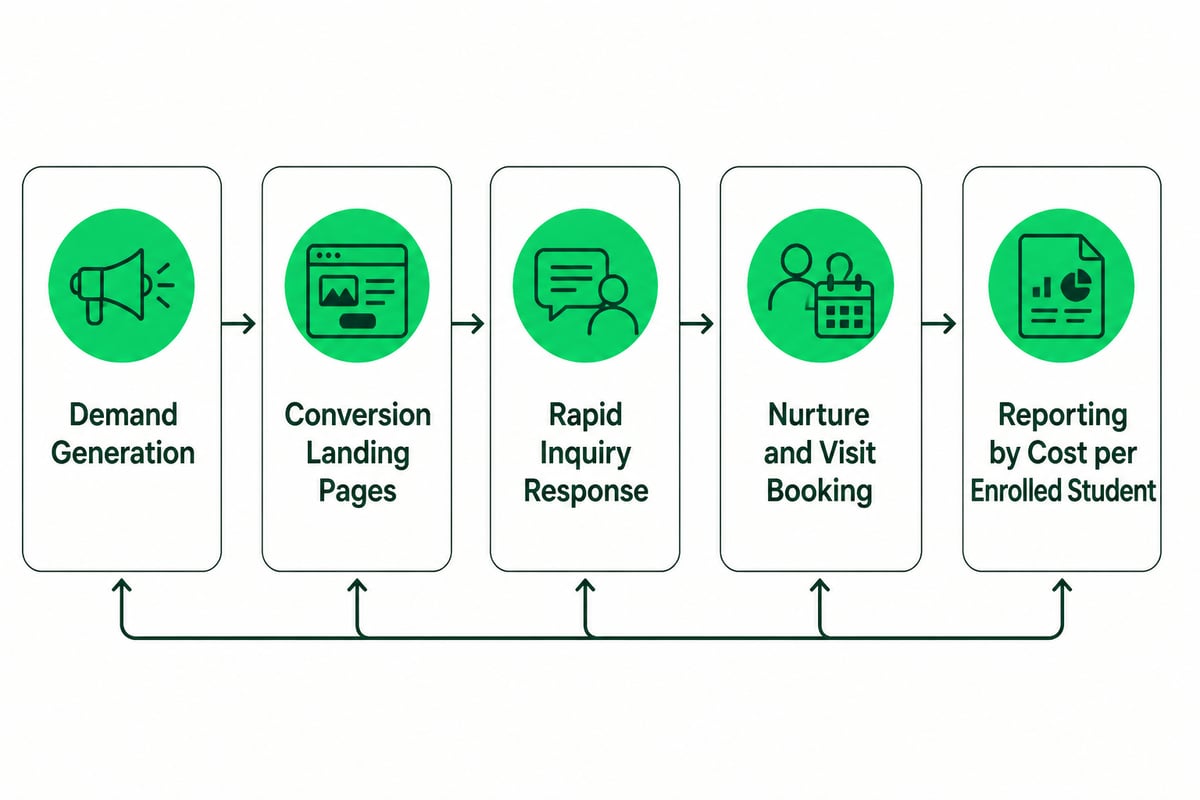
A full-service agency owns the entire path from first awareness to submitted application, so no stage depends on a handoff between companies that do not share accountability.
In practice, that path has five working parts:
- Demand generation: paid search, paid social, and content aimed at prospective students and, where relevant, their parents.
- Conversion assets: landing pages and inquiry forms built for a single program or audience, not a generic homepage.
- Inquiry response: immediate, personalized replies by email, text, and phone.
- Nurture and event booking: sequenced follow-up that moves an inquiry toward a campus visit, an information session, or an application.
- Reporting: cost per inquiry, cost per application, and cost per enrolled student, tied back to source.
Agencies that stop at the first two items hand you traffic and leave the hardest work to your own team. Agencies that cover all five are accountable for the outcome you actually care about: seats filled.
Why Institutions Are Looking for Outside Help in 2026
Most enrollment teams are being asked to produce more with the same or smaller resources. In a 2025 survey of 121 higher education marketing leaders, EAB found that 65% faced higher goals with flat or shrinking staff and budgets, and 80% cited limited budget as a barrier to enrollment marketing goals.
Demand itself has not collapsed. U.S. higher education enrollment reached 18.4 million in spring 2025, up 3.2% year over year, according to a Validated Insights report summarized by eCampus News. Growth is real, but it is uneven, and the institutions capturing it are generally the ones that respond fastest and track results most closely.
That combination, rising expectations and constrained capacity, is the core reason leaders consider a full-service partner. The goal is to add execution capacity without adding permanent headcount.
Core Services to Expect From a Full-Service Partner
A credible full-service engagement should include each of the services below, and you should ask how each one is staffed and measured.
Paid Media and Search Visibility
Search remains the primary research channel for many students. In the 2024 Higher Education Marketing Report from LaneTerralever and Convince & Convert, which surveyed 1,493 students and 203 higher education marketers, 34% of students named internet search as their preferred way to research colleges. Paid search, search-optimized program pages, and paid social campaigns should work together rather than compete for budget.
Landing Pages and Inquiry Capture
A program-specific landing page with a short form routinely outperforms sending ad traffic to a general admissions page. The agency should build, test, and revise these pages as part of the retainer, not as a billable extra.
Speed-to-Lead and Follow-Up
This is where many programs lose their return on ad spend. A prospect who submits an inquiry is comparing several institutions at once, and the first thoughtful reply often sets the tone. Channel preference matters too. In the same 2024 report, 55% of students preferred email during the application process, compared with 33% who preferred text messages. A good follow-up system uses both, in sequence, rather than betting on one.
CRM and Automation
Inquiries, replies, tour bookings, and application status should live in one system so that nothing depends on a staff member remembering to follow up. Ask which CRM the agency works in and who owns the data afterward.
Reporting Tied to Enrollment
Reports should show source-to-enrollment attribution, not only top-of-funnel activity. Tracking of marketing metrics is often inconsistent across higher education, which is a reminder to confirm exactly how your agency will measure results before you start.
Full-Service vs. Specialist vs. Generalist Agencies
The right model depends on what is broken in your funnel today. The table below compares the three common options on the attributes enrollment leaders weigh most.
| Attribute | Full-service enrollment agency | Single-channel specialist | Generalist marketing agency |
|---|---|---|---|
| Scope | Ads, landing pages, response, nurture, CRM | One channel such as paid search or email | Broad brand and digital work across industries |
| Accountability | One team owns the outcome | You coordinate multiple vendors | Often measured on activity, not enrollment |
| Education expertise | Built around admissions cycles | Varies | Usually limited |
| Handoffs to your staff | Fewer | Several | Several |
| Typical fit | Teams needing capacity and a single owner | Teams with strong in-house operations needing one gap filled | Brand refreshes or broad campaigns |
If your inquiries are strong but conversion is weak, a specialist in follow-up may be enough. If both demand and conversion need work, and your team is already stretched, a single accountable system is usually the cleaner choice. For a deeper look at how these models compare, see ScholarSurge's overview of a full-service education marketing agency.
How to Evaluate a Full-Service Higher Education Marketing Agency
Evaluate a prospective agency on evidence of enrollment outcomes, operational detail, and contract terms, in that order.
- Ask for enrollment results, not engagement metrics. Request cost per enrolled student and inquiry-to-application conversion rates from comparable institutions.
- Test their response process. Submit an inquiry through a client's form, if the agency allows it, and note how quickly and how personally you hear back.
- Clarify data ownership. Your CRM records, ad accounts, and landing pages should remain yours if the relationship ends.
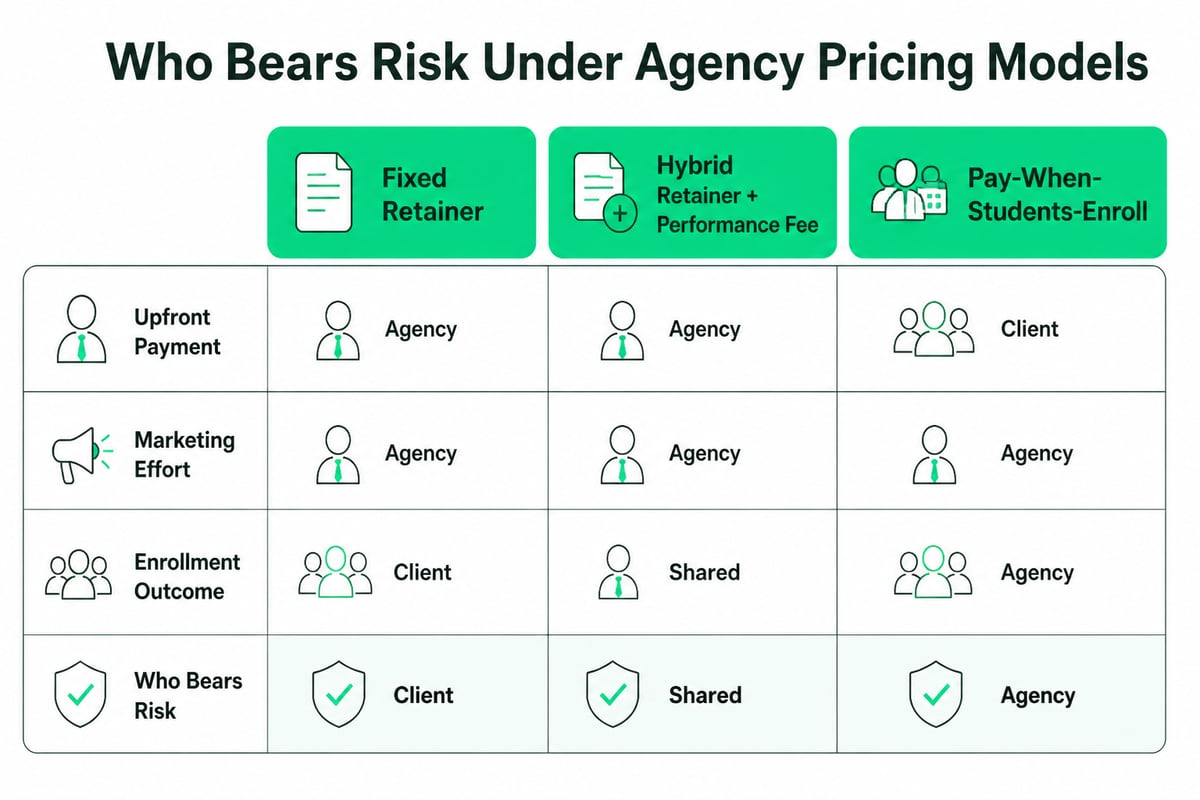
- Review the pricing structure. Retainers, performance fees, and hybrid models carry different risks. Understand who bears the cost if results fall short.
- Confirm student data practices. Ask how the agency handles privacy and security. Google's education privacy and security FAQ is useful background for framing questions to any technology vendor that touches student information.
- Check team continuity. Learn who actually does the daily work, and whether the people in the pitch are the people on your account.
A short reference call with a current client at a similar institution tells you more than any case study deck.

Metrics That Show Whether the Partnership Is Working
The metrics that matter are the ones closest to enrolled revenue, reviewed on a consistent schedule.
- Speed to first response: the time between an inquiry and the first personalized reply.
- Inquiry-to-visit rate: the share of inquiries that book a tour, call, or info session.
- Visit-to-application rate: the share that complete an application after engaging.
- Cost per enrolled student: total marketing spend divided by students who actually enroll.
- Return on investment over 12 months: because enrollment cycles are long, a quarterly view alone can mislead.
Set targets for each before launch, and review them monthly with the agency. A partner that resists being measured at the bottom of the funnel deserves scrutiny.
Where Performance-Based Models Fit
Some institutions prefer to pay for outcomes rather than activity, and a performance-based model shifts financial risk from the school to the agency. That structure suits teams that cannot absorb months of spend without evidence, which, given the budget pressure described earlier, describes many enrollment offices.
ScholarSurge builds its work around this idea. Its model is performance-based: you pay when students enroll, and work continues at no charge until a 50-inquiry target is reached. The company offers rapid response to every inquiry, typically in under 60 seconds, and a guarantee of 50+ qualified inquiries in the first 90 days, with work continuing free until the 50-inquiry target is reached. Its Surge System packages paid demand generation, rapid inquiry response, tour and visit booking, and CRM automation into one monthly retainer, which is the full-service structure described above in a single accountable engagement.
Matching the Agency Model to Your Institution Type
Institution type changes what full service should emphasize, so the best agencies adapt their playbook instead of reusing one template.
- Small and mid-sized colleges: limited admissions staff makes automated response and nurture the highest-leverage investment. See ScholarSurge's guide to marketing for small colleges.
- Private colleges and universities: brand differentiation matters, but it must connect to measurable inquiry volume. The page on higher education enrollment marketing outlines how that connection works.
- Graduate and adult programs: buying cycles are shorter and more search-driven, so conversion speed and program-specific pages carry more weight.
- Sports academies and athletic programs: recruitment depends on coaches, parents, and visit scheduling, which calls for a different nurture sequence. ScholarSurge covers this in its sports academy marketing resources.
- K-12 independent schools: the buyer is the parent, and the tour is the pivotal event. The private school marketing approach reflects that.
Whatever your category, ask the agency to describe a specific funnel built for institutions like yours, not a generic one.
Questions to Ask Before You Sign
These questions separate agencies that run a system from agencies that sell a bundle of services:
- Who is the single person accountable for my enrollment numbers?
- How quickly will every inquiry receive a first response, and through which channels?
- What happens to the ad accounts, landing pages, and CRM data if we part ways?
- How is success defined in the contract, and what happens if targets are missed?
- Which reports will I see monthly, and do they run all the way to enrolled students?
- How do you coordinate with our admissions staff so that human follow-up picks up where automation leaves off?
Clear, specific answers to these six questions tell you most of what you need to know. Vague answers about "synergy" or "brand storytelling" are a signal to keep looking.
Common Mistakes When Hiring a Full-Service Partner
Most disappointing agency relationships trace back to a few avoidable errors.
Judging on creative alone. A polished campaign that does not produce qualified inquiries is a cost, not an asset. Weight conversion evidence above visual appeal.
Leaving the admissions team out of onboarding. Automation works best when staff know what it sends, when it sends it, and when a person should step in. Agree on that handoff before launch.
Ignoring response speed internally. Even the best advertising underperforms if inquiries wait a day for a reply. If you adopt a partner, hold your own team to the same standard for phone and in-person follow-up.
Setting no baseline. Record your current cost per inquiry, application rate, and enrollment numbers first. Without a baseline, you cannot judge improvement honestly.
For a broader view of options in the market, ScholarSurge also maintains a comparison of top higher education marketing companies that can help you build a shortlist.
Your next step is to pull your last 12 months of inquiry data and calculate two numbers: how long the average inquiry waits for a first reply, and what share of inquiries become enrolled students. Those figures show exactly where seats are being lost, and they give you a baseline for judging any agency you consider. ScholarSurge gives schools, colleges, universities, and sports academies a virtual enrollment team that responds to inquiries in under 60 seconds and nurtures prospects through to application, and Book Your Free Enrollment Audit to see where your funnel can recover the most students.