
Insights
Done-For-You School Enrollment Marketing: A Guide for Schools
Learn what done-for-you school enrollment marketing includes, how to evaluate providers, and which metrics prove it is filling seats at your school.
READING TIME · 9 MIN · UPDATED QUARTERLY

Done-for-you school enrollment marketing is an outsourced model in which a specialist team runs your advertising, landing pages, inquiry response, follow-up and CRM so your admissions staff can focus on tours and family relationships. For heads of school and admissions directors facing flat or declining demand, it replaces a patchwork of vendors with one accountable system tied to inquiries, visits and enrolled students.
The case for outside help is grounded in demographics. U.S. public elementary and secondary enrollment was 49,387,403 in fall 2024, down from fall 2023 and fall 2019, according to the NCES Digest of Education Statistics. Fewer children means every family you reach is contested, and the schools that respond fastest and most personally tend to win them.
What Done-For-You School Enrollment Marketing Includes
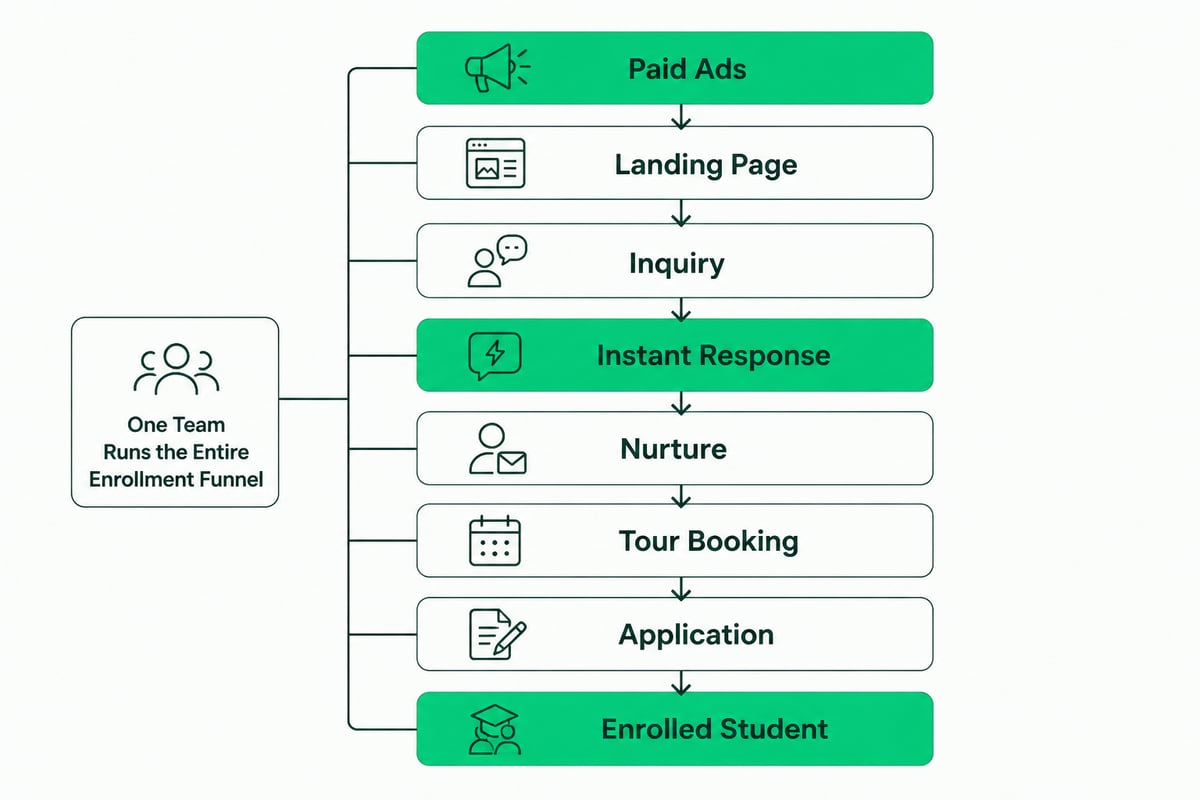
A complete done-for-you program covers every step between a family's first search and the first day of class, not only the advertising at the top.
The core components are:
- Demand generation: Paid search, social campaigns and retargeting aimed at families in your actual draw area.
- Conversion assets: Landing pages and inquiry forms built to turn a click into a conversation.
- Speed-to-lead response: Immediate acknowledgment of every inquiry, by text, email and phone.
- Nurture sequences: Structured follow-up that continues until a family books a visit or says no.
- Tour and visit booking: Scheduling that removes back-and-forth emails.
- CRM and reporting: One system that records each family's source, status and next step.
The word "done-for-you" matters. It means the provider operates these pieces, not that it hands you a strategy deck and a login. If your team still has to write the ads, build the pages and chase each lead, you have purchased advice, not a service.
Why Schools Outsource Enrollment Marketing
Schools outsource enrollment marketing because the work requires specialist skills and constant attention that an admissions office rarely has capacity to provide alongside tours, applications and family communication.
Consider the realities of a small admissions team. Someone must manage ad accounts, test creative, maintain landing pages, answer inquiries at nine at night, and still run an open house on Saturday. When one of those tasks slips, the family moves on. The NCES Condition of Education overview offers useful official context on how enrollment shifts by grade band, which helps leaders decide where to focus recruitment effort.
Outsourcing also changes the risk profile. A traditional agency bills for hours or ad spend whether or not families enroll. Newer models tie fees to results, which aligns the provider's incentives with yours. For a deeper look at the failure points of conventional arrangements, see why marketing agencies often fail at school enrollment.
The Speed-to-Lead Problem Most Schools Underestimate
Responding to an inquiry within minutes, not hours or days, is the single most controllable factor in converting a family from curious to committed.
Parents often submit inquiries to several schools in one sitting. The school that replies first, with a real person's voice, sets the tone for everything that follows. A form confirmation email does not count. The family wants to know someone read their message and cares about their child.
The 2025 Niche Parent Pulse Survey is instructive on this point. It found that most parents said a one-to-one phone call would favorably influence their impression of a school. The same survey showed how much personalization matters: most parents said personalized emails would positively influence their interest in enrolling, more so than email newsletters.
Text messaging follows the same pattern. In that survey, many more parents said personalized texts would positively influence enrollment interest than said the same of automated texts. The lesson is that automation should deliver speed, but the message must still read as if a person wrote it for that family.
How to Evaluate a Done-For-You Provider
Evaluate a provider by asking what they own, how they are paid, and what proof they can show, because these three answers separate accountable partners from vendors who simply resell ad clicks.
Use these questions in every conversation:
- Who runs the whole pipeline? Advertising, landing pages, follow-up and CRM should operate as one system, not four contracts.
- How fast is inquiry response? Ask for an average response time across current clients, not a best-case figure.
- How are you paid? Fees linked to enrolled students or guaranteed inquiry volumes reduce your exposure.
- What happens if targets are missed? Look for a stated remedy, such as continued work at no charge.
- What will I see each month? Reporting should trace spend to inquiries, visits, applications and enrollments.
- Do you work with schools like mine? K-12, college and sports academy audiences behave differently.
A provider unwilling to answer these plainly is signaling how the engagement will feel later. Our overview of school enrollment marketing companies covers more on how these models differ.
Pricing Models: Retainer, Hourly and Performance-Based
The pricing model you choose determines who carries the risk, so compare how each structure behaves when results fall short.
| Model | How you pay | Who carries the risk | Typical drawback |
|---|---|---|---|
| Hourly or project | Fees for time or deliverables | The school | Activity is billed whether or not families enroll |
| Fixed monthly retainer | Flat monthly fee | Mostly the school | Output can plateau without accountability |
| Performance-based | Fees tied to inquiries or enrolled students | Shared with the provider | Requires clear definitions of a qualified inquiry |
Hourly and project pricing suits narrow, one-time needs, such as rebuilding a landing page or auditing an ad account. It fits poorly with an ongoing enrollment pipeline, because the provider earns the same whether the phone rings or not. A retainer brings predictability and continuous coverage, but you should ask what the monthly fee includes: ad management, creative production, inquiry response, CRM maintenance and reporting. Ad spend is often billed separately, and the budget conversation changes once you know that.
Performance-based arrangements are not automatically better, but they force a conversation about definitions: what counts as a qualified inquiry, what counts as an enrollment, and over what time window. A family that inquires in October and enrolls the following August needs a stated rule for attribution. Settle those terms in writing before work begins, along with how disputed leads are handled and what happens if volume falls below the agreed target. Schools weighing this approach can read more about performance marketing for schools.

What a Done-For-You Program Looks Like in Practice
One example of a done-for-you school enrollment marketing program is The Surge System, which combines paid demand generation, rapid inquiry response, tour and visit booking, and CRM automation under one monthly retainer.
ScholarSurge, the company behind it, describes its approach as a virtual enrollment team. Its published commitments include speed-to-lead response to every inquiry, a guarantee of 50 or more qualified inquiries in the first 90 days, and continued work at no charge until that target is reached. Its pricing is performance-based, meaning payment follows student enrollment.
For specifics on scope, limits or terms, confirm details directly on the ScholarSurge site or through its contact page rather than relying on general descriptions. Any provider you consider should be willing to put its terms in writing.
Metrics That Prove the Program Is Working
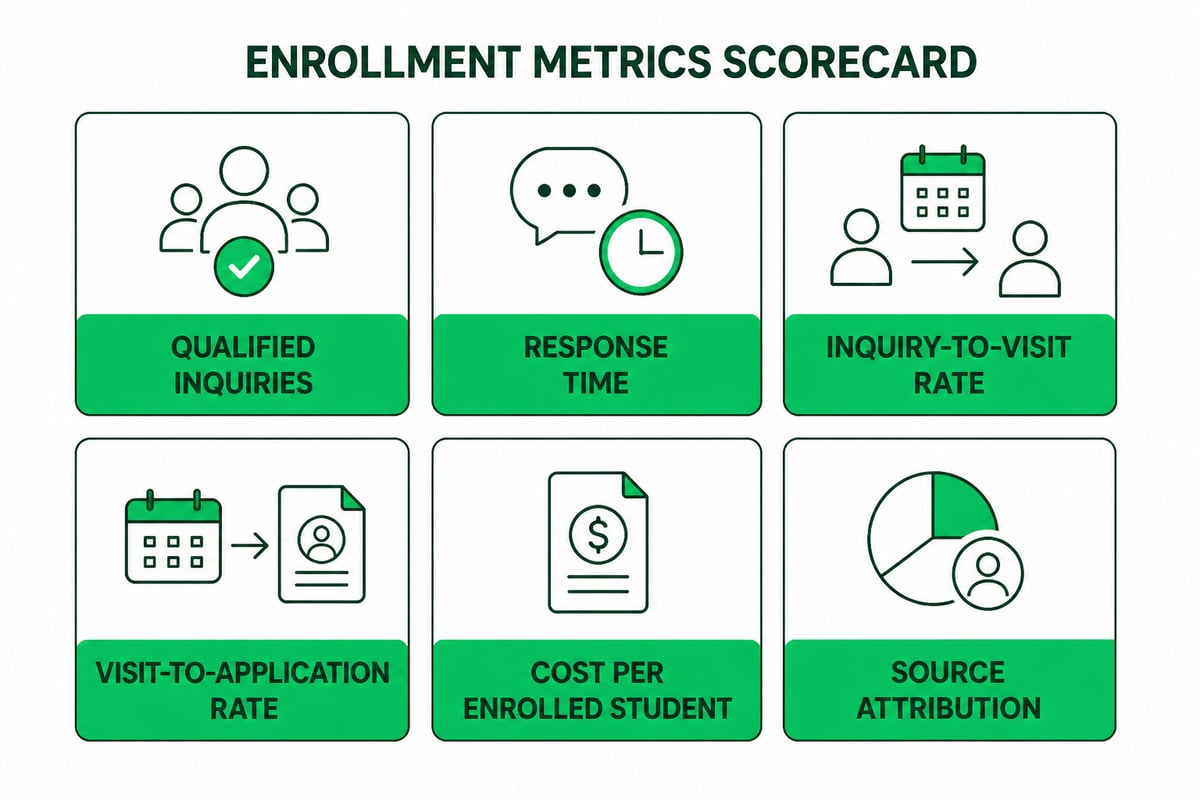
You can judge a done-for-you program by a short list of pipeline metrics that connect marketing activity to seats filled.
Track these monthly:
- Qualified inquiries: Families who match your grade levels, geography and tuition range.
- Response time: Median minutes from submission to first human contact.
- Inquiry-to-visit rate: The share of inquiries that book a tour or shadow day.
- Visit-to-application rate: The share of visitors who apply.
- Cost per enrolled student: Total marketing cost divided by new enrollments.
- Source attribution: Which channels produce enrolled families, not just clicks.
Read these numbers as a sequence. If qualified inquiries rise but the inquiry-to-visit rate falls, the problem usually sits in follow-up speed or message quality rather than in advertising. If visits are strong but few families apply, look at what happens on campus: who leads the tour, what follow-up arrives within a day, and how clearly the application steps are explained. Cost per enrolled student is the figure to compare against what a new student is worth in tuition over time, and it should be calculated on enrollments, not on inquiries or visits.
Vanity numbers such as impressions and page views deserve little attention. A rise in website traffic with no change in tours is a warning sign, not a success. Compare each metric against your own prior-year cycle, since admissions seasons run in waves and a single month rarely tells the full story. If your current reporting cannot show where each enrolled family originated, fixing attribution should come before any increase in ad spend.
What Stays on Your Side of the Table
Even the most complete done-for-you service depends on your school for the parts only your people can deliver: the tour, the conversation with the head of school, and the culture families sense when they walk the halls.
Plan for these responsibilities:
- Staff availability for tours: Booked visits only convert if someone welcoming leads them.
- Accurate information: Tuition, program details and deadlines must be current so messaging stays honest.
- Fast feedback: Tell your provider which inquiries were strong and which were not, so targeting improves.
- A clear brand story: Providers can sharpen your message, but the substance must be real.
A useful framing is that the provider fills the pipeline and your team closes it. Enrollment leaders who treat the relationship as shared work typically see smoother handoffs than those who expect marketing to run without internal involvement. For broader channel context, our guides on Google Ads for schools and Facebook Ads for schools explain how paid campaigns feed this pipeline.
Warning Signs When Choosing Done-For-You School Enrollment Marketing
Several patterns reliably indicate that a done-for-you school enrollment marketing offer will not deliver what it promises.
- Guarantees without definitions. A promise of "more leads" means little until the provider defines a qualified inquiry.
- Ad spend with no follow-up. Clicks that land in an unmonitored inbox waste money.
- Generic templates. Messaging that could belong to any school will not differentiate yours.
- Opaque reporting. If you cannot see raw inquiry and enrollment data, you cannot verify results.
- Long lock-in contracts. Extended terms with no performance remedy shift risk onto you.
- No education specialization. Admissions cycles, deadlines and parent concerns differ from other industries.
Match your concerns to your institution type as well. Boarding programs, charter schools and athletic academies each face distinct audiences, which is why specialization matters. If you want to examine options built around your category, ScholarSurge publishes guidance on private school enrollment marketing.
Questions to Settle Before You Sign
Before committing, align your leadership team on five decisions so the engagement starts with clear expectations.
- Your enrollment goal: The number of new students, by grade, for the coming cycle.
- Your definition of success: Inquiries, visits, applications or enrolled students, and by when.
- Your capacity: How many additional tours and conversations your team can handle each week.
- Your budget logic: What a new student is worth in lifetime tuition, which sets an acceptable acquisition cost.
- Your decision owner: One person with authority to approve messaging and respond to the provider quickly.
Leaders who answer these in advance spend the first month optimizing instead of debating. For historical and projected enrollment patterns by grade level that can inform your goals, the NCES public school enrollment indicator is a reliable reference.
Start by pulling your last twelve months of inquiry data and measuring how long each family waited for a first response; that single number shows how much recoverable enrollment you may be leaving behind. If the gap is wide, a team that connects advertising, instant follow-up and tour booking, such as The Surge System, can close it without adding to your staff's workload. ScholarSurge builds these systems for schools, colleges and sports academies, and you can Book Your Free Enrollment Audit to see where your pipeline loses families and what a performance-based plan would look like for your school.