
Insights
Full-Service Sports Academy Marketing Agency: Key Facts
What a full-service sports academy marketing agency does, which services matter, how pricing models differ, and how to judge results by enrollment.
READING TIME · 9 MIN · UPDATED QUARTERLY

A full-service sports academy marketing agency handles every stage between a family's first search and a signed enrollment: advertising, landing pages, inquiry response, follow-up, and reporting. The "full-service" label matters only if those pieces run as one accountable system, because an academy does not need more clicks, it needs more enrolled athletes. This guide explains what the service includes, how to compare agencies, and which numbers to hold them to.
What a Full-Service Sports Academy Marketing Agency Actually Does
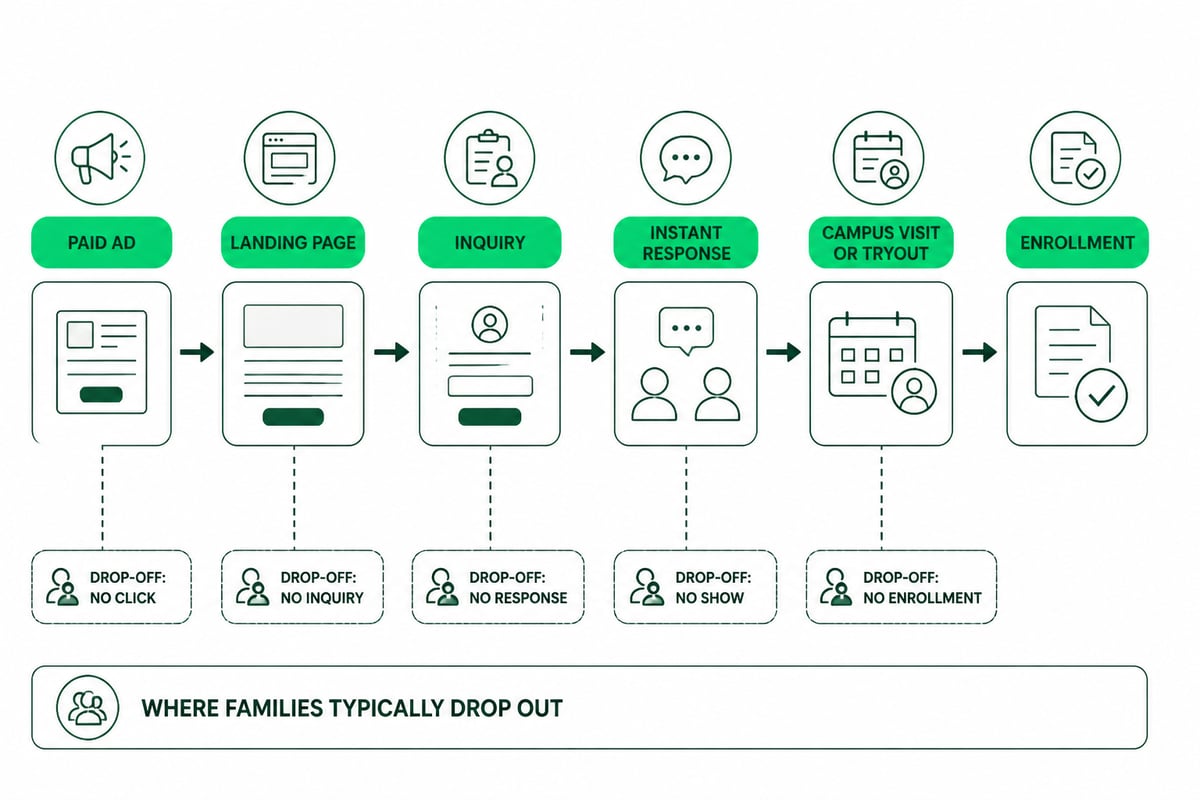
A full-service agency owns the entire path from awareness to enrollment, not a single channel. For sports academies, that path usually covers six functions:
- Demand generation: paid search, paid social, and local campaigns aimed at parents and athletes in your target markets.
- Conversion assets: landing pages and inquiry forms built around a single action, such as booking a tour, a tryout, or a call.
- Inquiry response: immediate, personal replies to every lead, including nights and weekends.
- Nurture and follow-up: structured email, text, and call sequences that move a family from curiosity to a campus visit.
- CRM and automation: a system that records every touchpoint and shows which lead sources produce enrolled students.
- Reporting: dashboards tied to inquiries, visits, applications, and enrollments rather than impressions.
Agencies that offer only the first two items are advertising vendors. The remaining four are where most enrollment is won or lost, since a family that inquires and hears nothing for a day usually contacts a competitor the same afternoon.
How Sports Academies Differ From Other Schools
Sports academies sell two outcomes at once: athletic development and academic progress. Marketing therefore has to speak to two decision makers, the athlete who wants a pathway and the parent who is weighing tuition, safety, academics, and college prospects.
Several features shape the marketing approach:
- Recruitment cycles tied to seasons. Tryouts, showcases, and signing windows create concentrated periods of demand.
- Geographic reach. Many academies recruit regionally, nationally, or internationally, which complicates targeting and follow-up across time zones.
- Proof requirements. Families expect to see coaching credentials, facility quality, game footage, and placement outcomes.
- Higher-consideration purchase. Boarding, relocation, and tuition raise the stakes, so families usually take weeks or months to decide.
An agency that treats an academy like a generic local business will misread this buying behavior. Agencies with a specific sports academy marketing practice, such as ScholarSurge's sports academy marketing agency page describes, tend to build campaigns around these seasonal and multi-stakeholder patterns.
Core Services to Expect, and What Each Should Deliver
Each service line should be tied to a measurable outcome. The table below shows what to ask for in each area.
| Service | What it should deliver | Metric to request |
|---|---|---|
| Paid advertising | Qualified inquiries from target families | Cost per qualified inquiry |
| Landing pages | Higher inquiry conversion | Inquiry rate per visitor |
| Speed-to-lead response | Contact before the family looks elsewhere | Average response time |
| Nurture sequences | Tours, tryouts, and visits booked | Inquiry-to-visit rate |
| CRM automation | No lead lost or forgotten | Percentage of leads with logged follow-up |
| Reporting | Clear link from spend to enrollment | Cost per enrolled student |
If an agency cannot provide the last column for each row, its reporting is likely built around activity rather than results.
Why Speed-to-Lead Deserves More Attention Than Ad Creative
Response speed is the single operational variable most academies underestimate, and it is the one a full-service agency should control directly. A family that submits an inquiry is typically comparing several programs at once. The first program to respond with a useful, personal message sets the tone for everything after.
Many academy offices cannot sustain fast replies. Admissions staff are on campus tours, at tournaments, or off for the weekend, which is when many parents browse and inquire. Automated first responses, followed by a human conversation, close that gap. Whatever agency you choose, ask for its measured average response time and how it staffs after-hours inquiries.
Pricing Models: Retainers, Fees, and Performance-Based Pay
Agencies typically price in one of three ways, and each shifts risk differently.
Monthly retainer
A fixed fee covers a defined scope of work. This is predictable, but you pay the same whether enrollment grows or not, so scrutiny of reporting is essential.
Ad spend plus management fee
The agency charges a percentage of advertising spend. This can reward higher spending regardless of outcomes, so set a cap and tie increases to results.
Performance-based pricing
Payment is linked to outcomes. ScholarSurge, for example, prices on a performance basis, with payment due when students enroll, and continues work at no charge until its 50-inquiry target is reached. For an academy with a limited budget and a fixed number of seats, this model moves much of the risk to the agency. Confirm exact terms on the ScholarSurge booking page or with any agency before committing.
A Practical Checklist for Evaluating Agencies
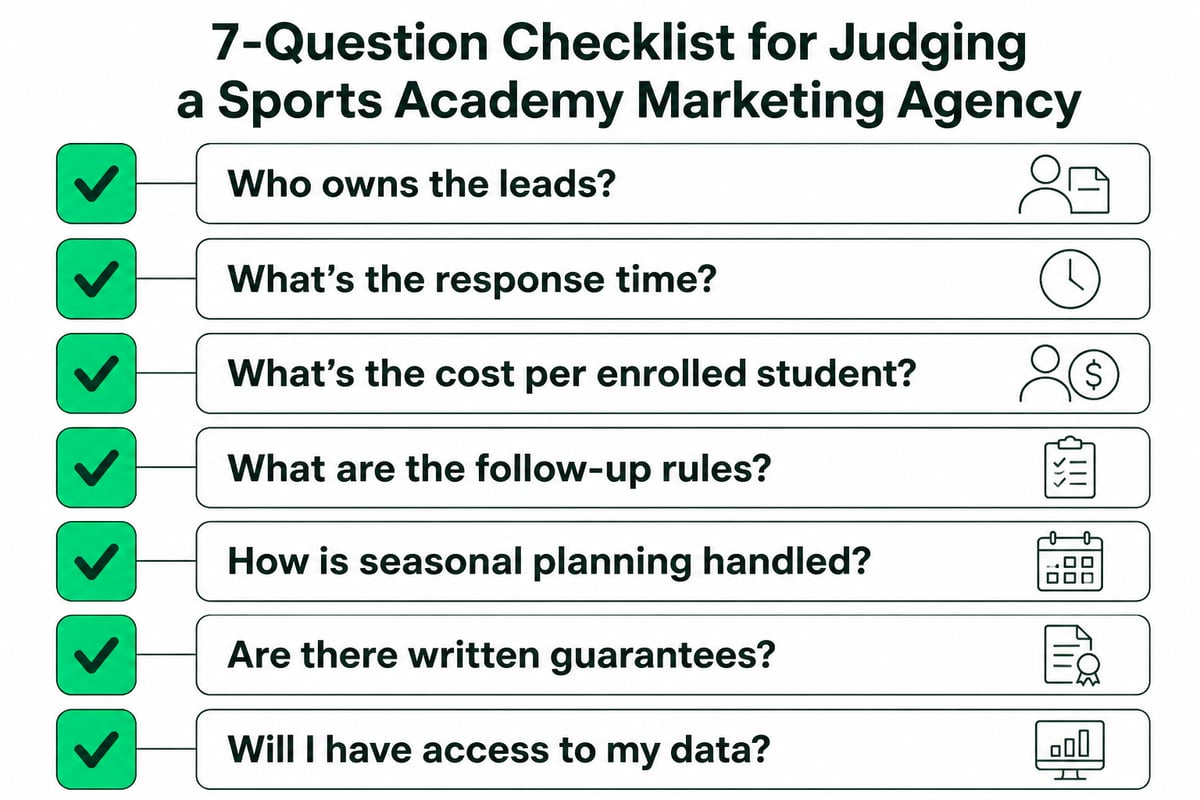
Use these questions in every agency conversation. The answers separate true full-service providers from channel specialists.
- Who owns advertising, landing pages, follow-up, and CRM, and is one team accountable for the combined result?
- What is your average inquiry response time, and how is it measured?
- Can you show cost per enrolled student, not just cost per lead?
- What happens to inquiries that do not book a visit within a week?
- How do you handle seasonal peaks around tryouts and signing periods?
- What do you guarantee, in writing, and what happens if the target is missed?
- Do you give us full access to our ad accounts, data, and CRM?
Agencies confident in their systems answer these directly. Vague replies about "brand awareness" or "engagement" are a signal to look further.
The Technical Foundation: Search Visibility and Site Quality
Paid campaigns bring traffic, but a site that search engines cannot read well will lose organic visibility over time. Google's SEO Starter Guide recommends making site content easier for search engines to crawl, index, and understand, and its developer documentation covers the technical steps that help Google Search access and understand a website. For an academy, that translates to clean site structure, clear program pages, fast loading on mobile, and accurate location details.
A capable agency should audit these basics early. Program pages for each sport, age group, and residential option give families direct answers and give search engines distinct pages to rank. In practice, that audit should confirm that important pages are not blocked from crawling, that each page has a descriptive title and a single clear topic, and that internal links connect the sport pages to admissions and tryout information. Parents often search from a phone, so check that forms load quickly and work on a small screen. Campus address, phone number, and tryout dates should match everywhere they appear, including your Google Business Profile, so that local searches return consistent details.

Digital Trends Worth Watching in 2026
Sports and fitness audiences are shifting toward more personalized and interactive digital experiences. IMG's 2025 digital trends report highlights direct-to-consumer strategies, gamification, AI personalization, and wearables as areas of focus. For academies in 2026, the practical lessons are modest and useful:
- Direct relationships. Build your own list of families through campus events, camps, and showcases rather than relying only on rented social reach.
- Personalization. Segment follow-up by sport, age, and location so a hockey family and a soccer family see different messages.
- Interactive content. Virtual tours, athlete profiles, and short training clips help out-of-region families picture the program.
Treat these as supporting tactics. They help only when the underlying response and follow-up system is already working.
Where Full-Service Differs From a Directory of Agencies
Many searchers land on long lists of sports marketing firms. Most of those firms represent professional athletes, negotiate endorsements, or run sponsorship campaigns for leagues and brands. That work is valuable, but it solves a different problem than an academy's: filling seats with tuition-paying students.
Before you shortlist anyone, confirm which problem they solve. An agency built for athlete representation or sponsorship will not typically offer inquiry response, tour booking, or enrollment-level reporting. Its deliverables tend to be media placements, brand deals, and audience reach, none of which tell you how many families booked a visit last month. A quick screen is to ask for a sample report. If it lists impressions, sponsor activations, or follower growth rather than inquiries, visits, applications, and enrollments, the firm is oriented toward a different buyer. Education-focused providers, including those covered in resources on top sports academy marketing companies, are structured around the admissions funnel instead. Their staffing reflects it, with roles for inquiry response, follow-up, and CRM management rather than talent relations.
What to Expect in the First 90 Days
A well-run engagement follows a predictable early timeline. Knowing it helps you judge progress fairly.
- Weeks 1 to 2: audit of your current inquiry handling, website, ad accounts, and CRM; agreement on target markets and enrollment goals.
- Weeks 3 to 4: campaigns and landing pages go live; response automation and nurture sequences are switched on.
- Weeks 5 to 8: early data on cost per inquiry and response time; adjustments to targeting, messaging, and follow-up.
- Weeks 9 to 12: visit and tryout bookings should be rising, and the agency should report which sources produce the best-fit families.
Some providers, including ScholarSurge, guarantee a set number of qualified inquiries in the first 90 days and cite projected returns drawn from their own internal audits. Treat any projection as an estimate and ask what assumptions sit behind it. Related guidance on performance marketing for sports academies and measuring ROI in education marketing explains how to set those expectations.
Matching the Right Agency Type to Your Situation
Not every academy needs the same arrangement. These patterns can guide the choice:
- You have strong inquiries but weak enrollment. Prioritize response speed, follow-up, and visit booking over more advertising.
- You have capacity and little inbound demand. Prioritize paid demand generation and conversion pages first.
- Your admissions team is small. Favor an agency that acts as a virtual enrollment team and handles first contact and nurturing.
- Your budget is fixed. Favor performance-based pricing or a clear guarantee.
An integrated provider such as The Surge System combines paid demand generation, rapid inquiry response, tour and visit booking, and CRM automation under a single monthly retainer, which suits academies that want one accountable partner rather than several vendors to coordinate. Academies seeking only scholarship or financial aid services, or a generalist marketing agency outside education, should look elsewhere.
Questions to Settle Before You Sign
Resolve these points in writing before any contract begins:
- Data ownership: your ad accounts, leads, and CRM records remain yours if the relationship ends.
- Definition of a qualified inquiry: agree on criteria such as sport, age, location, and budget fit.
- Reporting cadence: weekly early on, monthly once stable, always tied to enrollment.
- Exit terms: a clear notice period and no penalties for leaving.
Clear definitions prevent disputes later and keep both sides focused on the same outcome: enrolled students.
Start this week by timing your own response: submit a test inquiry through your website at an off-hour and record how long it takes to hear back, then compare that against the under-60-second benchmark above. If the gap is large, a full-service partner can close it quickly. ScholarSurge provides enrollment growth systems for schools, colleges, universities, and sports academies, acting as a virtual enrollment team with automated inquiry handling, rapid response, and nurturing built in. You can see how that would apply to your program when you Book Your Free Enrollment Audit and review where your current funnel loses families.