Insights
Top School Enrollment Companies in 2026: Complete Guide
Discover the top school enrollment companies helping K-12 schools, colleges, and academies fill their seats with proven systems and strategies.
READING TIME · 11 MIN · UPDATED QUARTERLY

Schools, colleges, universities, and sports academies face unprecedented enrollment challenges in 2026. With shifting demographics, increased competition, and evolving student expectations, educational institutions need more than traditional marketing tactics. They require specialized enrollment growth systems that deliver measurable results. The top school enrollment companies distinguish themselves through proven methodologies, technology integration, and deep understanding of the education sector's unique recruitment cycle. This comprehensive guide examines what separates industry leaders from generic marketing agencies and how institutions can select the right enrollment partner.
Understanding the Modern Enrollment Landscape
Educational enrollment has transformed dramatically over the past five years. According to the National Student Clearinghouse Research Center's Fall 2025 enrollment trends, postsecondary institutions experienced significant fluctuations in application behavior and enrollment patterns. These shifts require specialized expertise that traditional marketing firms cannot provide.
The enrollment environment in 2026 is characterized by:
- Declining birth rates affecting K-12 pipeline projections
- Increased price sensitivity among families evaluating educational investments
- Higher expectations for personalized communication throughout the admission journey
- Greater reliance on digital touchpoints during the research and decision phases
- Intensified competition for the same qualified student prospects
Data from NCES public school enrollment projections reveals continued pressure on private schools and colleges to differentiate their value propositions. The top school enrollment companies understand these dynamics and build systems specifically designed to address them.
Key Characteristics of Leading Enrollment Companies
Not all enrollment service providers deliver equivalent results. The companies that consistently help institutions achieve capacity enrollment share several distinguishing features that separate them from general marketing agencies.
Specialized Education Focus
Top school enrollment companies dedicate themselves exclusively to educational institutions. This specialization matters because enrollment cycles operate differently than typical sales processes. A company working with schools, colleges, and universities understands the extended decision timeline, multiple stakeholder involvement, and unique compliance requirements inherent in student recruitment.
These specialized firms maintain current knowledge of FERPA regulations, understand the Common App application trends, and recognize how families evaluate educational options differently than consumer products. Generic marketing agencies lack this depth of sector-specific expertise.
Proven Systems and Methodologies
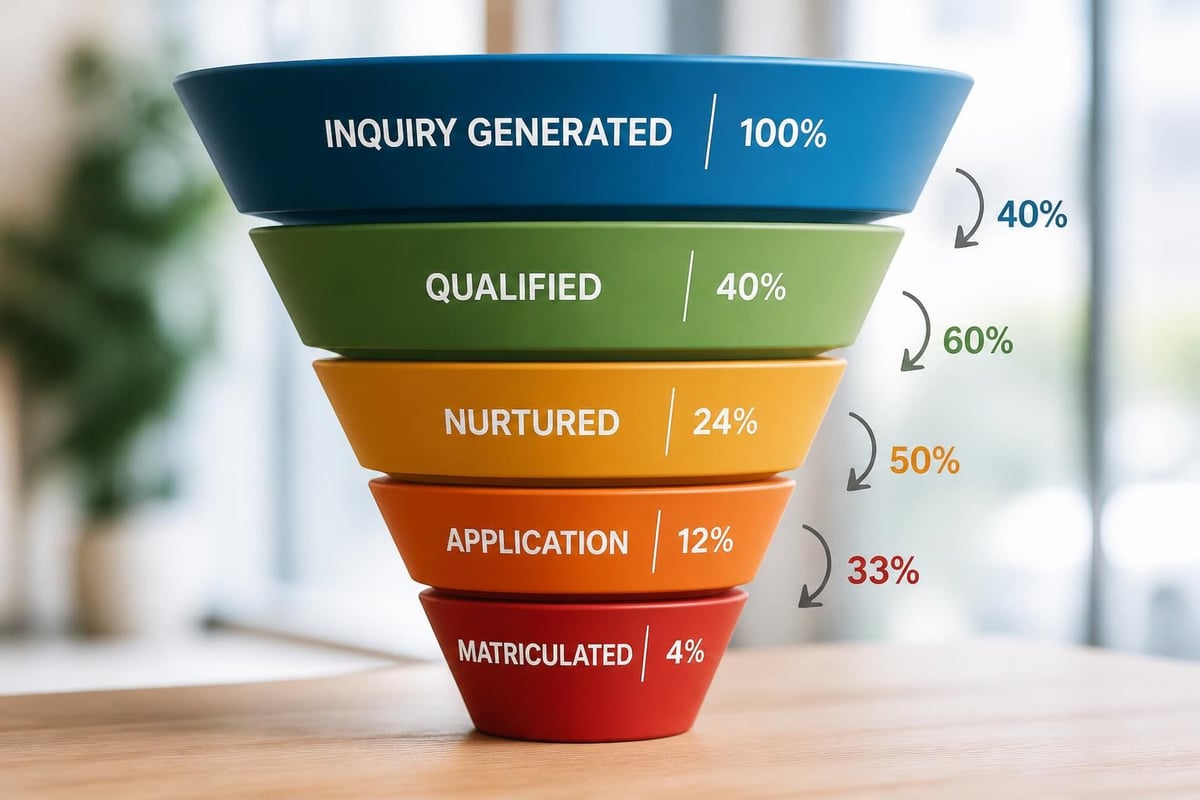
The most effective enrollment partners provide complete systems rather than isolated marketing tactics. They understand that successful enrollment requires coordinated efforts across multiple functions:
| Enrollment System Component | Purpose | Key Metrics |
|---|---|---|
| Inquiry Generation | Attract qualified prospects | Cost per inquiry, source quality |
| Rapid Response | Engage prospects immediately | Response time, connection rate |
| Lead Nurturing | Build relationships over time | Engagement rate, pipeline velocity |
| Application Support | Remove friction from process | Application completion rate |
| Yield Management | Convert admits to enrolled students | Deposit rate, matriculation rate |
Companies offering comprehensive school enrollment services integrate these components into cohesive systems that guide prospects from initial awareness through final enrollment.
Technology and Automation Integration
Modern enrollment success requires sophisticated technology stacks that automate repetitive tasks while enabling personalized communication at scale. The top school enrollment companies leverage CRM systems, marketing automation platforms, and analytics tools specifically configured for educational recruitment.
Essential technology capabilities include:
- Automated inquiry capture and distribution across multiple channels
- Intelligent lead scoring based on engagement and fit indicators
- Personalized nurture sequences tailored to prospect interests and stage
- Real-time reporting dashboards showing pipeline health and conversion metrics
- Integration with student information systems for seamless handoffs
These technological foundations enable enrollment teams to respond faster, communicate more relevantly, and make data-driven decisions throughout the recruitment cycle.
Evaluating Enrollment Company Capabilities
Selecting the right enrollment partner requires careful evaluation of their capabilities, track record, and approach. Institutions should assess potential providers across multiple dimensions to ensure alignment with their specific needs and goals.
Track Record and Results
Request specific case studies with quantifiable results from institutions similar to yours. The best enrollment companies can demonstrate:
- Year-over-year enrollment growth percentages for client institutions
- Inquiry volume increases with corresponding quality metrics
- Application and yield rate improvements compared to baseline
- Return on investment calculations showing cost per enrolled student
- Client retention rates indicating sustained partnership value
Be cautious of providers making unrealistic promises or unwilling to share detailed performance data. Effective higher education enrollment marketing produces measurable results that partners should transparently document.
Methodology and Approach
Understanding how a company approaches enrollment challenges reveals whether they offer strategic partnership or merely tactical execution. Top providers conduct thorough discovery to understand your institution's unique value proposition, target audiences, and competitive positioning.

Questions to ask potential enrollment partners:
- How do you determine which prospect segments to prioritize?
- What is your process for developing messaging and positioning?
- How do you balance inquiry volume with inquiry quality?
- What role does your team play versus our internal staff?
- How frequently do you adjust strategies based on performance data?
The responses reveal whether you're speaking with a true strategic partner or a vendor simply executing campaigns without deeper enrollment expertise.
Service Scope and Flexibility
Educational institutions vary widely in their enrollment needs and internal capabilities. Some require comprehensive virtual enrollment team support, while others need targeted assistance in specific areas.
| Service Model | Best For | Typical Components |
|---|---|---|
| Full-Service | Institutions lacking internal enrollment marketing capacity | Strategy, creative, media, automation, analytics, consulting |
| Specialized Support | Schools with internal teams needing expert assistance | Specific channels (digital, content) or functions (automation, reporting) |
| Consulting & Advisory | Well-resourced teams seeking strategic guidance | Enrollment planning, market research, training, audits |
| Technology & Systems | Institutions needing infrastructure | CRM implementation, automation setup, integration |
The top school enrollment companies offer flexible engagement models that adapt to your institution's specific situation and can scale as your needs evolve.
Industry-Specific Considerations
Different educational sectors face distinct enrollment challenges that require tailored approaches. Leading enrollment companies recognize these differences and customize their systems accordingly.
K-12 Schools and Academies
Private K-12 schools compete against tuition-free public options and must justify their value proposition to price-sensitive families. Enrollment strategies for this sector emphasize:
- Parent-focused messaging addressing educational outcomes and student experience
- Local market targeting within realistic geographic recruitment zones
- Extended nurture timelines as families plan months or years ahead
- Virtual tour and visit experiences that showcase campus and community
- Financial aid positioning that addresses affordability concerns transparently
Companies specializing in K-12 enrollment marketing understand the unique decision dynamics in this segment and build systems that address parent concerns throughout the consideration journey.
Higher Education Institutions
Colleges and universities face intense competition for a shrinking demographic of traditional-age students. Research from College Board on application and enrollment patterns shows changing student behavior that enrollment systems must address.
Higher education enrollment priorities include:
- Expanding geographic recruitment beyond traditional territories
- Diversifying student populations across multiple dimensions
- Managing yield more effectively through data-driven engagement
- Supporting specific program recruitment for graduate and professional schools
- Optimizing financial aid strategies to balance revenue and access
Effective higher education marketing strategies acknowledge these complexities and provide sophisticated approaches to student recruitment across all levels.
Sports Academies and Specialized Programs
Athletic development programs and specialized academies serve niche markets with unique recruitment considerations. These institutions benefit from enrollment partners who understand:
- Performance-based messaging that resonates with competitive athletes and families
- Showcase and tournament recruitment opportunities for direct prospect engagement
- Alumni success stories as powerful conversion tools
- Balance between athletic and academic positioning
- International recruitment for programs with global appeal
Companies offering sports academy marketing strategies recognize the specialized nature of this market and develop targeted approaches that connect with serious athletes and their families.
Technology Platforms and Integration
The top school enrollment companies leverage sophisticated technology stacks that extend far beyond basic marketing tools. These platforms enable personalized communication at scale while providing the data visibility necessary for continuous optimization.
CRM and Marketing Automation
Customer relationship management systems designed for education differ significantly from generic business CRM platforms. Education-specific solutions understand the unique enrollment funnel, accommodate multiple decision-makers, and integrate with student information systems.
Leading enrollment companies typically work with:
- Slate (Technolutions) for comprehensive enrollment management
- Salesforce Education Cloud for scalable CRM with deep customization
- HubSpot with education-specific configuration for inbound marketing
- Element451 for modern, mobile-first student engagement
- Mongoose (Advance Education) for streamlined communications
The platform matters less than how effectively the enrollment company configures and utilizes it. School admissions automation requires expertise in workflow design, data architecture, and integration strategy.
Analytics and Reporting Infrastructure
Data-driven enrollment management depends on robust analytics that connect marketing activities to enrollment outcomes. Top providers establish comprehensive reporting frameworks that track:
| Metric Category | Key Indicators | Strategic Value |
|---|---|---|
| Top of Funnel | Inquiries by source, cost per inquiry, inquiry quality score | Media optimization, budget allocation |
| Mid Funnel | Engagement rate, nurture velocity, application start rate | Content effectiveness, communication timing |
| Bottom Funnel | Application completion, admission rate, yield rate | Conversion optimization, competitive positioning |
| Outcomes | Enrolled students by source, cost per enrollment, lifetime value | ROI calculation, strategic planning |
These metrics enable institutions to understand which enrollment activities drive results and where opportunities for improvement exist.

Selection Process and Partnership Structure
Choosing among the top school enrollment companies requires a structured evaluation process that ensures alignment between institutional needs and provider capabilities.
Request for Proposal Development
A well-constructed RFP helps potential partners understand your specific situation and respond with relevant solutions. Include comprehensive information about:
- Institutional background including mission, programs, and competitive positioning
- Current enrollment situation with historical data and future goals
- Existing marketing and enrollment infrastructure including technology and staffing
- Budget parameters and expected investment levels
- Timeline expectations for implementation and results
- Success metrics and performance expectations
Clear RFP documentation enables providers to assess fit and propose solutions tailored to your actual needs rather than generic offerings.
Partnership Structure and Expectations
The most successful relationships between institutions and enrollment companies feature clear expectations, defined responsibilities, and regular communication cadences.
Establish agreements covering:
- Performance goals with specific, measurable targets
- Roles and responsibilities clarifying who handles which tasks
- Communication protocols including meeting frequency and reporting schedules
- Technology ownership and data access rights
- Contract terms including duration, renewal conditions, and termination provisions
According to HolonIQ's education market analysis, successful education technology implementations require strong institutional commitment and change management. The same principle applies to enrollment partnerships.
Investment Considerations
Enrollment services represent significant institutional investments that must demonstrate clear return on investment. The top school enrollment companies operate on various pricing models:
- Monthly retainer for ongoing services and support
- Performance-based compensation tied to enrollment outcomes
- Project-based fees for specific initiatives or implementations
- Hybrid models combining base fees with performance bonuses
When evaluating education lead generation partners, calculate the cost per enrolled student including all service fees, media spend, and technology costs. Compare this against the lifetime tuition revenue to determine true ROI.
Emerging Trends in Enrollment Services
The enrollment services industry continues evolving as educational institutions face new challenges and opportunities. Top providers stay ahead of these trends and incorporate emerging best practices into their methodologies.
Artificial Intelligence and Predictive Analytics
Advanced enrollment companies now leverage AI-powered tools for:
- Predictive modeling that identifies prospects most likely to enroll
- Chatbot engagement providing instant responses to prospective student questions
- Content personalization dynamically adjusting messaging based on behavior
- Optimal timing algorithms determining when to send specific communications
- Enrollment forecasting projecting final class composition based on pipeline indicators
These technologies enable more efficient resource allocation and more effective prospect engagement throughout the recruitment cycle.
Holistic Student Experience Design
Leading enrollment companies recognize that recruitment extends beyond marketing tactics to encompass the entire prospective student experience. This comprehensive approach addresses every touchpoint from initial awareness through matriculation.
Experience design considerations include:
- Virtual and in-person visit programming that converts attendees
- Application processes optimized for mobile completion
- Financial aid communication that clarifies affordability
- Admitted student engagement that builds excitement and commitment
- Parent involvement strategies appropriate to student age and independence
Research from the Wallace Foundation on program enrollment demonstrates that even well-designed programs struggle with enrollment when the registration experience creates friction. The same principle applies across all educational sectors.
Multi-Channel Integration
Modern prospective students engage across numerous channels throughout their enrollment journey. The top school enrollment companies orchestrate consistent experiences across:
- Search engine marketing and organic visibility
- Social media platforms where students spend time
- Email and SMS communication sequences
- Direct mail for high-value prospect segments
- Webinars and virtual information sessions
- Campus visits and in-person events
- Counselor and influencer outreach
Education Week's analysis of virtual education demand highlights how institutional choices about delivery models affect enrollment strategies. Effective multi-channel approaches acknowledge these complexities.
Building Long-Term Enrollment Success
The relationship between institutions and enrollment service providers should extend beyond single-year campaigns to build sustainable enrollment growth over time.
Continuous Improvement Methodology
Top enrollment companies employ disciplined testing and optimization frameworks that systematically improve results across enrollment cycles. This approach includes:
Quarterly strategy reviews assessing performance against goals and adjusting tactics accordingly. Teams examine conversion rates at each funnel stage, analyze cohort performance, and identify opportunities for improvement.
A/B testing programs that evaluate messaging variations, creative approaches, landing page designs, and communication timing. Structured experimentation reveals what resonates most effectively with target audiences.
Competitive intelligence monitoring tracking how peer institutions position themselves and evolve their recruitment strategies. This awareness informs differentiation approaches and identifies market opportunities.
Technology optimization ensuring that automation workflows, CRM configuration, and analytics infrastructure evolve with changing needs and available capabilities.
Capacity Building and Knowledge Transfer
The most valuable enrollment partners don't create dependency but rather build institutional capacity over time. They provide:
- Training for internal staff on enrollment best practices and system utilization
- Documentation of strategies and processes that become institutional knowledge
- Regular insights sharing about industry trends and emerging opportunities
- Collaborative planning that develops internal strategic thinking capabilities
This approach ensures institutions benefit from external expertise while simultaneously strengthening their own enrollment competencies.
Measuring Success and ROI
Ultimately, enrollment companies must demonstrate tangible return on investment through increased qualified inquiries, applications, and enrolled students. Establishing clear success metrics from the outset enables objective evaluation.
Leading and Lagging Indicators
Effective measurement tracks both immediate activity metrics and ultimate enrollment outcomes:
| Indicator Type | Metrics | Review Frequency |
|---|---|---|
| Leading | Inquiry volume, inquiry quality, engagement rates | Weekly |
| Mid-Cycle | Application starts, completions, admit rates | Bi-weekly |
| Lagging | Deposits, enrolled students, demographic composition | Monthly/Quarterly |
| Strategic | Cost per enrollment, student retention, lifetime value | Annual |
Institutions working with the top school enrollment companies review these metrics regularly to assess progress and make informed adjustments throughout recruitment cycles.
Attribution and Source Analysis
Understanding which marketing investments drive enrollment enables smarter budget allocation. Sophisticated attribution models track prospects from initial touchpoint through final enrollment, revealing:
- Which inquiry sources produce the highest yield rates
- How different prospect segments respond to various messaging approaches
- What communication sequences most effectively move prospects through the funnel
- Where prospects disengage and what interventions might re-engage them
Companies providing comprehensive school enrollment consulting establish robust attribution frameworks that connect investment to outcomes across the entire enrollment journey.
The top school enrollment companies in 2026 distinguish themselves through specialized expertise, proven methodologies, integrated technology systems, and measurable results that drive sustainable enrollment growth. Institutions seeking to fill their seats with qualified students benefit from partners who understand the unique dynamics of educational recruitment and provide comprehensive systems rather than isolated marketing tactics. ScholarSurge delivers exactly this type of specialized enrollment growth system for schools, colleges, universities, and sports academies, guaranteeing increased qualified inquiries and applications through automated inquiry management, rapid response protocols, and sophisticated nurturing that guides prospects to enrollment.