
Insights
Done-for-You Admissions Follow-Up: A Practical Guide for Schools
See how done-for-you admissions follow-up works, what to automate, which timelines matter, and how to judge a provider before you hand off your inquiries.
READING TIME · 10 MIN · UPDATED QUARTERLY

Done-for-you admissions follow-up is an outsourced or fully managed system that responds to every inquiry, nurtures each family through a set sequence of messages and calls, and hands qualified prospects to your admissions team ready to tour or apply. Instead of relying on staff to remember who needs a call, the system handles speed, persistence and tracking for you, so seats do not go unfilled because a message sat unanswered over a weekend.
This guide explains what follow-up should include, how long families expect to wait, what a sound sequence looks like, and how to evaluate a provider. It is written for heads of school, admissions directors and enrollment leaders in K-12 schools, colleges and sports academies.
What Done-for-You Admissions Follow-Up Actually Covers
A managed follow-up service covers every touchpoint between a family's first inquiry and the moment your admissions staff takes over a warm, qualified conversation. The scope usually includes the following:
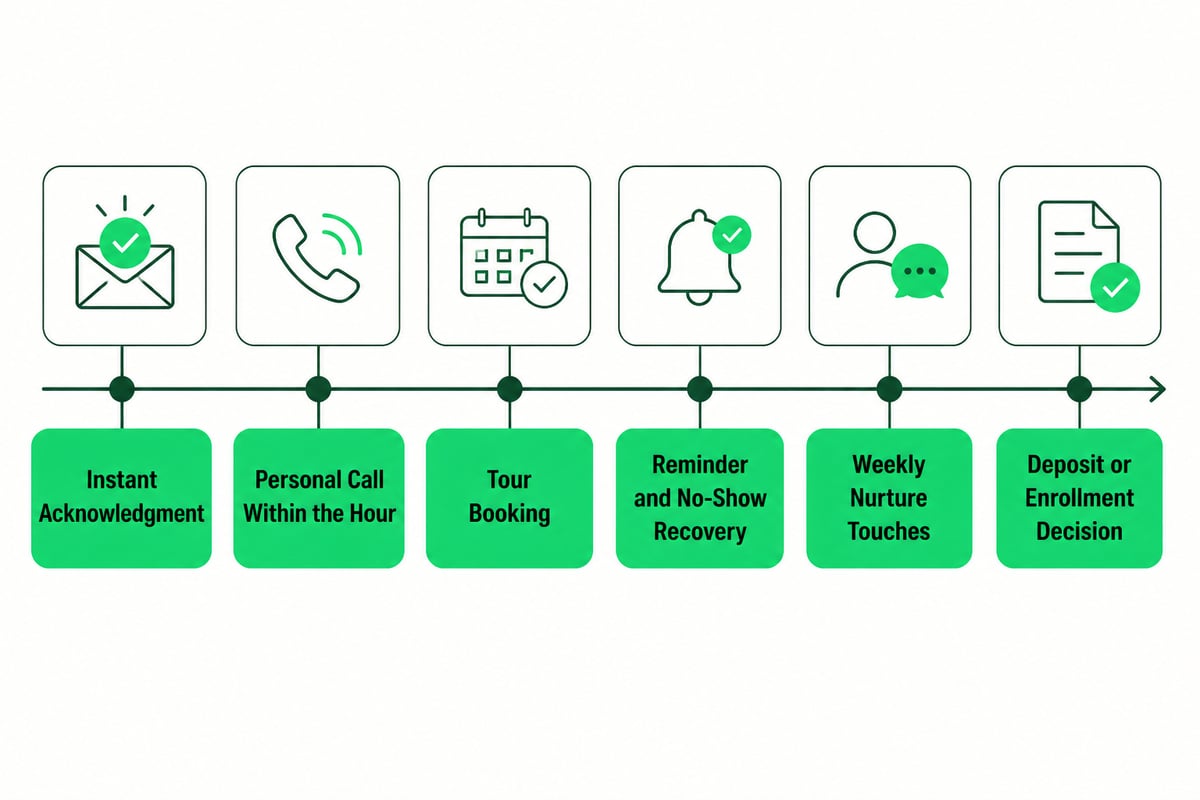
- Instant acknowledgment of every web form, ad lead, phone inquiry and event registration
- Multi-channel outreach by email, text message and phone, tied to a defined schedule
- Lead qualification based on grade or program, start date, location and fit
- Booking tours, open-house seats and interviews directly into your calendar
- Reminders and no-show recovery for scheduled visits
- CRM logging and reporting so you can see where each family sits in the funnel
The "done-for-you" element means a team or system executes these steps on your behalf, rather than handing you software and expecting your office staff to configure and run it. For a lean admissions office, that difference often decides whether follow-up happens consistently or only when the calendar is quiet.
Follow-up also differs from lead generation. Generating inquiries brings families to your door; follow-up determines whether they walk through it. Many schools spend heavily on advertising and then lose a large share of those inquiries to slow or inconsistent replies. For a broader view of how the two connect, see ScholarSurge's overview of done-for-you school enrollment marketing.
How Fast Should You Respond to an Admissions Inquiry?
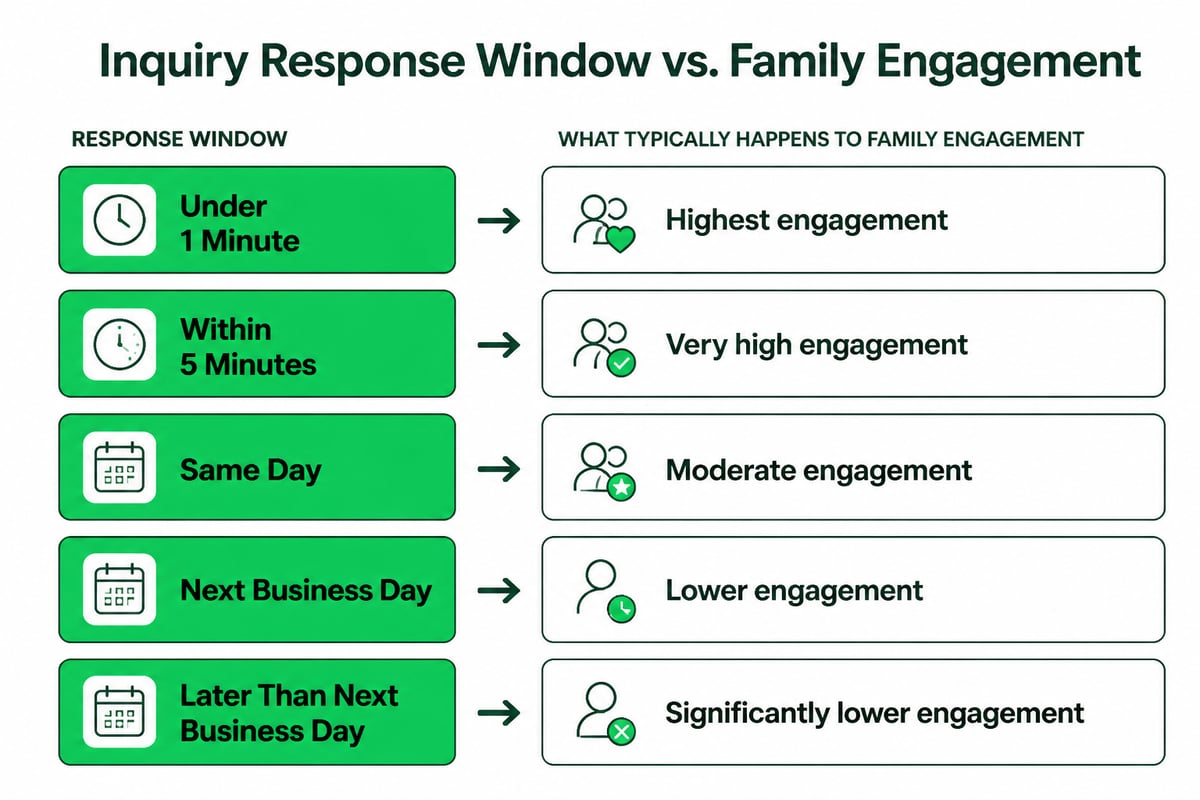
Respond within minutes, and ideally within one minute, because the first school to reply usually frames the rest of the family's decision. Families rarely contact a single school. Niche reports that most families consider three or more schools, which means your inquiry is competing with others in the same inbox at the same moment.
Speed also shapes perception. In the same Niche data, parents rated communication speed far more highly at the school they enrolled in than at schools they did not choose. A fast reply signals that the school is organized, attentive and ready to welcome a new family.
Most admissions offices cannot sustain a sub-minute response around the clock. Inquiries arrive at night, on weekends and during school events, when staff are teaching, touring or in meetings. ScholarSurge's speed-to-lead response targets every inquiry and typically replies in under 60 seconds, which is the kind of standard that manual processes rarely match. The reasoning behind that benchmark is laid out in the 5-minute rule for admissions speed-to-lead.
How Long Should Families Wait to Hear Back After Applying?
Families should receive an automatic confirmation immediately, a human or personalized acknowledgment within one business day, and a clear timeline for the decision at the point of application. The waiting period itself varies by institution, but the silence should never be unexplained.
This distinction matters for application follow-up, which is different from inquiry follow-up. Once a family has applied, their anxiety rises, and so does their tendency to refresh the portal, email the office and compare notes with other applicants. A school that sets expectations early reduces that inbound pressure and protects staff time.
A practical application-stage cadence looks like this:
- Immediately: confirmation that the application was received
- Within 48 hours: a checklist of any missing documents, with the deadline
- Weekly: a short status update until a decision is issued
- On decision day: a clear, warm message with the next step and a deadline to respond
- After acceptance: a short series that moves the family toward a deposit or enrollment contract
A 2025 survey of nearly 10,000 prospective families across 47 colleges and universities found that most expect at least weekly updates from institutions. A weekly rhythm is therefore a baseline expectation, not an extra courtesy.
Is It Appropriate for Families to Email About Their Application Status?
Yes, families can and do email about status, and a well-run admissions office plans for it. The goal is to make those emails unnecessary by answering the question before it is asked, and to respond quickly and warmly when they arrive anyway.
From the school's side, a status inquiry is a buying signal. The family is engaged enough to ask. A slow or generic reply at that moment wastes the interest you worked to build. Consider these practices:
- Publish expected decision dates on the application page and in confirmation emails
- Give families a single named contact rather than a generic inbox
- Auto-acknowledge status emails, then follow with a personal answer the same day
- Track status inquiries as a metric, since a spike usually points to a communication gap
How to Follow Up on a College Application or School Inquiry: A Sequence That Works
An effective follow-up sequence combines speed, variety of channels and a clear next step in every message. The sequence below is a general framework, and exact timing should be adapted to your enrollment cycle and your families' habits.
Days 0 to 2: Respond and qualify
Send an immediate acknowledgment, then a personal text or call within the first hour. Ask one or two qualifying questions: which grade or program, and when the family hopes to start. Offer two specific times for a tour or call instead of an open-ended invitation.
Days 3 to 10: Build trust and remove friction
Share content that answers real concerns: tuition and aid timelines, a day in the life of a student, a short message from a teacher or coach. Follow with a reminder for any scheduled visit, and a recovery message for any no-show within an hour of the missed appointment.
Days 11 to 30: Persist without pressure
Alternate between email, text and phone. Invite families to an open house, an information session or a trial day. Many families need five or more touches before booking, so persistence is part of the job, provided each message offers something useful.
Beyond day 30: Long-term nurture
Families who are not ready this cycle may be ready next year. Move them to a slower nurture track tied to application deadlines and open-house dates, and keep a human check-in on the calendar. For more on the stages behind this, see ScholarSurge's guide to student admissions.
Which Channels Get Families to Respond?
Direct, personal messages outperform broadcast announcements by a wide margin. A 2025-26 family-engagement report analyzed millions of school-family messages from hundreds of districts. It found that families read direct-conversation messages far more often within a week than schoolwide or districtwide announcements.
The implication for admissions is direct. A newsletter blast is easy to send and easy to ignore, while a short, personal text or email that references the family's stated grade or interest tends to be read. Strong sequences therefore lean on one-to-one style messaging, even when automation sends it.
A reasonable channel mix for most schools:
| Channel | Best use | Watch out for |
|---|---|---|
| Text message | Fast acknowledgment, tour reminders, quick questions | Obtain consent and honor opt-outs |
| Detailed information, tuition timelines, event invitations | Generic subject lines get buried | |
| Phone | Qualifying, objection handling, closing a booking | Call at times families can answer |
| Direct mail or handwritten note | Admitted-student warmth, high-intent families | Reserve for later stages due to cost |
If you want to understand how families and district leaders perceive school communication differently, the ClassDojo family engagement report compares both perspectives and may help you calibrate tone and frequency.

Why Manual Follow-Up Breaks Down
Manual follow-up fails mainly because of inconsistency, not effort. Admissions staff are skilled and committed, yet they are also giving tours, hosting events, processing applications and answering the phone. Follow-up tasks are the first to slip during a busy week.
Typical failure points include:
- Inquiries that arrive after hours and are answered the next afternoon
- Leads sitting in a shared inbox with no clear owner
- A single follow-up attempt, then silence
- No tracking of which families have been contacted, by whom and when
- Summer and holiday gaps when staff are out
Each of these is fixable, but fixing all of them at once requires process, tooling and time that small admissions teams rarely have. That is the practical case for a managed approach. You can read more about structuring the people side in this look at the admissions team and how its workload is best divided.
What to Look for in a Done-for-You Provider
A strong provider ties follow-up to enrollment outcomes, runs it as part of a connected system and shows you the data. Use these criteria when you evaluate options:
- Response speed commitment. Ask for a specific, measurable standard and how it is monitored outside business hours.
- Integration with advertising and landing pages. Follow-up works best when the ad, the page and the reply share the same message. Disconnected vendors tend to point at each other when results lag.
- CRM transparency. You should be able to see every family, every message and every outcome.
- Pricing tied to results. Fees based on enrolled students keep the provider's incentives aligned with yours.
- Brand voice control. Messages should sound like your school, not a template.
- Clear handoff rules. Define when a family moves from the managed team to your admissions staff, and what the staff member receives at that point.
ScholarSurge runs advertising, landing pages, follow-up and CRM as one accountable system, and its pricing is performance-based, meaning payment follows student enrollment. It also guarantees 50+ qualified inquiries in the first 90 days, with work continuing at no charge until the 50-inquiry target is reached. For K-12 schools that want grade-level campaigns, open-house registration systems and admissions follow-up aimed at specific open seats, ScholarSurge for K–12 Schools is built around that goal. For specifics on scope and terms, review the details on the contact page rather than assuming standard industry terms apply.
Measuring Whether Follow-Up Is Working
Follow-up should be judged on a short list of funnel metrics reviewed monthly, with a weekly glance at speed. The most useful measures are:
- Time to first response, in minutes, by channel and by hour of day
- Contact rate, the share of inquiries that reach a live conversation
- Inquiry-to-tour rate and tour-to-application rate
- No-show rate for tours and open houses
- Application-to-enrollment rate and cost per enrolled student
Compare your numbers against realistic reference points rather than guesses. ScholarSurge publishes admissions funnel benchmarks that help you see where a funnel is leaking, and a drop at one stage often points to a specific fix, such as faster first contact or stronger tour reminders.
Getting Started Without Disrupting Your Current Process
You can introduce managed follow-up in phases, starting with the stage where families are most often lost. A phased rollout keeps your admissions team in control and builds confidence in the results.
- Audit the current path. Map every inquiry source and note average response time and what happens after the first reply.
- Fix the first hour. Put instant acknowledgment and rapid personal outreach in place first, since that is where the largest losses occur.
- Add structured nurture. Introduce the multi-week sequence for families not yet ready to tour.
- Connect tours and applications. Automate reminders, document checklists and status updates.
- Review monthly. Adjust messaging and timing using the metrics above.
Throughout, keep your staff focused on what only they can do: showing the campus, answering nuanced questions and building the relationships that turn interest into enrollment.
FAQ
How many times should a school follow up with an inquiring family?
Most schools benefit from several touches over the first 30 days, spread across email, text and phone. Each touch should offer a reason to respond, such as a tour time, a short video or an answer to a likely question. Families who stay quiet after that window can move to a slower nurture track instead of being dropped.
Does automated follow-up feel impersonal to families?
It does when messages are generic, and it does not when they are specific and timely. Messages that reference the family's grade, program or sport, and that come from a named person, read as personal even when a system sends them. A live conversation should still be available at every stage.
When should a family be handed from the follow-up team to admissions staff?
Hand off once a family has been qualified and has either booked a tour, requested a call or shown clear intent to apply. The staff member should receive the family's stated needs, the messages exchanged and the next scheduled step. That context lets the first in-person conversation start further along.
If you want to see where inquiries are slipping today, start by timing your own response: submit a test inquiry on a weekend evening and record how long a real reply takes. From there, ScholarSurge can map those gaps and run the full follow-up system as your virtual enrollment team, with ScholarSurge for K–12 Schools available for grade-level campaigns. Book Your Free Enrollment Audit to find out how faster, more consistent follow-up could help fill your open seats.