
Insights
Done-For-You Student Recruitment: A Practical Guide
See how done-for-you student recruitment works, what a full-service system includes, and how to judge providers before you commit budget.
READING TIME · 9 MIN · UPDATED QUARTERLY

Done-for-you student recruitment is a service model in which an outside team plans, runs and manages the full enrollment funnel for a school, college or sports academy: advertising, landing pages, inquiry response, follow-up and reporting. Instead of assembling vendors and software yourself, you hand off execution and keep control of admissions decisions, campus experience and final enrollment.
For admissions directors, the appeal is practical. Most enrollment offices do not lack ambition. They often lack the hours to answer every inquiry quickly, run ads across channels and nurture families over time. This guide explains what a done-for-you model includes, when it makes sense, how to evaluate providers and what to expect in the first 90 days.
What Done-For-You Student Recruitment Includes
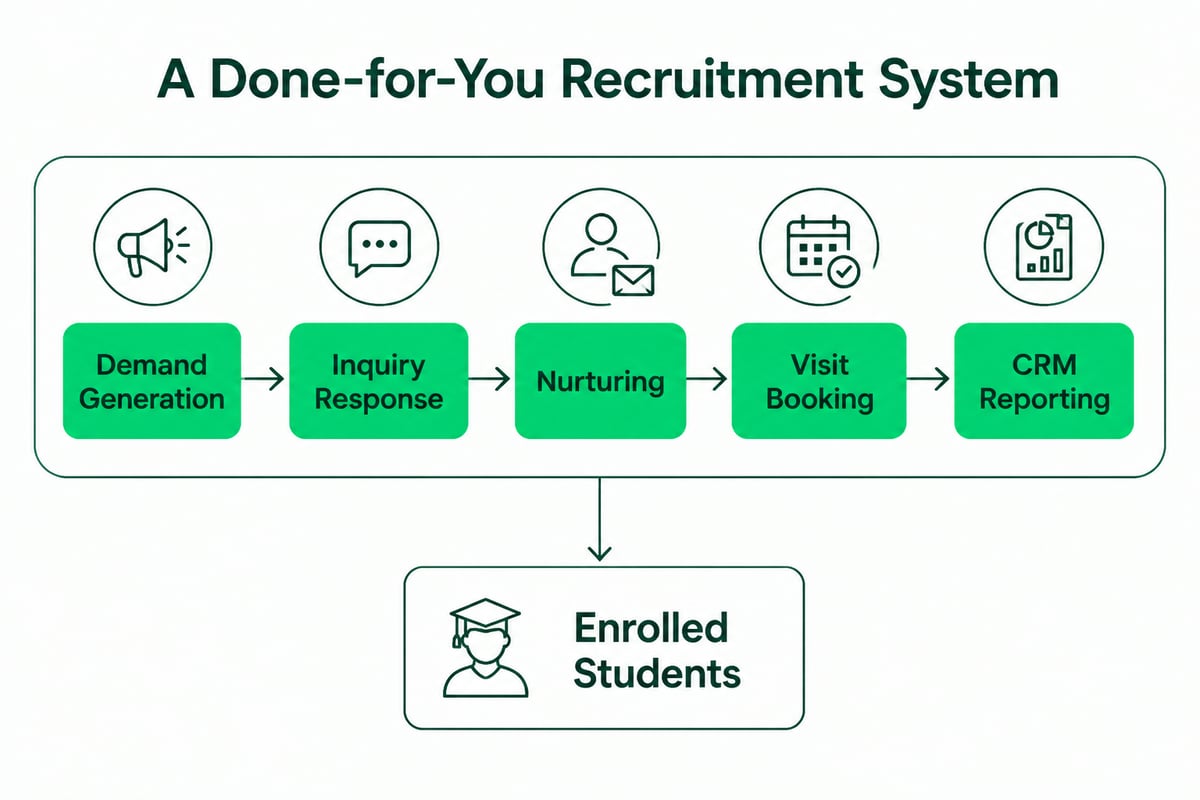
A complete done-for-you model covers five connected functions: demand generation, inquiry response, nurturing, visit booking and reporting. If a provider handles only one of these, you are buying a service line, not a system.
- Demand generation: paid search, social advertising and landing pages that attract families and students matching your target profile.
- Inquiry response: immediate contact by phone, text or email when someone raises a hand.
- Nurturing: structured follow-up that keeps prospects engaged between first inquiry and application.
- Visit and tour booking: scheduling campus visits, virtual tours, trial days or open house attendance.
- CRM and reporting: a single record of every prospect, with cost per inquiry, cost per visit and cost per enrollment visible to leadership.
The word "done-for-you" separates this from a consulting engagement. A consultant hands you a plan. A done-for-you provider operates the plan, which matters for small admissions teams that cannot absorb another project.
Why Schools Outsource Recruitment
Schools outsource recruitment because the gap between a good strategy and consistent execution is where enrollment is lost. Strategy documents are rarely the problem. Slow follow-up, inconsistent messaging and fragmented tools are.
Consider the practical pressure points:
- Inquiries arrive evenings and weekends, when staff are off.
- Ad platforms change constantly and need weekly attention.
- Admissions staff split time between recruiting, processing applications and supporting current families.
- Vendors for ads, websites and CRM rarely share data, so nobody owns the full cost of an enrolled student.
The market itself is also shifting. International enrollment, for example, shows how uneven recruitment conditions have become. U.S. colleges hosted 1,177,766 international students in 2024/25, up 5%, yet the Institute of International Education reports that new international enrollment fell 7% to 277,118 in the same year. Total numbers can look healthy while the pipeline of new students weakens, which is the kind of change that demands active, continuous recruitment work.
Speed to Lead: The Most Controllable Variable
Response speed is the part of the funnel you can fix fastest, and it often produces the quickest gains. A family that submits an inquiry form is typically comparing several schools at once. The first institution to reply with a useful, human message tends to shape the rest of the conversation.
Manual follow-up struggles here. A staff member who is touring a family, teaching a class or in a meeting cannot reply within a minute. Automated systems can acknowledge the inquiry instantly, qualify interest and offer a booking link, while a human follows up with substance.
ScholarSurge builds its model around this principle, aiming for a typical response to every inquiry in under 60 seconds. Whatever provider you choose, ask for their average response time in writing and ask how it is measured.
Components of an Effective Recruitment Funnel
An effective funnel moves a prospect from awareness to enrolled student through defined stages, each with an owner and a metric. Done-for-you providers should be able to show you all of them.
Awareness and Lead Capture
Paid channels such as Google Ads for schools capture families actively searching, while social campaigns reach those who have not yet started looking. Landing pages should speak to one audience and one action: request information, book a tour or start an application. Generic homepage traffic converts poorly.
Qualification and Nurture
Not every inquiry is a fit. Qualification questions on the form, grade level, start date, program interest and location, let your team prioritize. Nurture sequences then keep qualified families warm with relevant content: faculty introductions, student stories, tuition and aid information, and invitations to events.
Visits, Applications and Enrollment
The visit is the highest-converting step in most school funnels, so reminders, rescheduling options and post-visit follow-up deserve as much attention as the ad that started the journey. After the visit, a clear path to application and a named admissions contact reduce drop-off.
Who Benefits Most From a Done-for-You Model
Done-for-you recruitment suits institutions with a clear enrollment target and limited internal capacity. It is a weaker fit where leadership wants to build an in-house marketing department or where the challenge is retention rather than inquiry volume.
| Institution type | Typical recruitment challenge | Where done-for-you helps |
|---|---|---|
| Independent and private K-12 schools | Seasonal inquiry spikes, small admissions teams | Consistent response and nurture across the full year |
| Boarding schools | Long decision cycles, domestic and international audiences | Multi-touch follow-up over months |
| Small and private colleges | Rising competition for a narrowing applicant pool | Targeted campaigns and application-stage follow-up |
| Sports academies | Tryout-driven timelines, parent and athlete decision makers | Event and trial-day booking systems |
For deeper reading on sector-specific approaches, see ScholarSurge's pages on private school recruitment and performance marketing for colleges.
How to Evaluate a Done-for-You Provider
The most reliable way to evaluate a provider is to test accountability: who owns the numbers, how they get paid and what happens if results fall short. Marketing language is easy to produce. Contract structure is harder to fake.
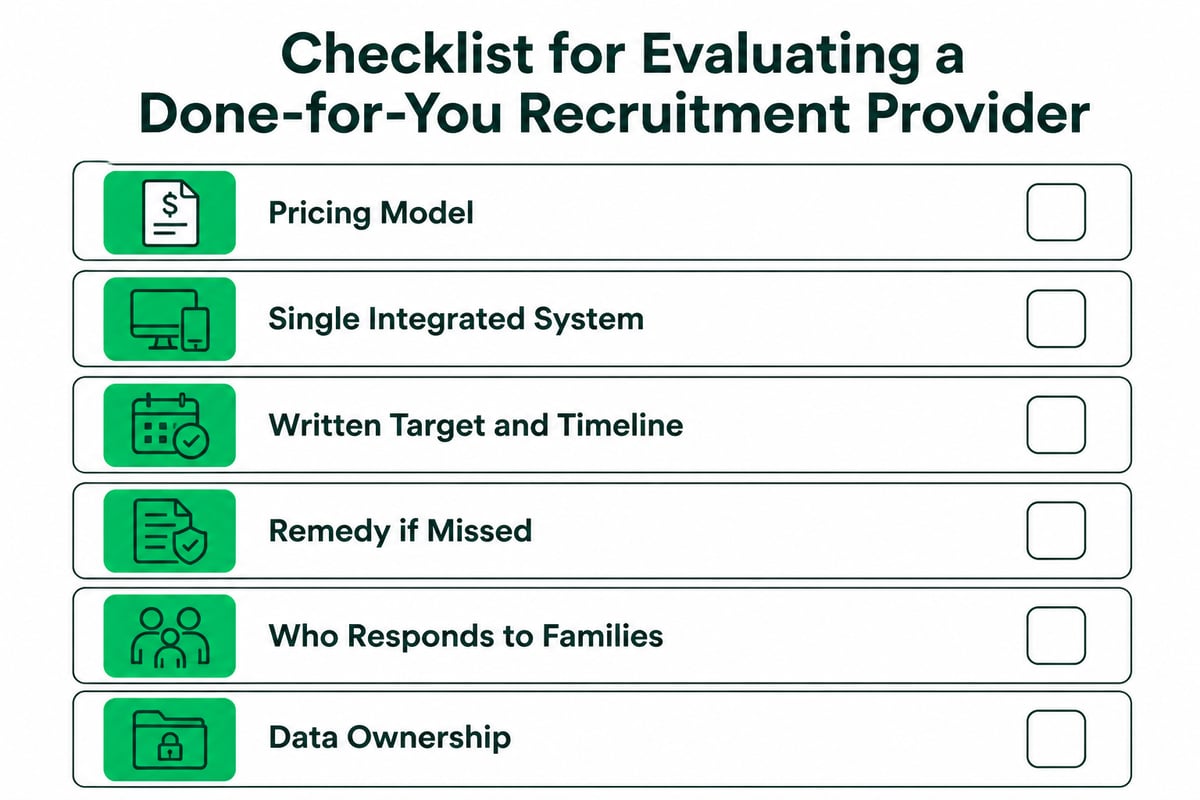
Ask these questions before signing:
- What is the pricing model? Retainers with no performance link shift all risk to you. Performance-based or hybrid models align the provider with enrollment outcomes.
- Is it one system or several vendors? Advertising, landing pages, follow-up and CRM should share data. Otherwise no one can tell you the true cost per enrolled student.
- What is the stated target and timeline? Look for a specific inquiry or application goal tied to a specific window, in writing.
- What happens if the target is missed? A credible provider has a defined remedy.
- Who answers your families? Ask to hear or read sample responses.
- What do you own at the end? Confirm that you keep your data, ad accounts and CRM records.
ScholarSurge's published terms illustrate what accountability can look like: pricing is performance-based, with payment tied to students enrolling. It guarantees 50+ qualified inquiries in the first 90 days, and work continues at no charge until that target is reached. You can compare that structure against other options in this overview of enrollment performance agencies.
Metrics That Show the System Is Working
A done-for-you provider should report on a short list of metrics tied to enrollment, not impressions or clicks. Review them monthly and ask for trend lines, not snapshots.
- Qualified inquiries: total volume and the share that match your target profile.
- Response time: average and worst-case time from inquiry to first contact.
- Inquiry-to-visit rate: the share of prospects who book and attend a tour or event.
- Visit-to-application rate: where many schools find their largest leak.
- Cost per inquiry, visit, application and enrolled student: the figure leadership should track most closely.
- Projected return: a forecast of tuition revenue against spend, tied to explicit assumptions.
For reference, ScholarSurge has cited a projected 12-month ROI of 3.2x based on its recovery plan, though this figure is a projection rather than a guaranteed result. Treat any projected figure, from any provider, as a model to be tested against your own tuition, retention and capacity data.

Done-for-You Student Recruitment for International and Niche Audiences
Done-for-you student recruitment can extend to international and specialized audiences, but these segments require more careful targeting and longer nurture timelines. The data shows why precision matters. Undergraduate international enrollment in the U.S. rose 4% to 357,231 in 2024/25, while graduate enrollment declined 3% to 488,481, according to IIE's Open Doors report. Within one national picture, segments moved in opposite directions.
IIE's fall 2025 snapshot adds another signal: participating institutions reported a 1% decline in total international students and a 17% drop in new international enrollments. Institutions that depend on one region, one program level or one visa pathway carry concentrated risk.
Practical steps for institutions recruiting across borders:
- Build separate landing pages and messaging by region and program level.
- Plan for longer decision cycles and more touchpoints with families and counselors.
- Track domestic and international funnels separately so a decline in one does not hide growth in the other.
- Review pathways such as pre-college programs or dual enrollment as alternative entry points.
Further guidance is available in ScholarSurge's overview of international student recruitment.
What the First 90 Days Should Look Like
A well-run onboarding follows a predictable sequence, and you should expect visible activity within weeks, not quarters. Use this timeline as a benchmark when reviewing any provider's plan.
- Weeks 1 to 2, audit and alignment: review current inquiry handling, past campaign data, tuition goals and capacity. Define the target audience and enrollment goal.
- Weeks 2 to 4, build and launch: set up landing pages, tracking, CRM pipelines, response automation and initial campaigns.
- Weeks 4 to 8, optimize: adjust creative, audiences and follow-up sequences based on early inquiry quality, not just volume.
- Weeks 8 to 12, scale and report: expand the channels that produce visits and applications, retire those that do not, and review progress against the written inquiry target.
Your team still has work to do. Admissions staff must show up to tours, return calls on warm prospects and give feedback on lead quality. The provider handles the machine, but the campus experience converts the family.
Where The Surge System Fits
For schools that want advertising, response, booking and CRM run under one accountable roof, The Surge System packages paid demand generation, rapid inquiry response, tour and visit booking and CRM automation into a single monthly retainer. It is built for K-12 schools, colleges, universities and sports academies in North America that want a virtual enrollment team rather than another set of tools to manage. It is not designed for institutions seeking scholarship or financial aid services, or for organizations that need a general marketing agency.
Common Mistakes to Avoid
Most failed outsourcing arrangements share a few causes, and nearly all are avoidable with clear expectations up front.
- Unclear ownership of response: if no one is accountable for replying to inquiries within minutes, even excellent advertising will underperform.
- Optimizing for inquiry volume alone: a flood of poor-fit inquiries overwhelms staff and lowers morale. Insist on quality definitions.
- No feedback loop: admissions teams that never tell the provider which leads enrolled prevent the system from learning.
- Switching providers too early: enrollment cycles are long, so judge results against the funnel stages rather than only final enrollment.
- Ignoring capacity: more tours than your team can host creates a poor first impression.
Related reading on building a durable funnel appears in this guide to student enrollment strategies.
Your next step is to gather the last 12 months of inquiry data, including how quickly each inquiry received a first response, and calculate your inquiry-to-visit and visit-to-application rates. Those two numbers show where seats are being lost. ScholarSurge builds enrollment systems for schools, colleges and sports academies, pairing rapid response and nurturing with The Surge System so qualified families reach your campus. If you want an outside read on your funnel, Book Your Free Enrollment Audit to see where your current process leaks and what a done-for-you approach could recover.