
Insights
Marketing Agency for Training Academies: What to Expect
Find out what a marketing agency for training academies delivers, how engagements are priced, and which questions to ask before you sign a contract.
READING TIME · 9 MIN · UPDATED QUARTERLY

A marketing agency for training academies should deliver qualified inquiries, fast follow-up, and booked visits, not just clicks and impressions. For admissions directors and heads of school in North America, the right partner treats advertising, landing pages, response speed, and CRM as one system that ends in enrolled students. This article explains what services to expect, how agencies price their work, what a realistic first 90 days looks like, and how to judge whether an agency is built for enrollment or for general brand awareness.
What a Marketing Agency for Training Academies Actually Does
A marketing agency for training academies builds and runs the channels that turn local or national interest into applications: paid search and social advertising, landing pages, inquiry follow-up, and reporting tied to enrollment. The strongest agencies work backward from seats filled rather than forward from creative output.
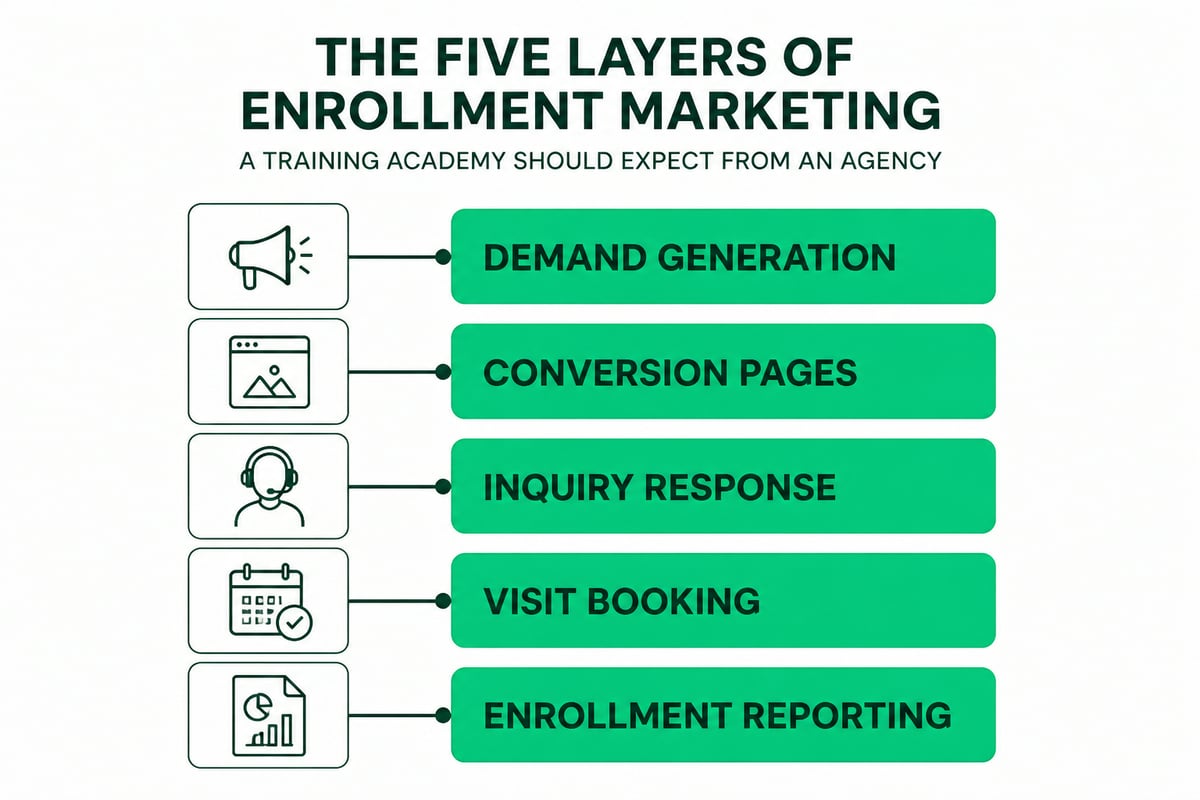
In practice, the work divides into five layers:
- Demand generation: Google Ads, Meta campaigns, and retargeting aimed at parents, prospective students, or athletes and their families.
- Conversion pages: Landing pages built for one action, such as booking a tour, requesting a program guide, or starting an application.
- Inquiry response: Immediate acknowledgment by text, email, or call, followed by structured nurture sequences.
- Visit and event booking: Open houses, campus tours, trial sessions, and tryouts scheduled directly from the inquiry thread.
- Reporting: Cost per qualified inquiry, inquiry-to-visit rate, visit-to-application rate, and cost per enrolled student.
An agency that covers only the first layer leaves you managing the rest. That gap is where most enrollment spending is lost.
Why Training Academies Need Specialized Marketing Support
Training academies sell a high-consideration decision, so generic lead generation tactics underperform. Families and adult learners compare programs for weeks or months, visit more than one campus, and expect a human-sounding reply within minutes.
Budgets are also tight. A summer 2025 survey by EAB found that most higher-education marketing leaders reported flat or declining budgets over the prior year, and that limited budget is a major barrier to their enrollment goals. The same survey showed that most non-staff marketing dollars went to enrollment marketing, mostly digital. When every dollar is scrutinized, the cost of a slow follow-up or a weak landing page becomes expensive.
Specialization matters for three reasons:
- Seasonality: Enrollment cycles, application deadlines, and start dates shape when budgets should rise and fall.
- Compliance and trust: Education advertising carries platform policy requirements and parent expectations that a generalist team may not anticipate.
- Process knowledge: Admissions teams run on tours, visits, tryouts, and counselor conversations. An agency that understands this builds the follow-up around it.
If your organization is a sports-focused program, a sports academy marketing agency will already understand tryout calendars, recruiting windows, and parent decision-making. Independent institutions can look at how a marketing agency for independent schools approaches the same problems.
Services to Expect From a Full-Service Partner
A capable agency should cover paid acquisition, conversion, and follow-up under one accountable owner. Splitting these across separate vendors is the most common reason inquiries stall.
Paid Advertising
Search advertising captures families and learners already looking for programs in your area. Social advertising builds awareness and retargets website visitors. A sound paid strategy separates branded and non-branded campaigns, excludes irrelevant traffic, and reports on qualified inquiries rather than raw form fills. For schools in particular, Google Ads for schools require careful geographic and intent targeting.
Landing Pages and Offers
Each campaign needs a page matched to its promise. A visitor who clicked an ad about a program should land on that program, with a clear next step, short form, and visible proof such as outcomes, accreditation, or placement data. Sending paid traffic to a general homepage is one of the quickest ways to inflate cost per inquiry.
Rapid Response and Nurture
Response time is where enrollment is often won or lost. An agency should be able to explain exactly how a new inquiry is acknowledged, who replies, and what happens when the prospect goes quiet. Look for multi-step sequences across text and email, with clear handoff to your admissions staff once a family is ready to talk.
CRM and Reporting
A CRM that records source, stage, and outcome lets you see which campaigns produce enrolled students. Without it, reports stop at the lead and the agency cannot be held to enrollment results. You can read more on how this works in practice in this overview of done-for-you admissions follow-up.
How Agencies Price Their Work
Agencies price training academy marketing in three main ways, and each shifts risk differently. Understanding the model matters as much as the number.
| Pricing model | How it works | Where the risk sits |
|---|---|---|
| Monthly retainer | Fixed fee for services, plus ad spend | Mostly with the school |
| Percentage of ad spend | Fee scales with media budget | Incentive to raise spend |
| Performance-based | Fees tied to inquiries or enrollments | Shared with the agency |
Retainers are predictable but reward activity over outcomes. Percentage-of-spend models can quietly push budgets upward. Performance-based arrangements align the agency with your goal, though you should confirm precisely what counts as a qualified inquiry and when payment is triggered.
Ask every agency to put the following in writing:
- The definition of a qualified inquiry
- Who owns the ad accounts, pages, and data
- Minimum contract length and exit terms
- What is and is not included in the fee, including ad spend
For a broader look at outcome-linked models, see this explanation of an enrollment performance agency.
What the First 90 Days Should Look Like
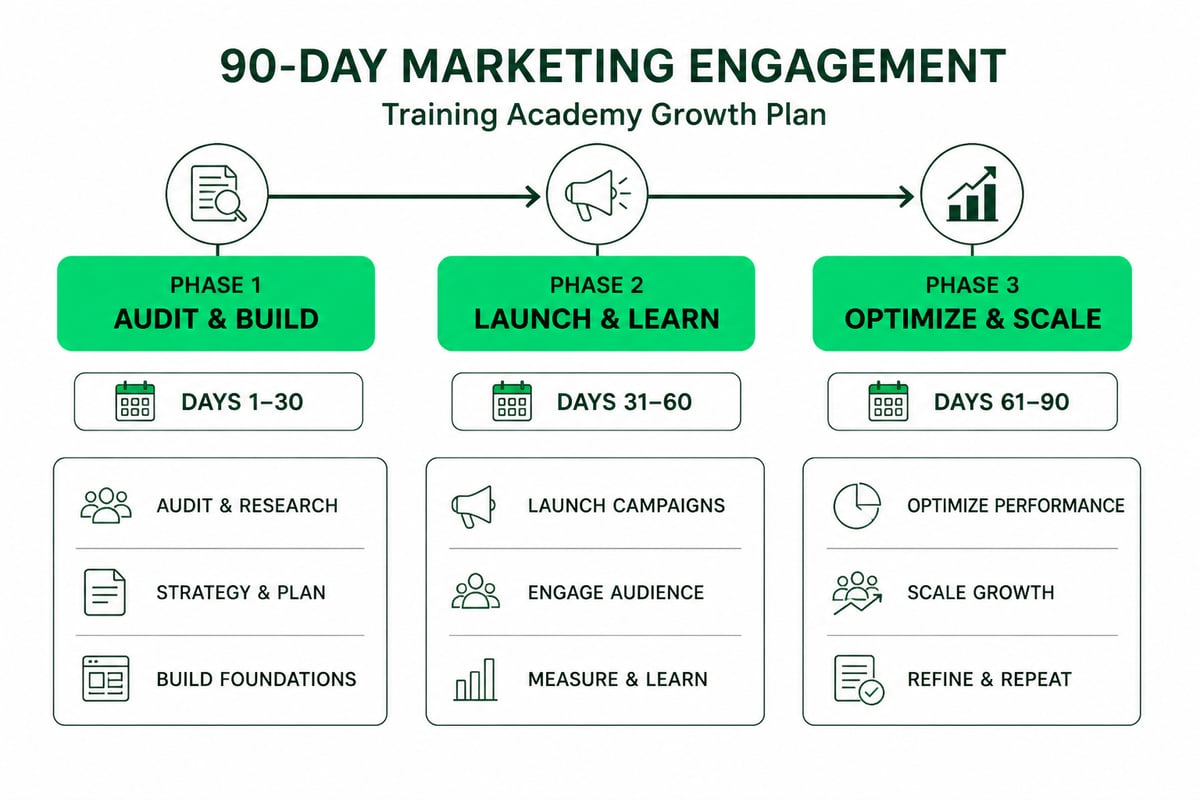
A credible agency should show a defined timeline, not a vague promise of "results soon." The first 90 days typically move through setup, launch, and optimization.
Days 1 to 30: Audit and Build
The agency reviews your current inquiry flow, response times, website, and any existing campaigns. It then builds tracking, landing pages, and follow-up sequences. This is the stage where a free audit is most useful, because it exposes leaks before new money is spent.
Days 31 to 60: Launch and Learn
Campaigns go live with modest budgets across a few audiences and offers. Early data will be noisy. What matters is whether inquiries are arriving, how fast they are answered, and how many convert to visits.
Days 61 to 90: Optimize and Scale
Weak ads are cut and winning ones expanded. By this point you should be able to see cost per qualified inquiry and the inquiry-to-visit rate with enough volume to trust the trend. Scaling before this stage often wastes budget.
Response Speed: The Metric That Separates Agencies
Speed to lead is the single most telling operational metric an agency can report. A family that submits a form at 8:15 p.m. and hears back the next afternoon has often already spoken to another school. Fast, personal-feeling replies keep the conversation alive while interest is highest.
When evaluating agencies, ask for their average inquiry response time and how it is measured. Be skeptical of answers framed in hours. Automated acknowledgment followed by a human reply within minutes is a reasonable standard, and some systems reach the first response in under a minute.
This is also where in-house teams struggle. Admissions staff are busy giving tours, running events, and processing applications, so evening and weekend inquiries wait. An external team or automated system covering those hours often improves inquiry-to-visit rates without adding headcount.
How to Evaluate a Marketing Agency for Training Academies
Choosing a marketing agency for training academies comes down to evidence of enrollment results, clarity of process, and honesty about what the agency controls. Use the following checklist during calls and proposals.
- Education focus: Does the agency work primarily with schools, colleges, and academies, or is education one of twenty verticals?
- Outcome reporting: Can they show cost per enrolled student, not just cost per lead?
- System ownership: Who is responsible for ads, landing pages, follow-up, and CRM? One accountable owner beats four vendors.
- Transparency: Do you own the accounts and data from day one?
- Fit with your size: A small program needs different tactics than a large university. Resources such as this guide to a school marketing agency for small schools show how scale changes the plan.
- Realistic promises: Be wary of guarantees that ignore your market, tuition, and capacity.
You may also find it useful to compare how top school marketing agencies describe their services, then test each claim against the checklist above.

Red Flags in Agency Proposals
Certain warning signs appear repeatedly in weak proposals, and spotting them early saves months of wasted spend.
- Vanity metrics: Reports built around impressions, followers, and reach with no link to inquiries or enrollments.
- Long lock-ins: Twelve-month contracts with no performance review point.
- Hidden media markup: Ad spend routed through the agency without line-item visibility.
- No follow-up plan: A strategy that ends at the form submission.
- Generic creative: Templates that could belong to any business, with no reference to your programs, outcomes, or community.
Agencies that serve very different audiences, such as live events or entertainment, can be excellent at their craft, and resources like SROAST Entertainment show how specialized production and promotion expertise is built around a single field. Training academies benefit from the same principle: look for a partner whose specialty is enrollment, not one adapting a general playbook.
Aligning Marketing With Your Admissions Team
Marketing results depend on what happens after the inquiry, so your admissions staff and agency need a shared definition of success. Agree on stage names, handoff rules, and response expectations before launch.
A short weekly review keeps both sides honest. Cover new inquiries, response times, visits booked, visits completed, and applications started. When numbers dip, trace the problem to a specific stage rather than blaming the channel. A drop in visit completions, for example, points to reminder sequences or scheduling friction, not advertising.
Sharing qualitative feedback also helps. Admissions counselors hear the objections families raise: tuition concerns, travel distance, program fit. Feeding those back into ad copy and landing pages improves relevance and lowers cost per inquiry.
A Done-for-You Option for Enrollment Teams
For academies that want advertising, rapid response, and follow-up handled by one team, The Surge System from ScholarSurge combines paid demand generation, inquiry response, tour and visit booking, and CRM automation into a single monthly retainer. ScholarSurge aims for speed-to-lead responses, typically in under 60 seconds, prices on a performance basis tied to enrolled students, and offers work that continues free until a 50-inquiry target is reached. As with any agency, ask to review the terms and definitions directly with their team.
Questions to Ask Before You Sign
Strong questions surface how an agency really operates. Bring these to every discovery call:
- What is your average response time to a new inquiry, and how is it measured?
- How do you define and verify a qualified inquiry?
- Which of our current leaks, such as slow replies or weak landing pages, would you fix first?
- Who owns the ad accounts, landing pages, and CRM data if we leave?
- What does a typical month of reporting include?
- How do you handle tuition-sensitive or seasonal swings in demand?
- Which academies of similar size and type have you worked with, and what can you share about their results?
If an agency cannot answer these plainly, keep looking. Clear answers usually signal a clear process.
Start by timing your own inquiry process: submit a test inquiry on your website tonight and note how long it takes to receive a real reply. If the answer is hours rather than minutes, that gap is costing you enrolled students. ScholarSurge runs advertising, rapid response, and follow-up as one system built for schools, colleges, and sports academies, and you can Book Your Free Enrollment Audit to see exactly where your current funnel is losing families.