
Insights
How Small Schools Can Find the Right Education Marketing Agency
Learn how to evaluate an education marketing agency for small schools, from pricing models to response speed, so every inquiry becomes an enrolled student.
READING TIME · 9 MIN · UPDATED QUARTERLY

The right education marketing agency for small schools is one that understands limited budgets and small admissions teams, ties its fees to enrollment outcomes, and manages the whole path from first ad impression to signed enrollment contract. A small school rarely needs more traffic alone. It needs qualified inquiries, fast follow-up and a repeatable process that works without adding headcount. This guide explains how to evaluate agencies against those requirements.
What Small Schools Need From an Agency That Larger Institutions Do Not
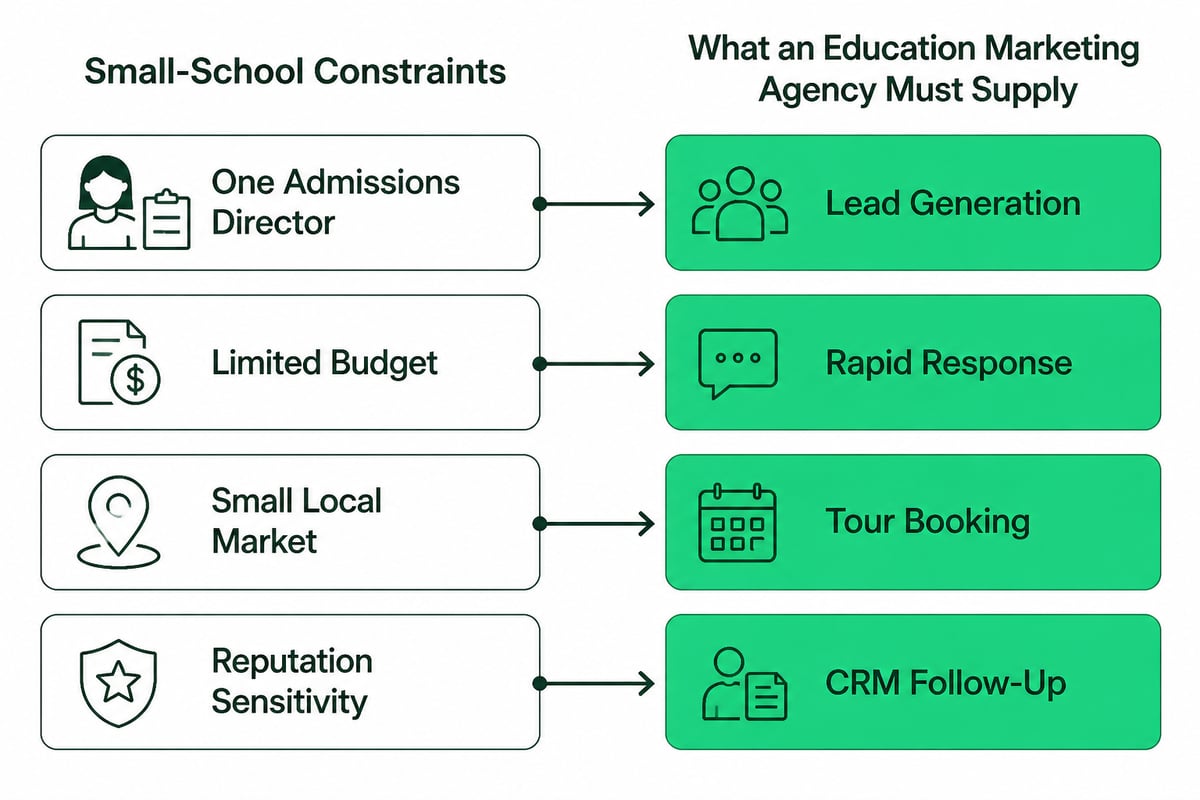
Small schools need an agency that fills seats with a lean team, because they cannot absorb the waste that large institutions can. A university with a 40-person marketing department can afford a slow quarter of experimentation. A K-12 school with one admissions director, a part-time communications coordinator and 200 students cannot.
The constraints are specific:
- Limited staff time. The person answering inquiries is often also giving tours, managing re-enrollment and handling parent concerns.
- Smaller addressable market. A school draws from a defined geographic radius, so ad targeting must be precise rather than broad.
- Higher cost per empty seat. Losing ten expected students can change a budget cycle, so every lead matters.
- Reputation sensitivity. In Niche's fall 2024 parent survey, most respondents said negative feedback from other parents or guardians would cause them to remove a school from their list. In a small community, a handful of reviews carries real weight.
Higher education leaders face similar pressure. Higher education marketing teams often report being stretched thin on staffing and budget, and the same dynamic is sharper at schools with fewer than 500 students.
What a Full-Funnel Education Marketing Agency Actually Delivers
A capable agency manages every stage between a parent's first search and a signed enrollment agreement, not only advertising. Many agencies stop at generating clicks, which leaves the hardest work with your staff.
A complete engagement for a small school typically covers these stages:
- Demand generation. Paid search and paid social aimed at families within your realistic draw area. See how this works in practice in this overview of Google Ads for schools and Facebook ads for schools.
- Landing pages built to convert. Pages written for a parent comparing options, with a clear next step such as booking a tour.
- Rapid inquiry response. Contact within minutes, not the next business day.
- Nurture and follow-up. Automated, personalized sequences that keep a family engaged between inquiry and visit.
- Tour and visit booking. Scheduling handled so your admissions director's calendar fills without manual back-and-forth.
- Reporting tied to enrollment. Cost per enrolled student, not only cost per click.
If an agency presents only the first two items, you will still need to build and staff the other four yourself. An agency that handles school enrollment marketing end to end removes that gap.
Why Response Speed Deserves More Weight Than Creative
Response speed is one of the most controllable factors in whether an inquiry becomes a tour, and it is entirely a process question rather than a creative one. Families research widely before they commit. In the same Niche survey, most parents were considering three or more schools for fall 2025.
That means your inquiry form is competing with several other forms the same family completed that week. The school that replies first, with a useful and human message, usually earns the visit.
When you interview an agency, ask direct questions:
- What is your typical response time to a new inquiry, and is it measured?
- Who responds, and what happens outside business hours?
- How are inquiries nurtured if a family does not book a tour right away?
- Where does the data live, and can we see every conversation?
An agency that cannot answer these precisely is likely not managing them.
How to Evaluate an Education Marketing Agency for Small Schools
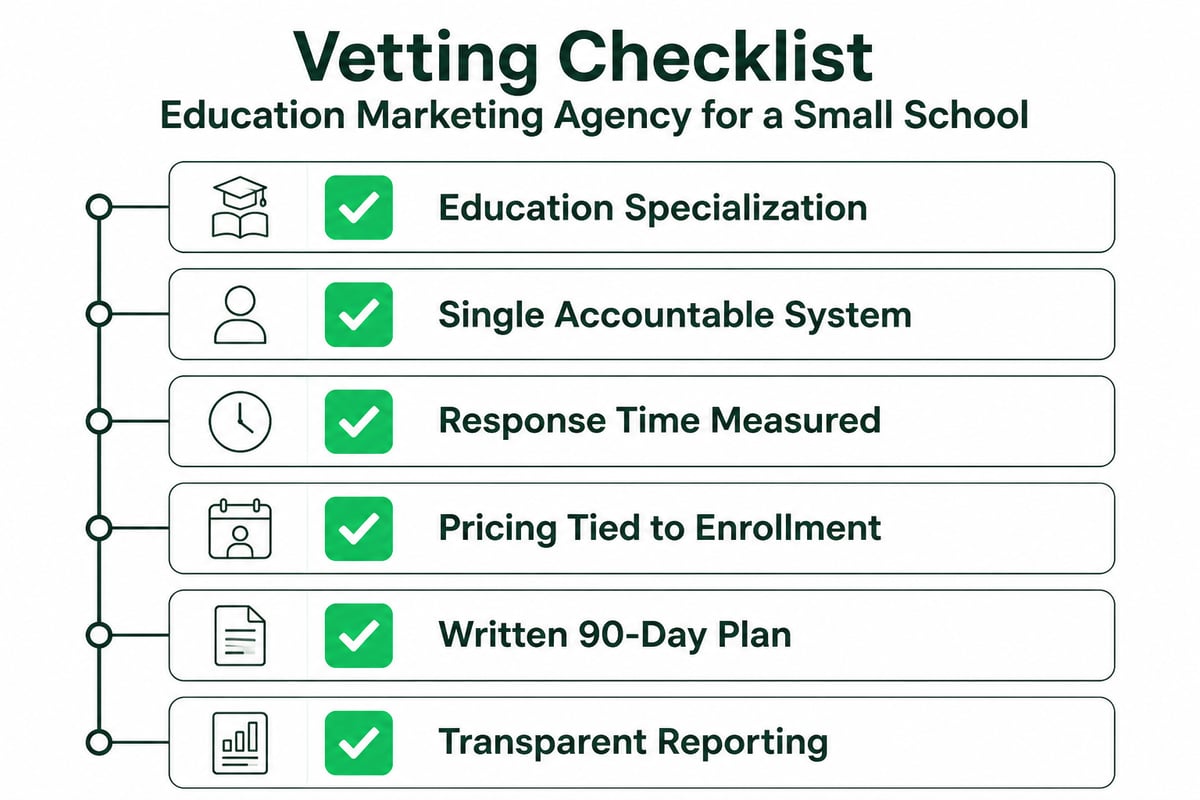
Evaluate an agency on four dimensions: education specialization, accountability, pricing structure and transparency. A polished portfolio matters less than how the agency is compensated and how clearly it reports results.
Education specialization
A generalist agency can run competent ads, but it will spend your budget learning how enrollment cycles, tour-based decisions and tuition sensitivity work. Look for evidence that the agency understands admissions calendars, re-enrollment timing and the difference between a parent inquiry and an e-commerce lead. Agencies that focus on independent schools or small colleges will recognize your constraints quickly.
Accountability across the system
When advertising, landing pages, follow-up and CRM are handled by separate vendors, each can point to another when results fall short. A single accountable team removes that finger-pointing. This is one reason many schools prefer full-service school marketing over assembling freelancers.
Pricing structure
Pricing is where small schools carry the most risk, so it receives its own section below.
Transparency and reporting
You should be able to see lead sources, response times, tour bookings and enrollments in plain language. Reporting that stops at impressions and clicks hides the metrics that determine revenue.
Pricing Models Compared: Retainer, Project and Performance-Based
Performance-based pricing aligns the agency's income with your enrollment results, which makes it the lowest-risk structure for a small school, though each model suits a different situation. The table below compares the three common approaches.
| Model | How you pay | Main advantage | Main risk for a small school |
|---|---|---|---|
| Monthly retainer | Flat fee regardless of results | Predictable budgeting | You pay even if enrollment does not move |
| Project-based | Fixed fee per deliverable (website, campaign) | Clear scope | No ongoing optimization or follow-up |
| Performance-based | Fees tied to inquiries or enrollments | Agency shares your risk | Terms must define "qualified" clearly |
A retainer is not inherently poor value, but it moves the risk onto you. If you choose one, ask what happens if agreed targets are not met. For a closer look at results-linked structures, this explanation of performance marketing for schools outlines what to look for.
Whatever the model, define terms in writing. "Qualified inquiry" should mean something specific, such as a family within your draw area who is interested in an available grade level.

Marketing Ownership Options When You Have Limited Capacity
Small schools generally choose among three ownership models: hire in-house, assign marketing to an existing staff member, or outsource to an agency. Each has trade-offs, and this school-leader guide to enrollment marketing from YPM Studio discusses practical ownership options for schools with limited capacity.
- In-house hire. Offers control and institutional knowledge, but a single hire rarely covers advertising, copywriting, analytics and automation. Salary and benefits also exceed many agency retainers. A new hire also needs months to learn the school's admissions cycle, and the role leaves a gap again if that person moves on.
- Existing staff member. Low cost on paper, but marketing becomes the task that slips whenever tours and re-enrollment peak. A communications coordinator who already manages newsletters and social posts will struggle to also monitor ad spend, rewrite landing pages and reply to every inquiry within minutes.
- Agency partnership. Provides a full team and tested systems, but requires careful vetting and clear contract terms. Confirm who owns the ad accounts and data, and what the school must supply each week, such as tour availability and approval of messaging.
A common hybrid is to keep brand voice and campus relationships in-house while the agency runs demand generation, response and follow-up. That division keeps your story authentic while removing repetitive, time-sensitive work from your team. In practice, the head of school or admissions director supplies student stories, faculty introductions and tour experiences, and the agency turns them into ads, pages and follow-up sequences. This also protects the school's reputation, since the people families meet in person remain the people they heard from online.
Warning Signs During the Sales Process
Several behaviors during the sales conversation reliably predict a poor fit. Watch for these:
- Promises of enrollment numbers without asking about your capacity, tuition or draw area.
- Case studies from unrelated industries presented as proof.
- Reports built around vanity metrics such as impressions and followers.
- Long contracts with no performance exit.
- No clear answer about who responds to your inquiries and how quickly.
- A strategy that begins with a website redesign before any lead generation.
Ask each agency for a written plan covering the first 90 days. A credible plan names the channels, the response process, the reporting cadence and the target for qualified inquiries.
How ScholarSurge Approaches Small-School Enrollment
ScholarSurge builds enrollment growth systems for schools, colleges and sports academies, with advertising, landing pages, follow-up and CRM run as one accountable system. Its inquiry response is typically under 60 seconds, and its pricing is performance-based, so you pay when students enroll. It also offers a guarantee of 50+ qualified inquiries in the first 90 days, with work continuing at no charge until the target is reached. For the specific terms, confirm the details with the team directly.
The offering most relevant to a small school is The Surge System, a done-for-you enrollment engine that combines paid demand generation, rapid inquiry response, tour and visit booking and CRM automation under one monthly retainer. It functions as a virtual enrollment team for schools that cannot staff those roles internally.
ScholarSurge's internal audits project a favorable 12-month return from recovery plan implementation. Treat any projected figure as a starting point for discussion, and ask to see the assumptions behind it, as you should with every agency.
ScholarSurge is built for schools, colleges and sports academies that need to fill seats. It is not designed for financial aid or scholarship services, or for organizations seeking a generalist agency outside education.
Questions to Ask Before You Sign
Before signing, confirm the answers to these questions in writing. Use the list in every agency conversation so you can compare responses side by side.
- How do you define a qualified inquiry for our school?
- What is your measured average response time, and who responds?
- Which parts of the funnel are included: ads, landing pages, follow-up, CRM, tour booking?
- How are you compensated, and what happens if targets are missed?
- Who owns the data, accounts and creative if we end the relationship?
- What will we see in reporting each month, and can we access it at any time?
- What do you need from our staff each week, and how many hours does that represent?
- Can you share education-specific results with context on school size and market?
Benchmarks can help frame the conversation. This look at marketing and enrollment management benchmarks from EducationDynamics offers context on how prospective students discover and evaluate institutions, which helps you judge whether an agency's channel recommendations are reasonable.
If you want a broader view of what the category offers, this overview of an education marketing agency describes common service scopes, and a K-12 marketing agency profile covers the specifics of serving younger-grade families.
Start by pulling your last 90 days of inquiries and recording how many received a reply within the hour, how many booked a tour and how many enrolled, because those three numbers show exactly where your funnel leaks. ScholarSurge can review that same data and show where fast response, follow-up and tour booking would recover seats you are already paying to attract. If you want a clear picture of what that recovery could look like for your school, Book Your Free Enrollment Audit and see what a virtual enrollment team can do for your numbers.