
Insights
School Marketing Agency for Small Schools: What to Look For
Choosing a school marketing agency for small schools? See which capabilities, pricing models and response systems separate agencies that fill seats from those that don't.
READING TIME · 10 MIN · UPDATED QUARTERLY

A school marketing agency for small schools should do more than produce attractive ads: it should connect advertising, inquiry response and follow-up into one system that turns families into enrolled students. Look for education-specific experience, a clear process for handling every inquiry within minutes, transparent reporting tied to applications, and pricing that reflects whether seats actually fill.
Small schools face a different problem than large districts or well-known independents. Budgets are limited, admissions teams are often one or two people, and every unfilled seat carries a visible cost. The wrong agency partnership can consume a full year of budget without a single additional enrolled family. The sections below explain what to evaluate before you sign.
Why Small Schools Need a Different Kind of Agency
Small schools need an agency that works within tight budgets and thin admissions staffing, because their enrollment challenges are structural, not cosmetic.
The demographic backdrop matters. U.S. public schools enrolled 49.6 million preK-12 students in fall 2022, and the National Center for Education Statistics projects that figure to decline 5% to 46.9 million by fall 2031. Private schools enrolled 4.7 million K-12 students in fall 2021, about 9% of combined public and private enrollment. In a shrinking pool, small schools compete for a limited number of families, often against larger institutions with dedicated marketing departments.
That reality shapes what you should expect from a partner:
- Lean operations. Your admissions director may also teach, run tours and manage re-enrollment. The agency must reduce that workload, not add reporting meetings.
- Narrow margins for waste. A campaign that spends broadly on brand awareness rarely suits a school that needs 15 to 30 additional students.
- Local and regional focus. Most small schools draw from a defined commute radius, so geographic precision matters more than national reach.
- Personal brand strength. Small class sizes and close community are real advantages, but they must be communicated in a way that converts.
Generalist agencies often treat schools as one more client category. An education-focused team understands enrollment calendars, open-house cycles and the way parents compare options over several months.
Core Capabilities to Look For in a School Marketing Agency for Small Schools
A strong school marketing agency for small schools should demonstrate competence in six areas: paid advertising, landing pages, search visibility, inquiry follow-up, CRM management and reporting.
Advertising built around enrollment goals
Paid campaigns should target specific grades, programs or seat counts. A request to "raise awareness" is a warning sign. Ask how the agency would structure campaigns for your open grades, which channels it would test first, and how it would cap spend per qualified inquiry. For deeper background on channel choices, see this overview of Google Ads for schools and a companion piece on Facebook ads for schools.
Landing pages designed to convert
Families who click an ad should land on a page built for one action: requesting information or registering for a visit. Check that the agency builds pages that load quickly, work on mobile and follow accessibility standards. The W3C's WCAG 2.2 recommendations set the benchmark for making web content usable by people with disabilities, and schools carry a particular responsibility to meet it.
Search visibility that supports paid efforts
Organic search will not fill seats by itself in a single semester, but it compounds over time. Google's SEO Starter Guide describes common improvements site owners can make to help search engines understand and present their websites. A capable agency applies those fundamentals to your site without overselling rankings as an instant fix.
Inquiry follow-up and CRM
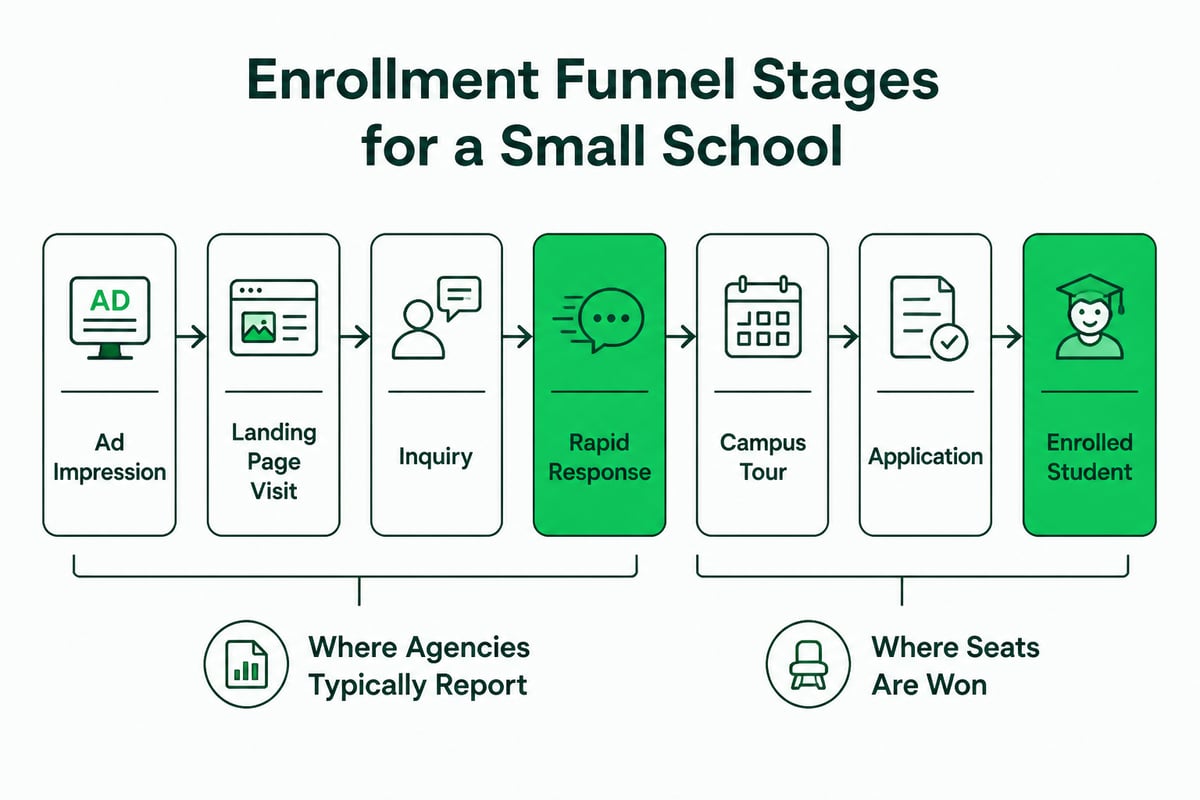
This is where many engagements fail. An agency may generate inquiries, then hand them to an overwhelmed admissions office with no process for responding quickly. Ask exactly who contacts a family, how soon, through which channels and what happens if the family does not reply.
Reporting tied to applications
Impressions and click-through rates are inputs. Your reporting should show inquiries, tours scheduled, applications submitted and students enrolled, by source.
Speed to Lead: The Capability That Decides Outcomes
Speed to lead, the time between a family submitting an inquiry and receiving a meaningful response, is the single most revealing capability to test when you evaluate an agency.
Parents researching schools often contact several at once. The first school to reply with a helpful, personal message tends to shape the rest of the conversation. A reply sent the next business day competes poorly with one sent within minutes.
When you interview agencies, ask them to describe their response process in specific terms:
- How is each inquiry routed, and to whom?
- What is the typical time to first response, and is it measured and reported?
- Does follow-up continue automatically if the family does not respond?
- How are after-hours and weekend inquiries handled?
- How does the system hand a warm family to your admissions director for a tour?
ScholarSurge, for example, aims to respond to every inquiry typically in under 60 seconds. Whatever agency you choose, press for numbers like these rather than general promises of "prompt follow-up."
Pricing Models: Retainers, Hourly Work and Performance-Based Fees
Most agencies price on a monthly retainer, a project fee or a percentage of ad spend, while a smaller group ties compensation to enrolled students, and each model shifts risk differently.
| Pricing model | How it works | Risk to the school | Watch for |
|---|---|---|---|
| Monthly retainer | Fixed fee for defined services | High: you pay regardless of results | Vague deliverables, long lock-in terms |
| Percentage of ad spend | Agency earns a share of media budget | Medium to high: incentive to raise spend | Reporting that stops at clicks |
| Project fee | One-time price for a site or campaign | Medium: no ongoing support | Launch without follow-up systems |
| Performance-based | Fees tied to enrolled students | Lower: payment follows outcomes | Clear definition of a qualified inquiry and an enrollment |
For a small school, the retainer risk deserves attention. A fixed monthly fee that produces no additional seats for six months is a serious budget problem. Performance-based arrangements align the agency's income with yours. ScholarSurge uses performance-based pricing, meaning it is paid when students enroll, and it continues working at no charge until its 50-inquiry target is reached. You can read more about this approach in performance marketing for schools.
Whatever model you consider, request the contract terms in writing. Confirm what counts as a qualified inquiry, who owns the ad accounts and data, and how termination works.
Guarantees: What to Ask and How to Read the Answers
An agency guarantee is only as useful as its definition, so ask what is guaranteed, over what period and what happens if the target is missed.
Be cautious with guarantees framed around traffic, impressions or "brand lift." Those measure activity, not enrollment. A more meaningful guarantee concerns qualified inquiries within a defined window, paired with a remedy if it is not met.
ScholarSurge guarantees 50+ qualified inquiries in the first 90 days. Its internal audits project a 12-month ROI based on recovery plan implementation. Treat any projected return, from any provider, as an estimate that depends on your tuition, capacity and conversion process, and ask to see how the projection was calculated for a school of your size.
Questions worth asking every agency:
- Is the guarantee in the contract, and what exactly triggers it?
- Who decides whether an inquiry is "qualified"?
- If the target is missed, does the agency keep working at no cost, issue a refund or simply apologize?
- Are projections based on audits of your actual funnel or on generic benchmarks?

Small-School Realities That Shape Your Agency Choice
The right agency adapts to constraints that are specific to small schools: single-campus geography, limited capacity per grade and an admissions office that is often one person.
Capacity matters. If your fifth grade has six open seats, a campaign designed to generate 200 inquiries is a mismatch. Campaigns should be sized to the seats you need, with enough volume to account for typical drop-off between inquiry, tour and application.
Teen audiences require a different lens for schools serving older students. Pew Research Center's 2024 survey of U.S. teens ages 13 to 17 found that nearly half of teens said they are online almost constantly. For secondary schools and sports academies, that means students are part of the research process, and content should speak to them as well as to their parents. A related guide covers social media marketing for schools.
Finally, consider the human element. Small schools sell relationships. An agency that automates response and follow-up should still preserve a personal tone and hand families to real people for tours and conversations. Automation exists to get families to your door faster, not to replace it.

A Practical Checklist for Vetting Agencies
Use a structured vetting process so you compare agencies on the same criteria instead of on presentation quality.
- Confirm education focus. Ask for the agency's experience with schools of your size and type, and what enrollment outcomes it can document.
- Request a funnel audit. A credible agency reviews your current inquiry-to-enrollment path and identifies where families are lost.
- Test the response process. Submit a sample inquiry to an agency's own client or demo environment if available, and time the reply.
- Review reporting samples. Look for enrollment-linked metrics, not vanity numbers.
- Clarify ownership. You should own your ad accounts, data and landing pages.
- Read the contract. Note minimum terms, cancellation rules and performance definitions.
- Check references. Speak with current clients about communication, results and how problems were handled.
For comparison across providers, the guides on school enrollment marketing companies and marketing companies for schools outline additional evaluation angles.
When a Done-for-You System Fits Better Than an In-House Hire
A done-for-you enrollment system fits best when your school lacks the time or specialized staff to run ads, respond to inquiries and manage follow-up consistently.
Hiring a full-time marketing coordinator is a reasonable option for some schools, but it concentrates responsibility on a single person who must cover creative, paid media, analytics, CRM and communications. Many small schools find that a coordinator can maintain the website and social channels but cannot sustain sub-minute inquiry response or multi-touch nurture sequences across evenings and weekends.
An outsourced system can fill that gap. It works best when the provider runs advertising, landing pages, follow-up and CRM as one accountable system rather than as separate vendors who each point to the others when results lag. If your school's challenge is open seats in particular grades, ScholarSurge for K-12 Schools builds grade-level campaigns, open-house registration systems and admissions follow-up around those specific openings.
If you serve athletes, review the specifics in this overview of a marketing agency for athletic academies, since recruiting families for sports programs involves different timelines and decision-makers.
Red Flags That Signal the Wrong Agency
Several patterns reliably predict a poor fit, and spotting them early saves a full budget cycle.
- Generic proposals. If the pitch deck could be sent to a dental practice with a logo swap, the agency has not studied your market.
- No enrollment metrics. Reports that end at clicks and impressions hide whether seats are filling.
- Long lock-in with no performance clause. A 12-month commitment without a remedy for missed targets shifts all risk to you.
- Silence on response time. An agency that cannot explain how quickly families are contacted has not solved the part of the funnel that matters most.
- Overpromised timelines. Organic search and brand building take months. Be wary of anyone promising overnight transformation from either.
- Unclear data ownership. If the agency controls your ad accounts and refuses to transfer them, leaving becomes costly.
An agency should also welcome scrutiny. Providers confident in their process will share audit methods, sample reports and references without hesitation.
Matching Agency Type to Your School's Stage
Your school's current situation determines which kind of agency relationship fits, so assess your stage before shopping.
Schools with open seats and a short runway. Prioritize speed to lead, rapid campaign launch and performance-based terms. Delays cost a full admissions cycle.
Schools with a healthy pipeline but weak conversion. Start with a funnel audit. The problem may be follow-up, not advertising, and spending more on ads would waste money.
Schools rebuilding after a decline. Look for an agency that pairs short-term inquiry generation with reputation and search groundwork.
Schools exploring growth into new programs or grades. Seek an agency that can test messaging for a new audience before committing a large budget.
This is also where fit matters in the other direction. If your needs are scholarship administration or financial aid processing, or if you want a generalist agency that serves many industries beyond education, an enrollment-focused system is not designed for those jobs, and you will be better served elsewhere.
Your next step is to pull your last 12 months of inquiry data and calculate how many families received a reply within five minutes, how many toured and how many enrolled; that single exercise shows whether your constraint is lead volume or lead handling. From there, a structured review of your funnel will tell you what an agency would need to fix. ScholarSurge builds enrollment growth systems for schools, colleges, universities and sports academies, acting as your virtual enrollment team with rapid response and automated nurturing for every inquiry, and for K-12 schools with specific open grades its K-12 enrollment marketing service is built for exactly that task. To see where your funnel is losing families and what a realistic seat-fill plan looks like, Book Your Free Enrollment Audit with ScholarSurge.