Insights
Online Program Marketing Guide for Schools and Colleges
Learn how schools and colleges can plan online program marketing, from channels and response speed to nurture and metrics that fill seats.
READING TIME · 10 MIN · UPDATED QUARTERLY

Online program marketing is the practice of attracting, converting and enrolling students for a specific school, college or academy program through digital channels such as search, paid social, email, landing pages and automated follow-up. For enrollment leaders, the goal is not traffic. It is a steady flow of qualified inquiries that turn into visits, applications and paid seats, with every step measured.
That definition matters because demand for online and hybrid learning keeps shifting how families and adult learners search. In fall 2024, a substantial share of students at U.S. Title IV institutions were enrolled exclusively in distance education, according to the NCES IPEDS Data Explorer. This guide covers how to build a program-level marketing plan, which channels earn their budget, how to handle response and nurture, and how to measure the results.
What Does Online Program Marketing Include?
Online program marketing includes every digital touchpoint between a prospective student or family and an enrolled seat, from the first ad impression to the signed enrollment agreement. It is narrower than institution-wide branding because each program has its own audience, price point, decision timeline and competitors.
A complete program marketing system has five parts:
- Targeting and advertising: search and social campaigns aimed at the specific family, student or adult learner each program serves.
- Landing pages: one page per program, built around a single conversion action such as requesting information or booking a visit.
- Inquiry capture and routing: forms, chat and phone paths that deliver every lead to a person or automated sequence immediately.
- Follow-up and nurture: email, text and call sequences that keep a prospect engaged between inquiry and application.
- CRM and reporting: a single record of each prospect that shows source, status and outcome.
Most enrollment problems trace to a break between these parts. An ad campaign that generates leads into a slow, manual follow-up process wastes the spend. A strong follow-up process fed by a vague landing page wastes the staff time. Treating the parts as one system is the difference between a campaign and a pipeline. The same logic underlies school enrollment marketing generally: each stage has to hand off cleanly to the next.
Why Program-Level Marketing Matters Now
Program-level marketing matters because students increasingly choose a program first and an institution second, and because delivery modes are splitting the market into distinct audiences.
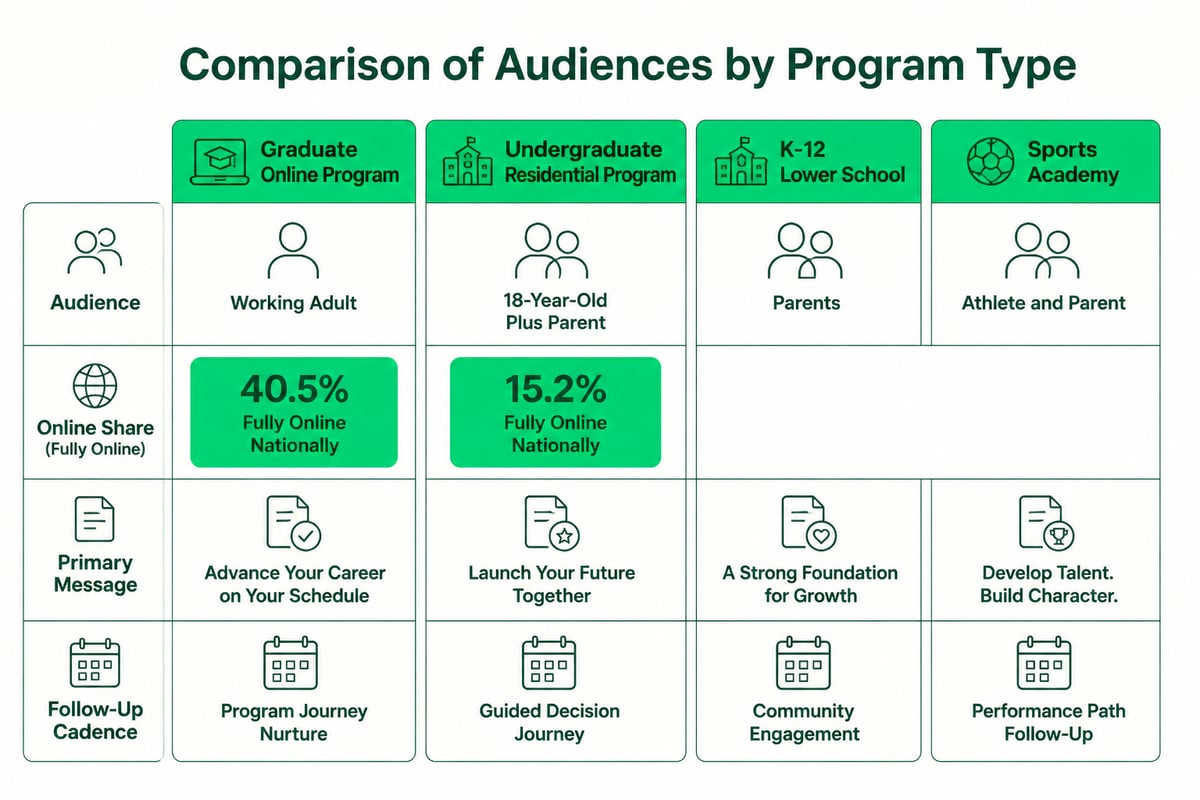
The federal data shows how varied those audiences are. In fall 2024, many students took some but not all of their courses through distance education, while a large share took none. The split by level is sharper: graduate students are far more likely than undergraduates to be enrolled exclusively in distance education. A graduate certificate and an undergraduate residential program are effectively different products sold to different buyers. They need different keywords, different proof points and different follow-up cadences.
For K-12 schools and sports academies, the same principle applies on a smaller scale. A lower school, an upper school and a boarding program each attract different parents with different concerns. A sports academy recruits both athletes and the parents who pay. Marketing them all with one generic message dilutes every one of them.
How to Build an Online Program Marketing Plan
A workable online program marketing plan starts with a seat target and works backward through the funnel to the number of inquiries required. This keeps spending tied to enrollment rather than to impressions.
- Set the seat goal per program. Decide how many new students each program needs and the tuition value of each.
- Work backward through conversion rates. If roughly one in five inquiries becomes an applicant and one in two applicants enrolls, you can calculate inquiries needed. Use your own historical rates, not industry guesses.
- Define the buyer. For each program, write down who decides, who pays, what they fear and what would make them act.
- Choose two or three channels. Concentrate spend instead of spreading it thin across six platforms.
- Build one landing page per program. Match the page's message to the ad and the search term that brought the visitor.
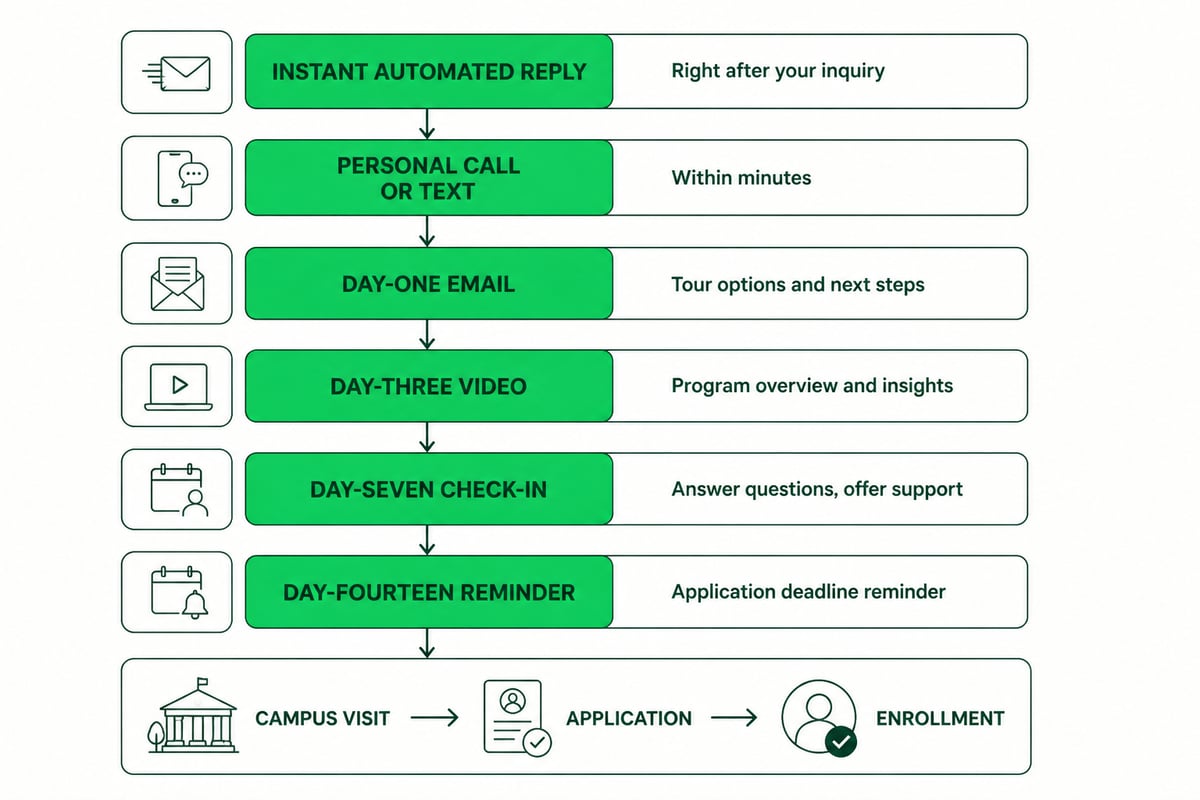
- Design the response and nurture sequence before launching ads. Decide who answers, how fast and what happens at day one, three, seven and fourteen.
- Set reporting. Track cost per inquiry, inquiry-to-application rate, application-to-enrollment rate and cost per enrolled student.
Step six is where most plans are weakest. Institutions often spend weeks on creative and minutes on what happens after the form submit. Reversing that priority tends to produce better returns than increasing ad budgets.
Which Channels Work Best for Program Marketing?
The channels that work best are the ones that match how your specific audience searches and decides, so the right mix differs by program type. No single channel wins everywhere.
| Channel | Best for | Main strength | Main limit |
|---|---|---|---|
| Paid search | Graduate, certificate and adult programs | Captures active intent | Cost per click rises in competitive categories |
| Paid social | K-12, academies, undergraduate awareness | Precise targeting of parents and age groups | Lower intent, needs strong follow-up |
| Email and text nurture | All programs | Low cost, high relevance to existing inquiries | Depends on a healthy inquiry list |
| Organic search and content | Programs with long consideration cycles | Compounds over time | Slow to build |
| Video and virtual events | Boarding, academies, selective programs | Shows culture and results | Production effort |
Two practical notes. First, paid social is strong for parents researching private schools, but those parents rarely convert on first contact, so retargeting and nurture carry much of the weight. Our guide to social media marketing for schools covers that pattern in more detail. Second, search for graduate and adult programs is often the most efficient channel because the searcher is already comparing options.
Sports academies add a wrinkle: they recruit two audiences at once, the athlete and the parent. Messaging for each should be separate, as discussed in this look at best sports academy marketing strategies.
What Is the 3-3-3 Rule for Marketing?
The 3-3-3 rule is a simple framing device, usually described as giving a prospect three seconds to grasp your message, three key points to remember and three touchpoints to build recognition. It is a heuristic, not a formal standard, and definitions vary by source.
In enrollment, the underlying idea holds up well. Your landing page headline should state what the program is and who it is for within seconds. Your message should rest on no more than three differentiators, such as outcomes, class size and schedule flexibility. And a prospect should hear from you several times, through different channels, before they are asked to apply. A single email followed by silence is the most common way institutions lose interested families.
Speed to Lead: The Step That Decides Many Enrollments
Speed to lead is the time between a prospect submitting an inquiry and a real person or relevant automated message responding, and it is often the largest controllable factor in whether an inquiry becomes a student.
A family researching schools typically contacts several at once. The institution that replies first, with a helpful and specific answer, frames the conversation. Replying the next business day means competing against a school that has already booked a tour.
Practical standards to adopt:
- Respond within minutes, not hours. Automated acknowledgment plus a personal follow-up closes the gap during evenings and weekends, when many inquiries arrive.
- Answer the question they asked. A generic brochure email wastes the moment.
- Offer a next step in the first message. A call, a virtual tour or a campus visit slot works better than "let us know if you have questions."
- Follow up on a schedule. Plan multiple attempts across channels over two weeks instead of relying on one call.
ScholarSurge builds this into its system by responding quickly to every inquiry as one part of an advertising, landing page, follow-up and CRM setup that runs under a single accountable team. The firm describes the same logic in its piece on why marketing agencies fail school enrollment, where disconnected vendors leave gaps exactly at the handoff points.
Online Program Marketing for Colleges and Universities
For colleges, program marketing works best when each degree or certificate gets its own audience definition, landing page and follow-up path, and when campus visits are treated as a conversion goal and not a courtesy.
Small private colleges face a particular problem: they cannot outspend large universities on search, so they win by being more specific and more responsive. A program page that speaks directly to a prospective nursing, education or business student, with real outcomes and a clear next step, will outperform a general admissions page. Pair that with a fast reply and a nurture sequence that moves the student toward a visit, and cost per enrolled student falls.
ScholarSurge offers this kind of program-level recruitment, campus visit booking and application nurture for small private colleges and universities through ScholarSurge for Colleges. For a broader view of strategy options, the best higher education marketing strategies overview is a useful companion.

How Do You Measure Online Program Marketing?
You measure online program marketing by following each prospect from source to enrolled seat and calculating cost per enrolled student for every program and channel. Clicks, impressions and even raw inquiry counts are indicators, not results.
Track these in order:
- Cost per inquiry, by channel and program.
- Inquiry quality, meaning the share that fit your admissions criteria and budget.
- Response time, median and worst case.
- Inquiry-to-visit and inquiry-to-application rates.
- Application-to-enrollment rate (yield).
- Cost per enrolled student and the resulting return against tuition.
One useful discipline is a weekly lead review. Open a sample of recent inquiries, check how fast each was contacted and what was said, and note where prospects went quiet. This surfaces process problems that dashboards hide. If your reporting cannot tie an enrolled student back to the ad or search that started the journey, fix the CRM tracking before increasing spend.
Pricing models matter here too. Performance-based arrangements, where an agency is paid when students enroll, align incentives with the metric that counts. ScholarSurge operates this way and works at no charge until a 50-inquiry target is reached. Readers weighing this model can compare it with how performance marketing for education is structured.
What Are the Best Online Marketing Programs to Learn From?
If you are asking about training in the discipline, the best online marketing programs are those that teach analytics, paid media, email and CRM management with hands-on projects, offered by accredited institutions or recognized industry bodies. For an enrollment leader, a full degree is rarely necessary.
A more practical route is targeted learning in the specific skills your team lacks: paid search management, marketing automation, conversion rate optimization and data reporting. Short certificates and platform-specific courses often deliver faster value than a long program. Evaluate any course by asking whether it includes real campaign work, whether instructors have run education or lead-generation campaigns, and whether it covers measurement and not only creative.
Staff time is the other constraint. Many admissions teams are already stretched, which is why some institutions choose to hand execution to a full-service education marketing agency and keep internal staff focused on conversations with families.
Common Mistakes That Slow Enrollment Growth
The most common mistakes are structural rather than creative, and they tend to appear together.
- Sending all traffic to the homepage. Visitors who searched for a specific program should land on a page about that program.
- Slow or inconsistent follow-up. Inquiries that wait a day lose ground to faster competitors.
- Using separate vendors with no shared reporting. Ads, web, email and CRM managed by different parties produce finger-pointing instead of data.
- Judging campaigns by cost per click. A cheap click that never enrolls is expensive.
- Stopping nurture at the first "not yet." Many families decide months after their first inquiry. Keep them engaged until the decision window closes.
- Ignoring seasonality. K-12 and college enrollment cycles have predictable peaks. Plan campaigns and staffing around them.
FAQ
Is digital marketing still worth it in 2026?
Yes, for most schools and colleges it remains the most measurable way to reach prospective students, because search and social let you target specific programs and track results through to enrollment. Its value depends on execution: fast follow-up and accurate tracking matter more than channel choice.
How do you get paid for online marketing?
Marketers are typically paid through salaries, monthly retainers, hourly or project fees, or performance-based models tied to results. In education, performance-based pricing, where payment follows enrolled students, is an option for institutions that want cost aligned with outcomes.
How long does online program marketing take to show results?
Paid channels can produce inquiries within weeks of launch, while organic search and content usually take several months to build momentum. Enrollment results follow the admissions cycle, so a realistic first read comes after inquiries have moved through visits and applications.
Start this week by auditing your current response time: submit a test inquiry through your own site and note how long it takes to hear back and what the reply says. If the answer is hours rather than minutes, that gap is likely costing you seats. ScholarSurge builds enrollment growth systems for schools, colleges, universities and sports academies, combining automated inquiry handling, rapid response and nurturing into one accountable team, and you can see where your pipeline leaks when you Book Your Free Enrollment Audit with ScholarSurge.