
Insights
Student Recruitment for Education Organizations: A Practical Guide
Build a student recruitment plan for your school, college or academy, from audience research and channels to response speed, follow-up and measurement.
READING TIME · 9 MIN · UPDATED QUARTERLY

Student recruitment for education organizations is the coordinated work of attracting qualified families and applicants, responding to them quickly, and guiding them from first inquiry to enrolled seat. The schools and colleges that fill their classes consistently tend to share three habits: they know exactly who they are recruiting, they use more than one channel, and they follow up faster and more persistently than their competitors.
This guide walks through each stage of that process for heads of school, admissions directors and enrollment leaders. It covers audience definition, channel selection, messaging, response speed, nurture, measurement and the staffing question that determines whether any of it works.
Define Who You Are Recruiting Before Choosing a Channel
The first step in any recruitment plan is a written profile of the students and families most likely to enroll and succeed at your institution. Without it, every later decision about budget, messaging and channels becomes a guess.
A useful profile separates the student from the decision-maker. In K-12 and academy recruitment, a parent or guardian usually controls the decision. At a college, the applicant decides, but parents often influence the shortlist. Each group asks different questions and trusts different sources.
Build the profile from your own data rather than assumption:
- Review the last three enrolled classes for common entry grades, geographic radius, referral sources and program interests.
- Identify the point at which most lost inquiries went silent.
- Interview recently enrolled families about the two or three factors that tipped their choice.
- Note the competing schools those families also considered.
Sports academies should add athletic level, training goals and the role coaches play in the decision. Private colleges should segment by program, since a nursing applicant and a business applicant respond to different proof points. For more on how audience composition shapes strategy, see this overview of student demographics.
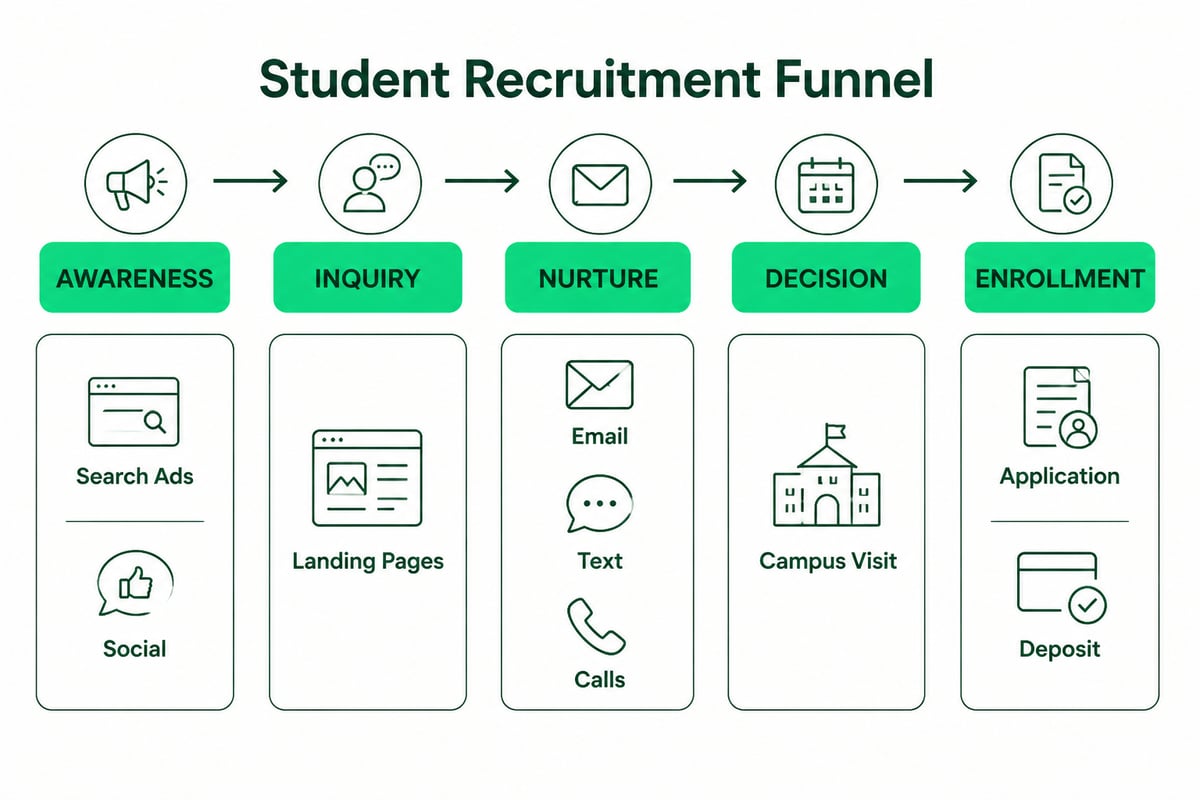
Choose a Channel Mix That Matches Your Funnel
Effective recruitment relies on several channels working together instead of one dominant tactic. A 2025 survey of U.S. two-year and four-year institutions, published through ERIC, found that effective undergraduate recruitment combines in-person meetings, digital advertising, personalized communication, social media and search engine optimization.
Each channel does a different job. Matching the channel to the funnel stage prevents overspending on the wrong activity.
| Channel | Best funnel stage | Primary role |
|---|---|---|
| Search ads and SEO | Awareness and consideration | Capture families already searching for options |
| Social media advertising | Awareness | Build recognition and reach new households |
| Landing pages | Inquiry | Convert interest into a captured contact |
| Email and text follow-up | Nurture | Keep the school top of mind and answer questions |
| Campus visits and open events | Decision | Convert interest into emotional commitment |
| Referrals and partnerships | All stages | Add trust through existing families and feeder schools |
Paid search deserves careful attention because intent is high but costs are not stable. EducationDynamics reported selected 2025 higher-education marketing benchmarks, including shifts in non-brand search advertising costs, which is a reminder to track cost per qualified inquiry rather than clicks alone. Schools weighing specific platforms can review practical guidance on Google Ads for schools and Facebook ads for schools.
Write Messaging Around Outcomes and Proof
Strong recruitment messaging states what a student gains from attending and backs the claim with evidence a family can verify. Generic language about excellence, community and tradition appears on nearly every school website, so it rarely persuades anyone to act.
Replace broad claims with specifics:
- Outcomes. Graduation rates, college placement, certification pass rates, scholarship offers to athletes, or career placement within six months.
- Differentiators. Class size, a signature program, facilities, coaching staff credentials or an unusual schedule.
- Proof. Named alumni achievements, parent and student testimonials you have permission to use, accreditation, and third-party recognition.
- A clear next step. One action per page or message: request information, book a tour or start an application.
Match the message to the audience from your profile. A parent worried about safety and academic fit needs reassurance about supervision and results. A prospective academy athlete wants to see training pathways and competition schedules. A graduate applicant wants program outcomes and return on investment.
Consistency also matters. The promise made in an advertisement should appear on the landing page, in the first email and during the campus visit. A mismatch between stages is one of the most common reasons qualified inquiries stall.
Speed to Lead: Respond to Every Inquiry Within Minutes
Response speed is the most controllable variable in student recruitment, and it is where many institutions lose families they have already paid to attract. An inquiry represents active interest at a specific moment. That interest fades as the family contacts other schools, and the first institution to engage in a real conversation gains a lasting advantage.
Most admissions offices cannot answer every form submission within minutes, particularly in the evenings and on weekends when many parents browse. The fix is a combination of automation and staffing:
- An immediate confirmation by text and email that acknowledges the specific inquiry.
- A trained team member or system that follows with a personal message and a call attempt.
- Instant scheduling links so families can book a tour or call without back-and-forth.
- Routing rules that send inquiries to the right admissions counselor by program or grade level.
ScholarSurge builds this speed into its enrollment systems, with a response to every inquiry designed to happen within minutes. Whatever approach you choose, measure your own average first-response time before setting a target. Many offices discover it is measured in hours or days.
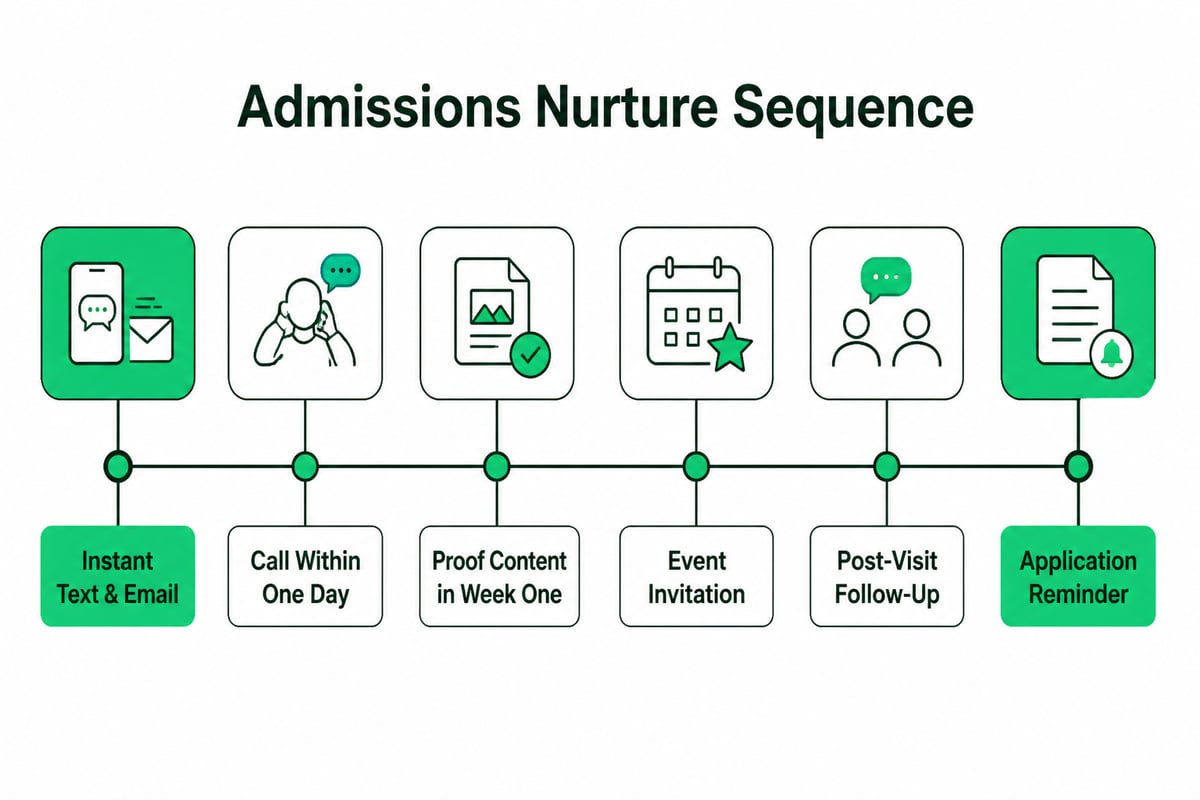
Build a Nurture Sequence That Moves Families to Decision
Nurture is the structured follow-up between a first inquiry and a submitted application, and it is where most enrollment is won or lost. Admissions cycles are long, families compare several options, and one email rarely closes the gap.
A workable sequence has a defined cadence and a purpose for each contact:
- Minutes after inquiry: acknowledgment and a direct invitation to speak or visit.
- Days one to three: a personal call or video message from an admissions counselor.
- Week one to two: proof content, such as outcomes, student stories or a program overview.
- Ongoing: event invitations, deadline reminders and answers to common objections like cost and logistics.
- After a visit: a same-day thank-you and a clear path to apply.
Mix channels. Email suits detailed information, text suits quick reminders, and phone calls suit relationship building and objection handling. Track every contact in a CRM so no family disappears between staff changes or busy periods. Teams that want to hand this workload off can look at what done-for-you admissions follow-up involves, and those who prefer to build in-house can use the same structure as a template.
Treat Campus Visits and Events as the Conversion Point
Campus visits, open houses and trial days convert interest into commitment because families see the culture rather than read about it. For most schools and academies, the visit is the single strongest predictor of an application.
Increase visit volume and quality with a few practical changes:
- Offer online booking with several time slots, including evenings and weekends.
- Send reminders by text 24 hours and two hours before the visit.
- Assign each family a guide who matches their interests, such as a coach, a program faculty member or a current student.
- Prepare a short, clear follow-up the same day, including the application link and key dates.
- Offer a virtual option for out-of-area families, then invite them to visit in person.
Private colleges that want program-level recruitment and visit booking handled together can see how ScholarSurge for Colleges approaches application nurture alongside campus visit scheduling. Sports academies often add trial sessions, which function like a visit but give the athlete a direct experience of coaching and training.

Use Referrals and Partnerships to Lower Acquisition Cost
Referral and partnership channels often produce higher-quality applicants at lower cost because the family arrives with trust already established. They also compound over time, since each enrolled family becomes a potential source of the next.
Practical referral and partnership tactics include:
- A simple, recognized program for current families to introduce friends, with a personal thank-you rather than a gimmick.
- Relationships with feeder schools, club coaches, counselors and community organizations.
- Alumni engagement that gives graduates a reason to speak well of the institution.
- Local employer or club partnerships that place your program in front of a relevant audience.
Treat these relationships as ongoing, not seasonal. A quarterly note to a feeder-school counselor with program updates and deadlines costs little and keeps your name present when families ask for recommendations.
Plan for Enrollment Pressure Beyond Your Local Market
Demand patterns vary widely across institution types, so recruitment plans should reflect the segment you serve instead of relying on national headlines. Data from AACSB shows the gap clearly: in 2024-25, undergraduate applications at participating business schools rose far faster over five years than new entrants did. Master's applications also grew faster than new entrants.
The lesson for enrollment leaders is that applications and enrollments are different measures. More interest does not automatically translate into more students, and the gap between the two is a conversion problem. Yield depends on response speed, nurture quality, visit experience and affordability conversations.
Institutions that depend on international students face additional pipeline risk. The AACRAO analysis of 2024-25 data summarizes international enrollment trends and institutional strategies, and it is worth reviewing before committing budget to cross-border recruitment. A broader view of that work appears in this guide to international student recruitment.
Measure the Metrics That Predict Enrollment
A recruitment plan is only as good as the numbers used to manage it. Track conversion between each stage so you can see where families drop out and fix that point first.
The core metrics to review weekly or monthly are:
- Qualified inquiries: families who match your profile, not total form fills.
- Cost per qualified inquiry: spend divided by qualified inquiries, by channel.
- First-response time: average minutes between inquiry and first human or system contact.
- Inquiry-to-visit rate: the share of inquiries who book and attend a visit.
- Visit-to-application rate: the share of visitors who submit an application.
- Application-to-enrollment rate (yield): the share of admitted students who enroll.
- Cost per enrolled student: total recruitment spend divided by new enrollments.
Review these by source and by program. A channel that produces many inquiries but few visits is a weak investment, while a small referral channel with high yield may deserve more attention. Compare cost per enrolled student against lifetime tuition revenue to judge whether a channel pays back.
Decide Whether to Build, Outsource or Combine
Student recruitment for education organizations succeeds only when someone owns the whole system, from advertising through follow-up. The decision is therefore less about tactics than about capacity: does your team have the people, tools and hours to run every stage well?
Consider these three models:
| Model | Strength | Risk |
|---|---|---|
| In-house team | Deep institutional knowledge and control | Limited bandwidth, tool costs and slow response after hours |
| Fragmented vendors | Specialist skill in each area | Gaps between advertising, landing pages and follow-up that no one owns |
| Single accountable system | One party responsible for results from ad to enrollment | Requires clear targets and transparent reporting |
The fragmentation risk is common. When an ad agency, a web developer and a CRM consultant each work separately, no one is accountable for the number of students who enroll. ScholarSurge runs advertising, landing pages, follow-up and CRM as one accountable system, and it offers performance-based pricing so the school pays when students enroll. Its stated commitments include a target of 50 or more qualified inquiries in the first 90 days, with work continuing at no charge until that target is reached. For comparison points on the broader category, read about student recruitment services and how performance marketing for education aligns cost with results.
Whichever model you select, ask any partner for specifics on response time, reporting frequency, ownership of data and how success is defined. Confirm commercial terms directly with the provider rather than assuming industry norms apply.
Start this week by pulling your last 90 days of inquiries and calculating two numbers: your average first-response time and the percentage of inquiries that reached a campus visit. Those two figures will show you quickly whether your biggest enrollment gap is in attracting families or in converting the ones you already have. If the gap is conversion, ScholarSurge can run the inquiry response, nurture and follow-up for you as one connected system, and you can Book Your Free Enrollment Audit to see where seats are being lost and what a recovery plan would look like for your school.