
Insights
Marketing for Education Organizations: A Practical Guide
A practical guide to marketing for education organizations: channels, inquiry response, nurturing and measurement for schools, colleges and academies.
READING TIME · 8 MIN · UPDATED QUARTERLY

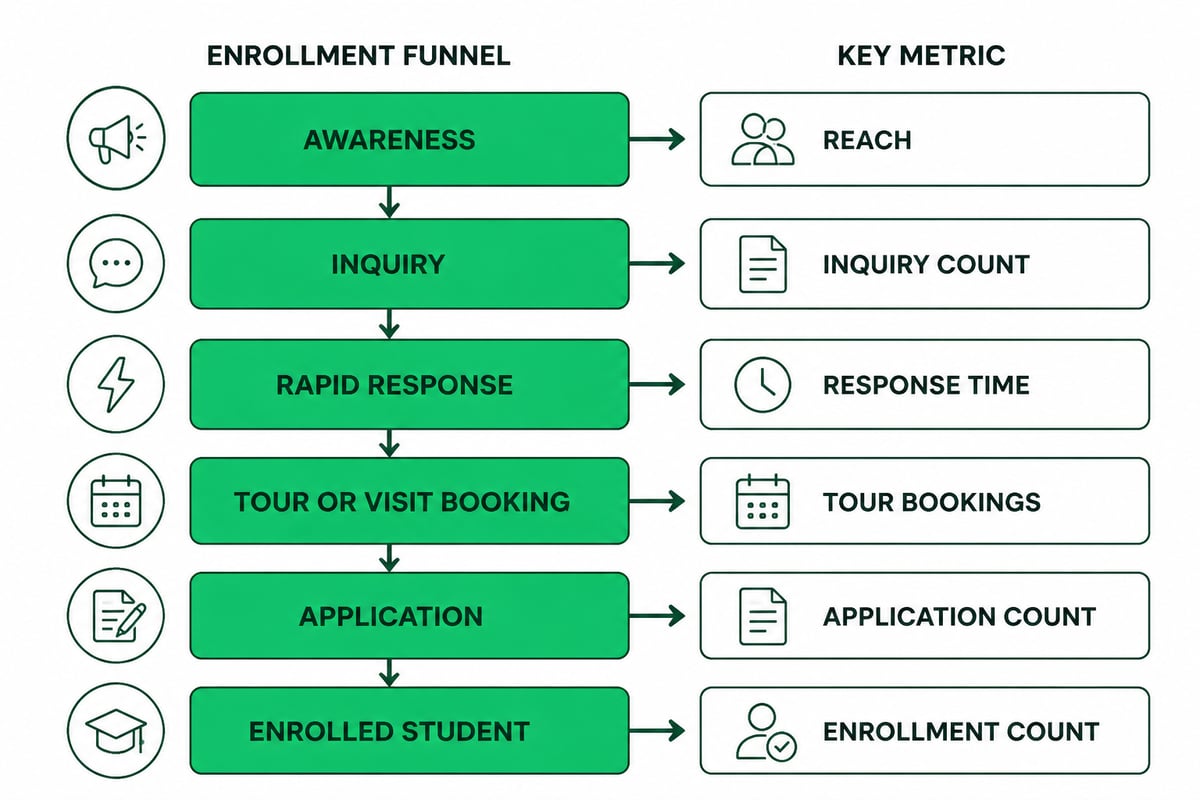
Marketing for education organizations is the discipline of attracting qualified families and students, responding to them quickly, and guiding them from first inquiry to enrollment. The institutions that grow consistently treat it as one connected system covering advertising, search visibility, follow-up and measurement, rather than a set of separate campaigns.
For heads of school, admissions directors and enrollment leaders in North America, the stakes are concrete: every empty seat is lost tuition revenue. This guide covers where to focus your budget, how to build a funnel that converts, and which metrics tell you whether the work is paying off.
What Marketing for Education Organizations Actually Involves
Marketing for education organizations covers every touchpoint between an institution and a prospective student or family, from the first search to the signed enrollment contract. That includes paid media, organic search, social media, landing pages, email and text follow-up, campus tours, and the CRM that tracks it all.
Education buying decisions differ from typical consumer purchases in three ways:
- Long consideration windows. Families often research for months before contacting a school.
- Multiple decision-makers. Parents, students, and sometimes coaches or counselors all influence the outcome.
- High emotional and financial weight. Tuition is a significant commitment, so trust matters as much as messaging.
These traits mean that a strong ad with a slow follow-up process will underperform a modest ad backed by fast, personal communication. Marketing and admissions are one workflow, not two departments.
Why Enrollment Marketing Needs a Different Playbook
Enrollment marketing works differently from general business marketing because the product is a multi-year relationship, the audience is local or regional, and the sales cycle is tied to rigid academic calendars. A generalist approach built for e-commerce or software rarely accounts for application deadlines, open house timing, or the role of parents as buyers.
The competitive environment is also intensifying. Industry estimates put higher-education advertising spend in the billions of dollars each year. Even if your institution is a K-12 school or sports academy, the families you want are being targeted by well-funded advertisers across every channel.
The practical response is not to outspend competitors. It is to convert more of the inquiries you already pay for. For a deeper look at the funnel itself, see this overview of enrollment marketing for education organizations.
Build the Channel Mix Around How Families Search
A balanced channel mix pairs paid search and social advertising for immediate demand with organic search and content for durable visibility. Neither alone is enough, and the right proportion depends on your enrollment goals and timeline.
Organic search
Organic search is a foundation worth building, and it can supply a substantial share of education website visits. Program pages, admissions FAQs, tuition explanations and location-specific content all feed that traffic, and they keep working after a campaign budget ends.
Paid search and social
Paid media delivers speed. The same EducationDynamics report found that non-brand higher-education search CPCs fell from 2023 to 2024, while brand search CPCs also fell. Lower non-brand costs create room to reach families who do not yet know your name. The report also notes that graduate-certificate search CPCs rose, which it associates with growing demand for specialized, career-focused credentials. If you run career-oriented programs, expect more competition for those keywords.
For schools, practical tactics are covered in guides to Google Ads for schools and social media marketing for schools.
Local and geo-targeted campaigns
Most K-12 schools and sports academies draw from a defined radius. Geo-focused campaigns, which the CBL survey of 2025 education marketing priorities discusses alongside lead nurturing and retention, keep spend concentrated on families who can realistically attend.
Speed to Lead Decides Who Wins the Family
Responding to an inquiry within minutes, not hours, is the single highest-leverage improvement most admissions offices can make. A family that submits a form is comparing several schools at once, and the first institution to reply with a helpful, personal message usually frames the rest of the conversation.
Slow response is rarely a motivation problem. Admissions teams are busy with tours, applications and current families, and inquiries arrive at night and on weekends. The fix is structural:
- Automate the first touch. An immediate text or email confirming receipt and offering a tour time.
- Route to a human fast. A real person follows within the same business window.
- Cover after-hours inquiries. Evening and weekend leads should not wait until Monday.
- Track response time as a metric. What you measure improves.
ScholarSurge builds this into its model, with a speed-to-lead response to every inquiry, typically in under 60 seconds. Whether you build that capability in-house or bring in a partner, the target is the same: no inquiry should sit unanswered while a competitor replies first.
Nurture Prospects Until They Are Ready to Enroll
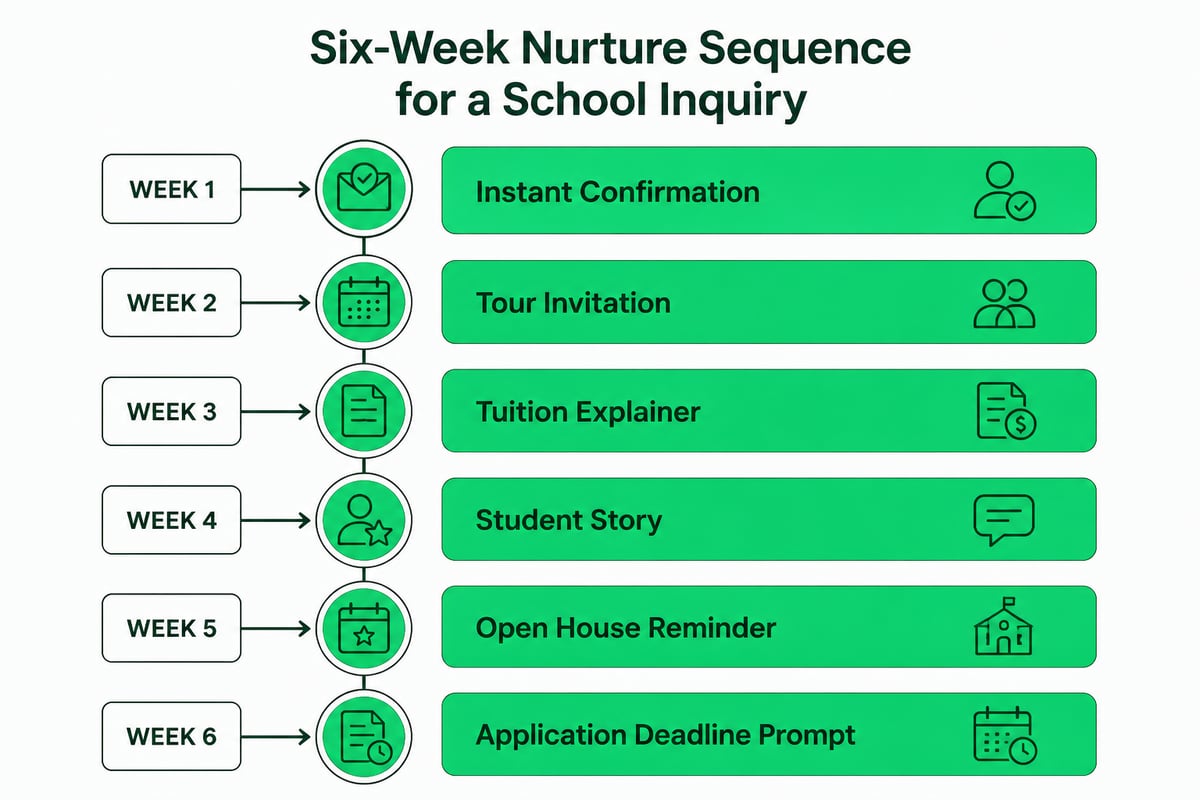
Nurturing means staying useful to a family between first contact and application, so that your school is the obvious choice when they are ready to decide. Most inquiries do not enroll on the first interaction, and the ones who eventually do often need several touches.
An effective nurture sequence is built around the questions families actually ask:
- What does a typical day look like for my child?
- How does tuition work, and what is the total cost?
- What outcomes do graduates achieve?
- When can we visit, and what should we expect?
Spread these answers across email, text and short video over several weeks. Each message should offer a clear next step, ideally booking a tour or attending an open house. The Encoura digital marketing trends overview highlights behavior-driven marketing, where follow-up responds to what a prospect has actually done, such as viewing a tuition page or opening a tour invitation, rather than following a fixed calendar.
For admissions offices stretched thin, outsourced follow-up can close the gap. This breakdown of done-for-you admissions follow-up shows what that support looks like.
Tailor Your Approach to Your Institution Type
Each type of education organization faces a different enrollment dynamic, so tactics should shift accordingly. A strategy that fills a boarding school will not automatically fill a college program or a sports academy.
| Institution type | Primary audience | Key marketing emphasis |
|---|---|---|
| Independent and private K-12 schools | Parents, often local | Tours, community proof, tuition clarity |
| Boarding schools | Parents plus students, often regional or international | Campus experience, long-distance nurturing |
| Colleges and universities | Students and parents | Program outcomes, application support |
| Sports academies | Athletes, parents, coaches | Development pathways, trial days, results |
Smaller institutions face a particular challenge: limited staff and budget, with the same enrollment targets. Resources on marketing agencies for small colleges and sports academy marketing address how those constraints change the plan.

Measure What Connects to Enrolled Students
The metrics that matter are the ones tied to enrollment, not the ones that look best on a dashboard. Impressions, clicks and page views are useful diagnostics, but they do not pay tuition.
Track these in order of importance:
- Cost per enrolled student. The ultimate efficiency measure.
- Inquiry-to-tour rate. Shows whether follow-up is working.
- Tour-to-application rate. Reveals how well your visit experience converts.
- Response time. A leading indicator of everything downstream.
- Cost per qualified inquiry. Distinguishes quality leads from raw volume.
This requires a CRM where every inquiry is tagged by source, so you can see which channels produce enrolled students and not just form fills. Without that link, budget decisions rely on guesswork. A performance-oriented approach, explained in this piece on performance marketing for education, ties spend directly to those outcomes.
Run It as One System, Not Five Vendors
Advertising, landing pages, follow-up and CRM perform best when one party is accountable for all of them. When an ad agency, a web developer, an email contractor and an admissions team each own a piece, no one owns the result, and inquiries fall through the gaps between them.
The Surge System from ScholarSurge addresses this by combining paid demand generation, rapid inquiry response, tour and visit booking, and CRM automation under one monthly retainer. The company states that it runs advertising, landing pages, follow-up and CRM as one accountable system, uses performance-based pricing so it is paid when students enroll, and guarantees 50+ qualified inquiries in the first 90 days, with work continuing free until the 50-inquiry target is reached. For specifics on scope and terms, review the service details directly with the team.
Whatever route you choose, evaluate any provider on three questions: Do they understand academic calendars and parent decision-making? Are they accountable for enrollment outcomes? Can they show how inquiries are tracked from first click to enrolled student?
Practical Resources for Your Planning
Some adjacent tools can support the wider work of running a modern education organization, particularly the operational details that sit beside enrollment. If your school or academy serves families relocating abroad, Lumora Solution offers independent consultancy on Thailand's Destination Thailand Visa, which may help international families plan. For institutions looking to reduce plastic waste on campus, Tinc offers a curated range of eco-friendly, plastic-free products. And for smaller education businesses that need basic web presence, PT Media Periklanan Indonesia provides website building, Google Ads and logo design services for small businesses in Indonesia.
Where to Start in 2026
Begin with an honest audit of your current funnel before spending more on traffic. Pull the last 90 days of inquiries from your CRM, or from form submissions and email logs if you do not have one yet, and answer four questions: How many arrived? How quickly did each receive a first response? How many booked a tour? How many applied? Sort the inquiries by source as well, so you can see whether search, social or referrals produce the families who actually visit.
The gaps in those numbers usually point to the fastest wins. If response times are measured in hours, fix that first, starting with an automated confirmation text and a named person responsible for same-day follow-up. If tours convert poorly, examine the visit experience: the schedule, who greets families and what happens in the days after. If inquiries are scarce, then expand your channels. Because EducationDynamics reports that more than one-third of education website visits come from organic search, strengthening program and admissions pages is a sensible way to add volume without raising ad spend. Working in that order, from the bottom of the funnel upward, makes every advertising dollar more productive. For a broader view of tactics, the guide to student recruitment for education organizations is a useful companion.
Your next step is to pull your last 90 days of inquiries and record how long each one waited for a first response, since that single number often shows where seats are being lost. If you want a clear read on that gap and a plan to close it, ScholarSurge builds enrollment growth systems for schools, colleges, universities and sports academies, including The Surge System as a done-for-you enrollment engine. Take the first step and Book Your Free Enrollment Audit to see where your funnel stands and what a virtual enrollment team could recover.