
Insights
How to Choose a Higher Education Marketing Agency
Learn how to evaluate a higher education marketing agency on services, pricing, speed-to-lead and enrollment results before you sign a contract.
READING TIME · 8 MIN · UPDATED QUARTERLY

The right higher education marketing agency is one that is accountable for enrolled students, not just traffic, impressions or brand awareness. To choose well, judge each candidate on four things: how they generate qualified inquiries, how fast they respond to them, how they nurture applicants to deposit, and how their pricing ties to results you can verify.
Most agencies in this category sell visibility. Fewer own the full path from first click to first day of class. For heads of school, admissions directors and enrollment leaders in North America who need to fill seats, that difference decides whether a marketing budget produces tuition revenue or a polished report.
What a Higher Education Marketing Agency Actually Does
A higher education marketing agency plans, runs and measures the activities that turn prospective students and families into applicants and enrolled students. The scope varies widely, so it helps to know the typical service categories before you compare proposals.
- Brand and positioning: messaging, visual identity and program storytelling.
- Paid media and search: Google, Meta and other channels aimed at prospective students and parents.
- Web and landing pages: program pages, inquiry forms and conversion design.
- Content and social: campus stories, faculty features, video and email.
- CRM and automation: inquiry routing, follow-up sequences and reporting.
- Enrollment consulting: funnel audits, yield strategy and conversion benchmarks.
Some agencies specialize in one or two of these. Others bundle several. Roundups such as this list of higher education marketing agencies show how broad the market is, from branding studios to enrollment consultancies. The category you need depends on where your funnel is leaking.
Start With Your Enrollment Problem, Not the Agency List
Before you request a single proposal, define the specific gap between your current enrollment and your target. An agency can only be judged against a goal you have stated clearly.
Pull four numbers from your own data:
- Qualified inquiries per month, by source.
- Average time between an inquiry arriving and the first human response.
- Conversion rates at each stage: inquiry to visit, visit to application, application to enrolled.
- Cost per enrolled student across all channels.
If inquiries are low, you need demand generation. If inquiries are healthy but visits are scarce, the problem is response and nurture. If applications stall before deposit, the problem is yield. A branding refresh will not fix a slow follow-up process, and a new ad campaign will not fix a weak program page.
This diagnosis also protects you in vendor conversations. When an agency pitches a rebrand and your funnel data points to a response-time problem, you will know to ask why.
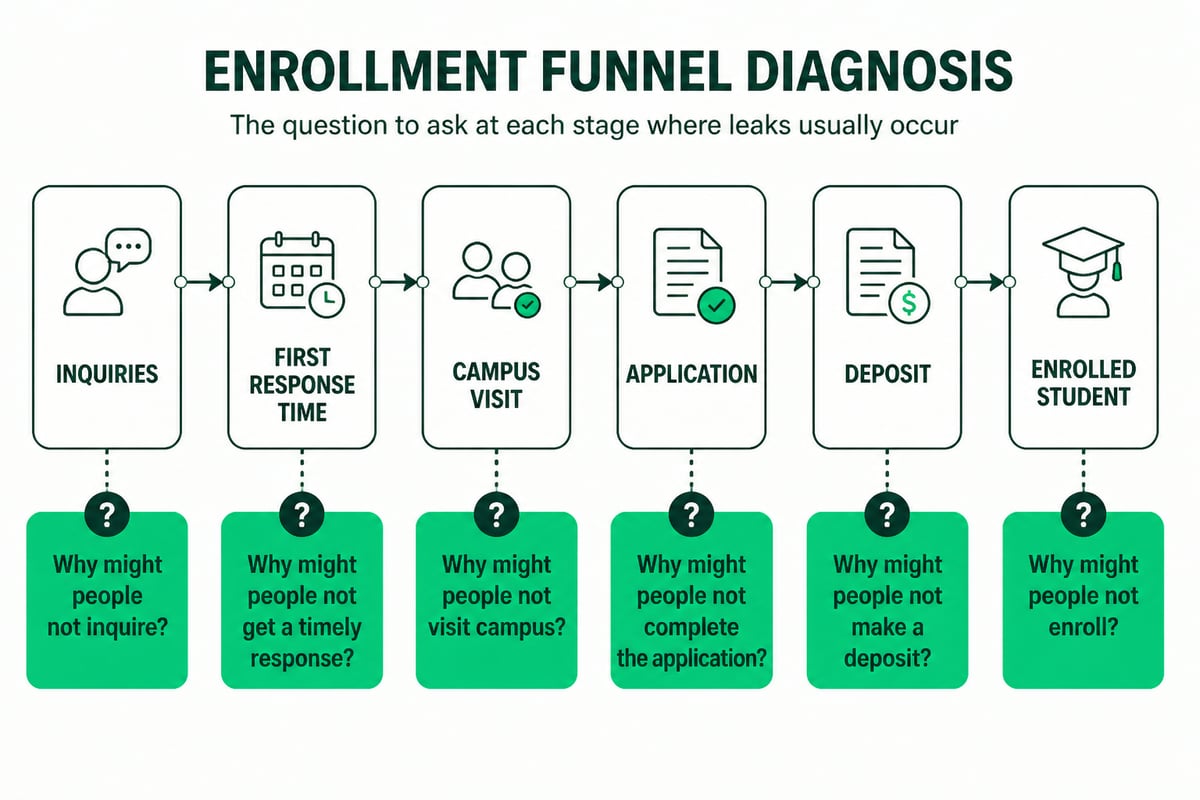
Criteria for Evaluating Agency Candidates
Strong candidates share a few traits you can verify before signing anything. Use the criteria below as a scorecard and rate every finalist the same way.
Education-Specific Experience
Admissions cycles, family decision timelines, program-level recruitment and visit-to-application behavior are different from retail or B2B marketing. Ask for work with schools, colleges or academies of your size and type. A team that has recruited for a 400-student independent school understands different pressures than one that has only served large public universities.
Accountability for Enrollment, Not Activity
Ask what the agency reports on. Impressions and click-through rates are inputs. Qualified inquiries, scheduled visits, completed applications and enrolled students are outcomes. The more of the funnel an agency owns, the more accountable it can be. Our guide to an ROI-focused education marketing agency covers how to frame these conversations.
Speed and Process After the Inquiry
This is the criterion buyers most often leave out of their RFPs, and it frequently matters more than the ad creative. Prospective families contact several schools at once. The institution that responds first, with a relevant answer, usually gets the campus visit. Ask every candidate:
- Who responds to new inquiries, and how quickly?
- Is follow-up automated, human or both?
- What happens to an inquiry that arrives at 9 p.m. on a Sunday?
- How are cold leads re-engaged?
An agency that stops at delivering leads to your inbox has handed you the hardest part of the job.
Transparency and Reporting
You should be able to see lead sources, response times and conversion rates in a dashboard or regular report, in plain language. If an agency cannot show you how a lead moved from ad click to enrollment, it cannot prove what is working.
Fit With Your Size and Systems
Small schools and small colleges have limited staff and budgets. An enterprise-grade engagement built for a university with a 20-person admissions team will overwhelm a school with two. Look for providers that have worked at your scale, such as those described in this overview of a marketing agency for small colleges.
Agency Models Compared
Agencies fall into a few broad models, and each suits a different situation. The comparison below summarizes where each tends to fit.
| Model | Typical strength | Typical limitation | Best fit |
|---|---|---|---|
| Branding and creative studio | Positioning, identity, campaign concepts | Rarely owns follow-up or enrollment outcomes | Institutions with a genuine identity problem |
| Digital media agency | Paid search, social and channel optimization | Hands off leads without nurture | Teams with strong internal admissions follow-up |
| Enrollment consultancy | Strategy, audits, yield planning | Advice without execution capacity | Institutions with staff ready to implement |
| Full-funnel enrollment system | Ads, landing pages, response and nurture as one process | Requires sharing funnel data and access | Schools that need seats filled and lack bandwidth |
Many institutions end up combining a creative studio with a media agency and a CRM vendor, then spend months coordinating three parties who each report their own metrics. A single accountable system removes that coordination cost, and our write-up on a full-service higher education marketing agency explains what to expect from that model.
Pricing Structures and What They Signal
How an agency charges tells you where its incentives sit. The structure matters as much as the number.
- Monthly retainer: predictable, but payment does not depend on results. Works when scope is narrow and measurable, such as ongoing creative support.
- Project fee: suited to defined deliverables like a website rebuild or campaign launch. Weak for ongoing enrollment growth.
- Ad spend percentage: common in media buying, but it rewards spending more, not enrolling more.
- Performance-based: the agency is paid when students enroll. This aligns incentives most directly, though you should understand exactly how an enrolled student is defined and verified.
Ask each finalist to explain what happens if results fall short. A confident agency will state its guarantee in writing. A vague answer is itself information.

Red Flags in Proposals and Pitches
Certain patterns reliably predict disappointment. Watch for these during the selection process:
- Promises of rankings or traffic with no reference to enrollment.
- Case studies that report awareness metrics and never mention applications or enrollments.
- No plan for response time or lead follow-up.
- Long lock-in contracts with no performance exit.
- Reports that arrive as spreadsheets of impressions rather than funnel conversion.
- A pitch that is identical to what the agency would present to a retailer.
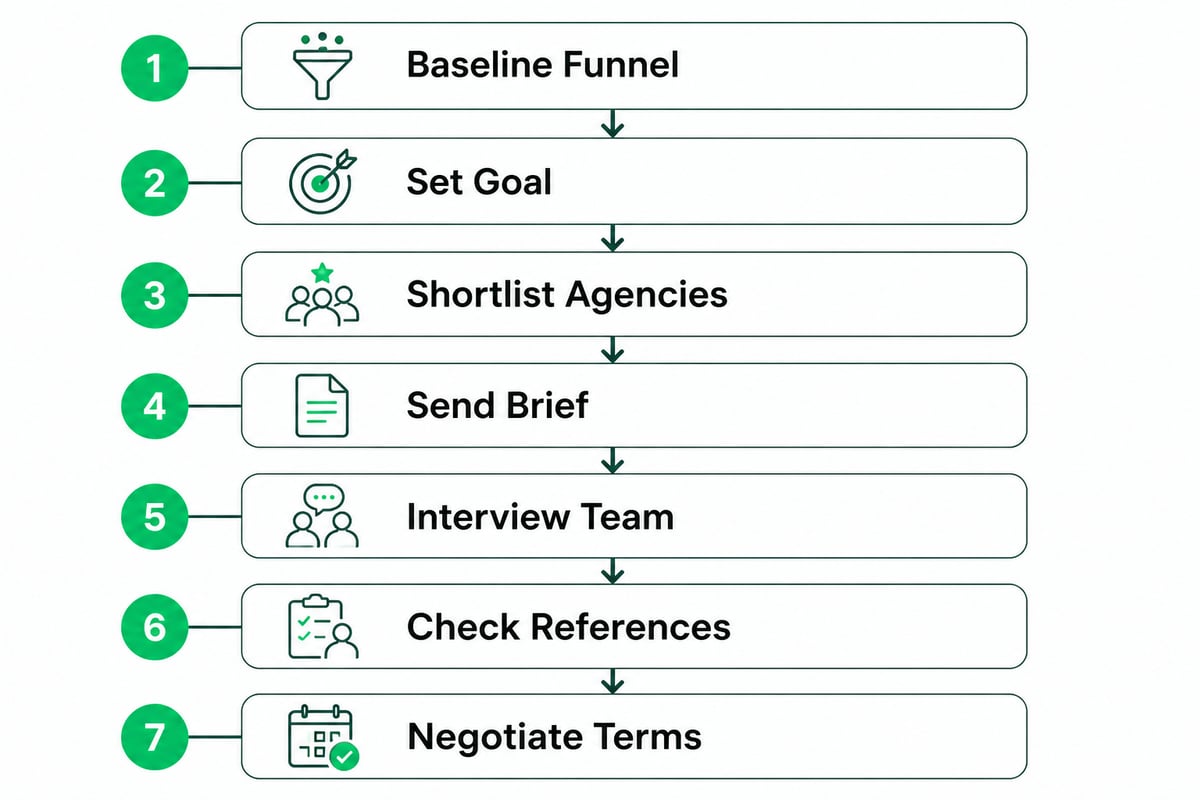
A Seven-Step Selection Process
A structured process keeps the decision grounded in evidence instead of presentation polish.
- Document your funnel baseline. Capture current inquiry volume, response times and stage conversion rates.
- Set one primary goal. For example, a target number of qualified inquiries and enrolled students by a specific term.
- Shortlist three to five agencies with experience at your institution type and size.
- Send the same brief to each and ask for a plan tied to your numbers.
- Interview the people who will do the work, not only the sales lead.
- Check references from institutions that resemble yours, and ask about enrollment results specifically.
- Negotiate terms that include reporting access, a clear definition of success and an exit clause.
Comparing finalists on identical criteria makes it easier to defend the decision to your head of school, board or president.
Questions to Ask Every Finalist
These questions surface substance quickly and are hard to answer with generic claims.
- What is your average response time to a new inquiry, and how do you measure it?
- Which parts of the funnel do you own, and which do you hand back to us?
- How do you define a qualified inquiry?
- Can you show a client with a similar enrollment size and the results they achieved?
- What does reporting look like in month one, month three and month twelve?
- What happens if we do not hit the agreed target?
- Who owns the ad accounts, landing pages and contact data if we end the relationship?
The last question matters more than it seems. You should retain ownership of your data and accounts regardless of the contract outcome.
Where an Enrollment-First Agency Fits
Institutions whose main constraint is staff time and follow-up speed, rather than brand awareness, tend to benefit most from an enrollment-first model. ScholarSurge operates this way for schools, colleges and sports academies, running advertising, landing pages, follow-up and CRM as one accountable system. The facts it publishes include a response to every inquiry typically in under 60 seconds, performance-based pricing where it is paid when students enroll, and a guarantee of 50+ qualified inquiries in the first 90 days, with work continuing at no charge until that 50-inquiry target is reached. Its projected 12-month ROI is a projection based on recovery plan implementation, so treat it as a projection to verify against your own numbers.
For small private colleges and universities that need program-level recruitment, campus visit booking and application nurture, ScholarSurge for Colleges is built for that use case. Terms, scope and fit for your institution are best confirmed directly with the team rather than assumed from a summary like this one.
Measuring Results After You Hire
Measure the agency against the baseline you documented, using a small set of outcome metrics reviewed on a fixed schedule. Monthly, track qualified inquiries, median first-response time, visit bookings and applications started. Quarterly, review cost per enrolled student, yield from application to deposit and the quality of leads by source.
Allow for your enrollment cycle. A K-12 school recruiting for next fall will see inquiries move within weeks but enrollments only after tours, applications and decisions. A sports academy with rolling intake may see faster conversion. Agree in advance which leading indicators you will judge at 30, 60 and 90 days, and which lagging results you will judge at the end of the admissions cycle. If you want more detail on structuring that review, the guide to best higher education marketing strategies outlines the tactics worth measuring.
An agency worth keeping will welcome this scrutiny and bring its own analysis of what is working. One that resists reporting against enrollment is telling you where its accountability ends.
Your next step is to pull your inquiry count, average first-response time and stage conversion rates for the past twelve months, because those numbers tell you which kind of partner you need before any agency pitches you. From there, a funnel review shows whether your biggest gain lies in generating more inquiries or in responding to and nurturing the ones you already have. If you want an outside read on that, ScholarSurge can walk through your funnel with you, and you can Book Your Free Enrollment Audit to see where seats are being lost and what a virtual enrollment team could recover.