
Insights
Performance Marketing for Sports Academies: A Practical Guide
Learn how performance marketing for sports academies turns ad spend into trial bookings and enrolled athletes, with channels, metrics and tracking steps.
READING TIME · 9 MIN · UPDATED QUARTERLY

Performance marketing for sports academies is a pay-for-results approach to advertising in which every dollar is tied to a measurable outcome, such as an inquiry, a booked trial or an enrolled athlete. Instead of paying for impressions or sponsorship visibility, you fund the channels that produce qualified families and cut the ones that do not.
For enrollment leaders at residential and day sports programs, this shift matters because the sales cycle is long, the decision involves parents and athletes, and a single empty seat carries real tuition cost. The sections below cover how the model works, which channels fit, how to build the funnel, and how to measure it honestly.
What Performance Marketing Means for a Sports Academy
Performance marketing is advertising paid for by outcome, tracked through a defined chain from first click to enrolled student. For an academy, the outcome that matters is not traffic or followers. It is a seat filled by an athlete who fits your program and a family that can commit.
Traditional sports marketing relies on brand exposure: sponsorships, event banners, local press and word of mouth. Those tactics build reputation, but they are difficult to attribute and slow to scale. Performance marketing keeps the reputation work and adds a layer of accountability on top of it.
Three characteristics separate it from general promotion:
- Defined conversion events. Each stage, from inquiry form to trial booking to deposit, is recorded as its own action.
- Continuous optimization. Budgets move toward the audiences, creatives and keywords that produce enrollments.
- Cost per outcome. You evaluate cost per qualified inquiry, cost per trial and cost per enrolled athlete, not cost per click.
The principles overlap with what schools and colleges use, which is covered in more depth in ScholarSurge's guides to performance marketing for schools and performance marketing for colleges. Academies have a distinct twist, though: the athletic evaluation step, the trial, sits in the middle of the funnel and changes how you design everything around it.
The Academy Enrollment Funnel, Stage by Stage
An academy funnel has five stages: awareness, inquiry, response, trial, and enrollment decision. Each stage needs its own metric, because a weak stage hides behind healthy numbers elsewhere.
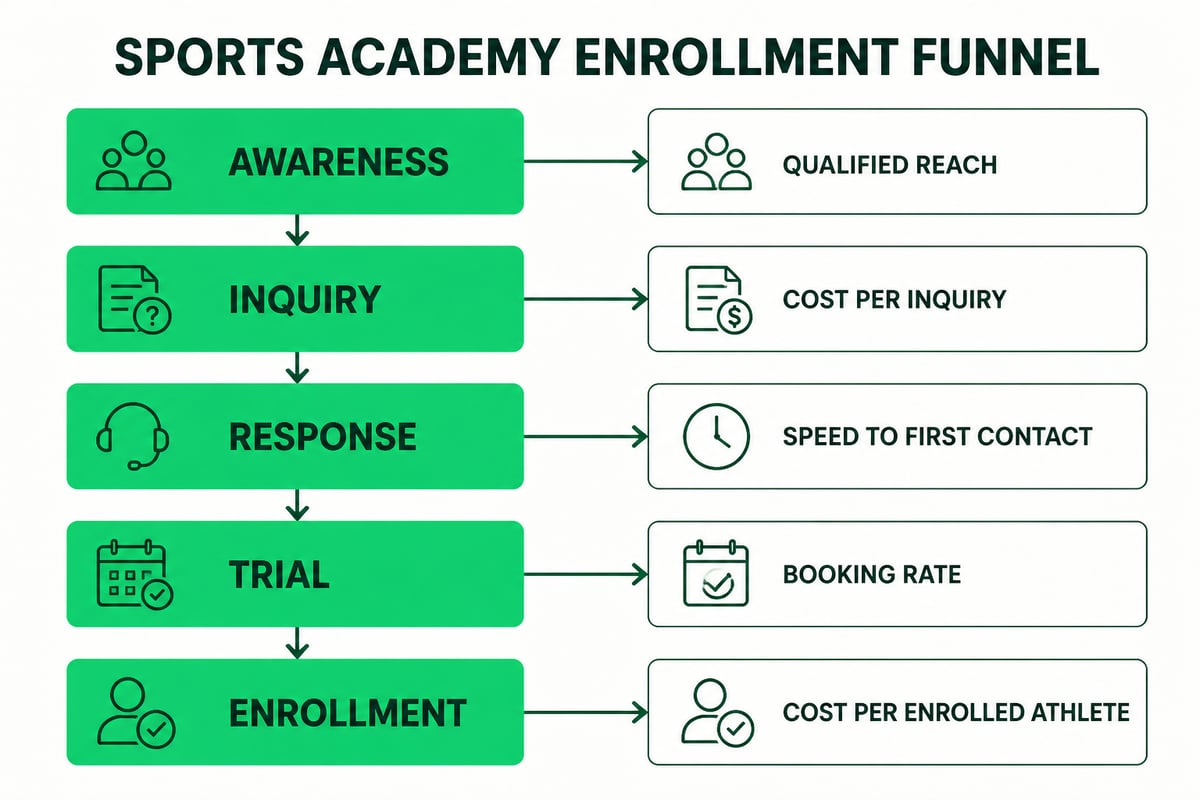
- Awareness. Paid social, search and video place your program in front of athletes and parents who match your profile by sport, age, level and region.
- Inquiry. A dedicated landing page captures the family's details and, ideally, the athlete's sport, position and graduation year.
- Response. Contact within minutes, not days. Families inquire at several academies at once, and the first useful reply often sets the tone for everything after.
- Trial or visit. A booked evaluation, camp day or virtual assessment moves a curious family into a serious one.
- Enrollment decision. Follow-up, scholarship conversations, housing details and visa or transfer logistics (for international athletes) close the loop.
Most academies overspend at the top and underinvest in stages three and four. Fixing response speed and trial booking often lifts enrollments more than adding ad budget.
Channels That Work for Performance Marketing for Sports Academies
The channels that perform best for academies are paid search, paid social, video and retargeting, each serving a different part of the decision. Choosing among them depends on whether you recruit locally, nationally or internationally, and on whether the buyer is the athlete, the parent or both.
| Channel | Best use | Primary metric |
|---|---|---|
| Paid search | Capturing families already looking for academies, camps or prep programs | Cost per qualified inquiry |
| Paid social | Reaching parents and athletes by interest, age and location | Inquiry rate by audience |
| Video (YouTube, short-form) | Showing facilities, coaching and athlete outcomes | View-through to landing page visits |
| Retargeting | Re-engaging visitors who viewed programs or tuition pages | Trial bookings from returning visitors |
| Email and SMS nurture | Moving inquiries to trials and decisions | Reply rate and trial booking rate |
Paid search
Search captures intent. A parent typing a query about a residential soccer program or a hockey prep school is far closer to a decision than a scroller on social media. Keep campaigns tightly grouped by sport and program, and send each group to a matching landing page. ScholarSurge covers the school-side version in its guide to Google Ads for schools.
Paid social and video
Social creates demand among families who were not yet searching. Short athlete-focused videos, coach introductions and day-in-the-life clips work well because they let parents picture the experience. For related tactics, see the guidance on Facebook ads for schools and social media marketing for schools.
Retargeting
Most families do not convert on the first visit. Retargeting keeps the academy visible to those who looked at tuition, housing or trial pages, and it typically costs less per inquiry than cold traffic.
Building a Landing Page and Offer That Convert
A high-converting academy landing page has one goal, one offer and one form. Sending paid traffic to a general homepage splits attention across navigation, news and unrelated programs, and conversion rates suffer.
Elements worth including:
- A headline naming the sport, level and outcome (for example, a residential program for competitive athletes seeking college placement)
- Proof: placement results, coach credentials, facility images, athlete and parent testimonials
- A single call to action, such as booking a trial or requesting a program guide
- A short form that asks for athlete sport, age or graduation year, and parent contact details
- Clear next steps, so the family knows what happens after submitting
The offer matters as much as the page. A trial booking tends to qualify better than a generic brochure download, because it asks for a real commitment of time and signals genuine interest.
Speed to Lead and Nurture: Where Enrollments Are Won
Response speed and follow-up discipline decide how many paid inquiries become trials. A family that submits a form at 8 p.m. after watching a highlight video is at peak interest, and that interest fades quickly.
An effective follow-up system includes:
- Immediate acknowledgment by text and email, ideally within minutes of the form submission.
- A human conversation that clarifies the athlete's goals, level and timeline.
- A structured sequence of messages that share coach introductions, schedules, housing information and trial dates.
- Time-zone-aware outreach for international families, who often make decisions with several relatives involved.
- Reminders and re-engagement for families who go quiet after a trial.
ScholarSurge builds this as part of a single system in which advertising, landing pages, follow-up and CRM run together, with a speed-to-lead response to every inquiry, typically within a minute. For academies that recruit residential athletes, ScholarSurge for Sports Academies covers trial booking and international family follow-up as part of that system.

Tracking and Attribution: Proving What Drives Enrollments
Reliable measurement starts with defining which actions count as conversions and which model assigns credit to the channels behind them. Without both, performance marketing becomes guesswork with a dashboard.
Start by marking your important actions as key events. Google Analytics defines a key event as an event that measures an action particularly important to a business, and any collected event can be marked as one. For an academy, candidates include form submissions, trial bookings and deposit payments.
Next, choose an attribution approach. Google Analytics offers data-driven attribution, paid-and-organic last-click, and Google-paid-channels last-click models in its Attribution reports. Because academy decisions can take weeks or months, the attribution settings, which cover the reporting model, the channels eligible for credit and the key-event lookback window, deserve deliberate configuration rather than defaults.
Finally, improve the accuracy of conversion reporting inside your ad platform. Google Ads enhanced conversions supplement existing conversion tags with hashed first-party data, and they can take up to 30 days to train before their impact appears in reporting. Plan for that lag so you do not judge a campaign too early. Google also explains how it uses first-party data for enhanced conversion measurement across its advertising media.
One gap deserves attention. Ad platforms see form fills, but enrollment happens offline, after a trial and a conversation. Pass enrollment status from your CRM back into your reporting, so campaigns are judged on enrolled athletes and not only inquiries.
Metrics That Matter, and Benchmarks to Set
The metrics worth managing are cost per qualified inquiry, inquiry-to-trial rate, trial-to-enrollment rate, cost per enrolled athlete and response time. Vanity metrics such as impressions, likes and raw click volume should sit in the background.
Set your own baselines before you set targets. Academies differ widely by sport, tuition level, geography and residential versus day model, so published averages are a weak guide to what you should expect. Instead, track a rolling 90-day view of each stage and look for the weakest conversion step.
A simple diagnostic helps:
- Low inquiry volume at healthy cost: the offer or audience reach is too narrow.
- High inquiries, few trials: response speed, lead quality or follow-up is the problem.
- Strong trials, few enrollments: pricing communication, scholarship clarity or family fit needs attention.
Ask whether your cost per enrolled athlete sits comfortably below the lifetime tuition value of that athlete. That ratio, not click cost, tells you whether a channel deserves more budget.
Common Mistakes in Academy Performance Marketing
Most underperforming academy campaigns share a short list of avoidable problems:
- Sending all traffic to a homepage instead of a sport-specific landing page
- Measuring inquiries but never reconciling them with actual enrollments
- Responding to leads in hours or days rather than minutes
- Ignoring international families' time zones, languages and decision-makers
- Cutting campaigns before conversion tracking has had time to stabilize
- Running ads and follow-up through separate vendors with no shared accountability
The last point is structural. When an ad agency, a web developer and an internal admissions team each own one piece, nobody owns the result. The same logic appears in the broader discussion of enrollment marketing for education organizations, where a single accountable system outperforms disconnected parts.
A 90-Day Plan to Launch Performance Marketing
A focused 90-day plan lets an academy launch, learn and adjust without overspending. The steps below assume you already have a clear program offer and a team that can respond to inquiries quickly.
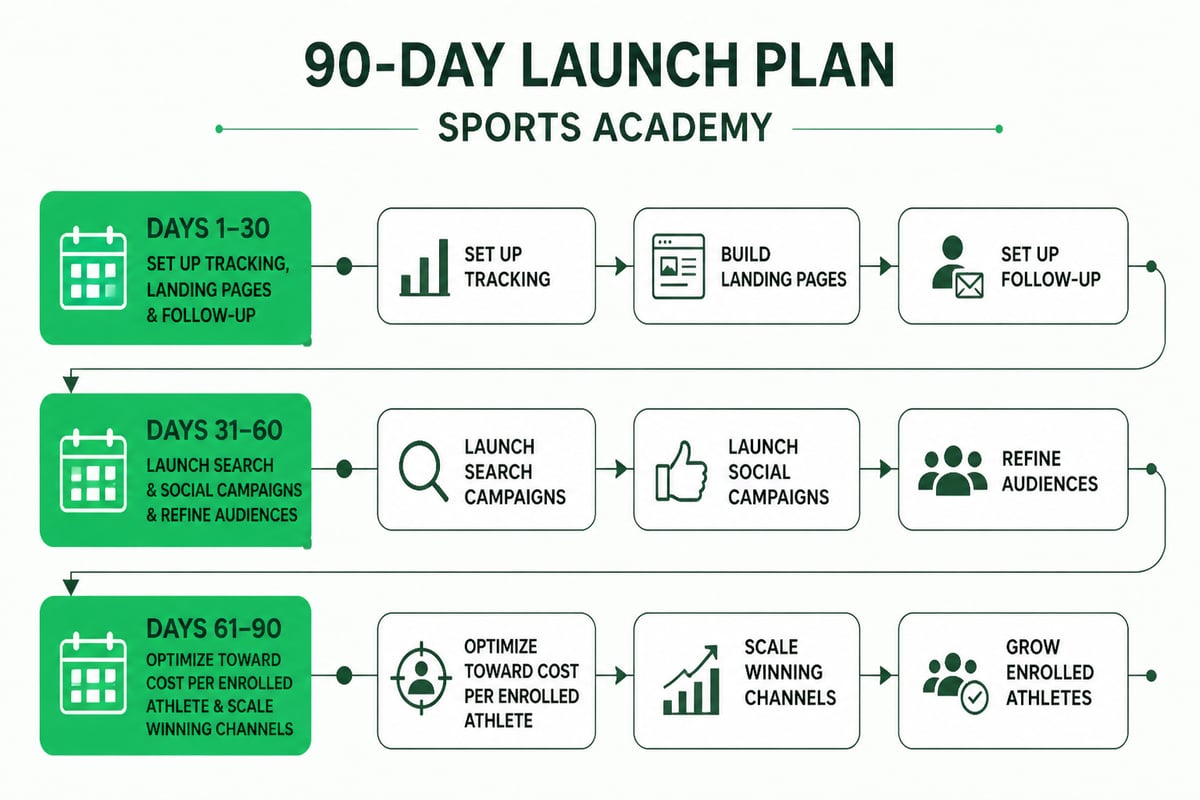
- Days 1 to 30: foundation. Define key events, build sport-specific landing pages, connect your CRM and write the follow-up sequence. Confirm that every form submission is recorded and routed to a person within minutes.
- Days 31 to 60: launch. Start with one or two channels, usually search and paid social, with a modest budget per sport. Test two or three creatives and offers, and review inquiry quality weekly.
- Days 61 to 90: optimize. Shift budget toward the audiences producing trials, tighten targeting, add retargeting and feed enrollment data back into reporting.
Some academies prefer to hand this work to a partner. ScholarSurge offers enrollment growth systems and states a guarantee of 50+ qualified inquiries in the first 90 days, which is a service commitment rather than a pricing model.
How Performance Marketing for a Sports Academy Differs From Other Education Sectors
Performance marketing for a sports academy differs from school or college marketing because of the trial, the dual audience and the recruitment calendar. A K-12 school may enroll on open-house attendance and application deadlines. An academy enrolls on athletic fit, which has to be seen to be believed.
Three differences shape campaign design:
- The athlete and the parent are both buyers. Creative should speak to the athlete's ambition and the parent's concerns about safety, academics and outcomes.
- The trial is a gate. Campaigns should optimize toward booked trials, not just form fills.
- Recruitment is seasonal and international. Cohorts form around seasons, tryout windows and graduation years, and many residential programs recruit across borders.
Academies that recruit abroad can find further detail in ScholarSurge's resources on marketing for international education and its look at sports academy recruitment.
Your next step is to pull the last 90 days of inquiries and trace each one to a trial, a decision and an enrollment, noting how long the first reply took. That single exercise shows where your funnel leaks and what performance marketing would need to fix first. If you recruit residential athletes, ScholarSurge for Sports Academies is built around trial booking and international family follow-up, and you can Book Your Free Enrollment Audit to see where your current system stands and what a performance-based approach could change.